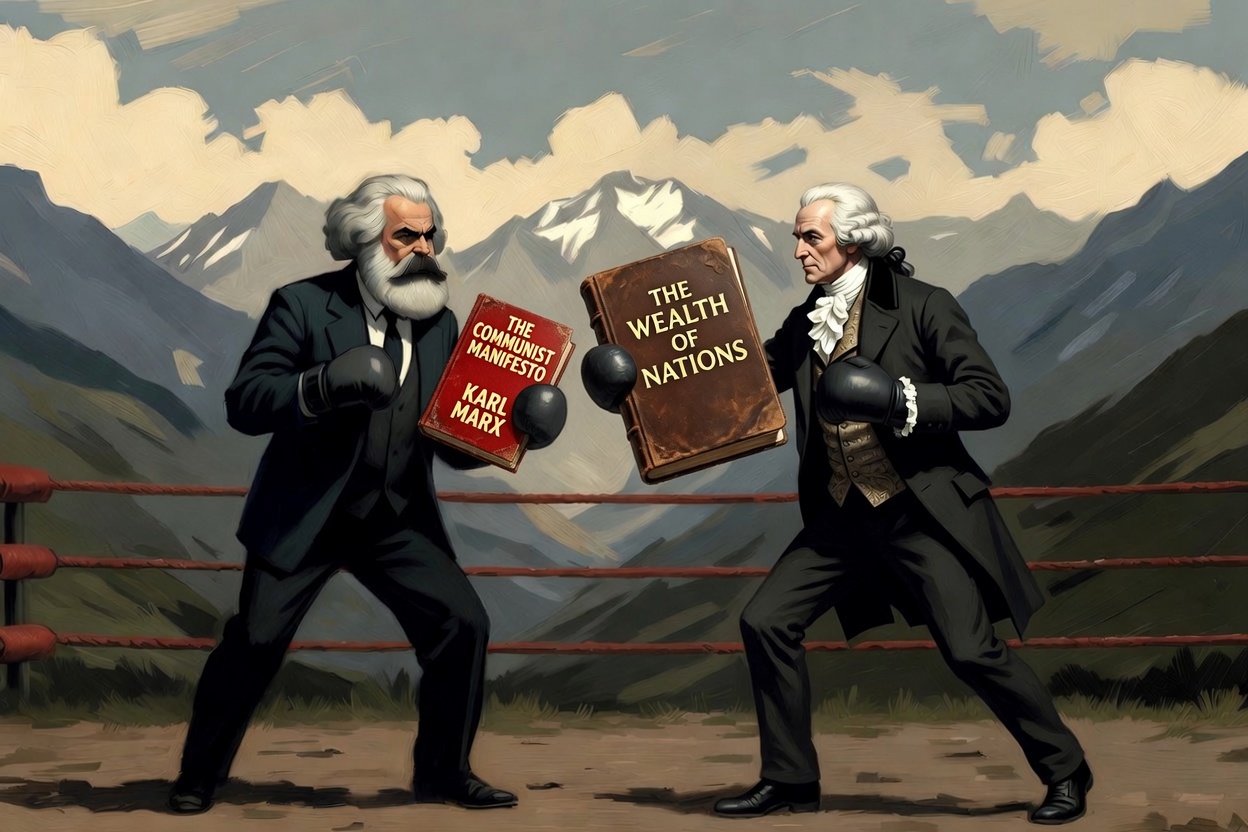
“Workers of the world, unite! You have nothing to lose but your chains!”
—Karl Marx and Frederick Engels, The Communist Manifesto, English translation, originally published 1848
“All profit is value extraction. And that means that all profit is theft — from you.”
—Richard D. Wolff, contemporary Marxist intellectual (2021)
“You can’t earn a billion dollars.”
—Alexandria Ocasio-Cortez (2026)
What unites all of these thinkers and commentators is their view that capital is at war with labor. The gains of a capitalist, like John Rockefeller or Jeff Bezos, come at the expense of the workers. The capitalists’ gain is the workers’ loss… and vice versa. Thus, Marx advocated getting rid of the capitalists – “The expropriators are expropriated.” (Das Kapital, 1867) – and seizing their property, the “means of production.”
All of the progressive proposals today, in lesser form, essentially operate from the same Marxist premise. A billionaire’s tax, a tax on capital, higher income tax rates for the wealthy, antitrust prosecutions, and government takeovers of capitalist businesses all stem from the same intellectual root. All of these proposals stem from the idea that labor is not getting its “fair share” of an amorphous pot of “national wealth.”
Was Marx right? Is capital the enemy of labor – when capitalists gain, is it by harming workers? What is the actual economic relationship between capital and labor?
Karl Marx vs. Capitalism: The Argument from Inequality
“The interests of capital and the interests of wage-labour are diametrically opposed to each other.” Karl Marx (1848)
Marx anchored his argument against capitalism in his study of history. He spent decades in the library of the British Museum researching the broad sweep of history. In every era, he observed the same pattern: a ruling class exploiting the laboring class. The players changed, but the essential principle was always the same. The ruling class scooped up nearly all of the value – the “surplus value” – created by the workers. The workers who toiled in the fields or workshops or, later on, factories, created all of the value in Marx’s view, in order to support a parasite class at the top. And the workers were left with just enough food and sustenance to barely survive.
For Marx, the proof was the tremendous inequality in wealth between the upper and lower classes. Roman patricians lived in palaces, while their slaves toiled in the mines, workshops, and baths to keep the Romans in a state of luxury. After Rome fell, during the Medieval era, the players changed, but the exploitative nature of the relationship between rich and poor did not. Feudal lords lived in palatial castles wearing imported silks from China while peasants labored in the fields from dawn to dusk. The peasant serfs were tied to the land. Their lords decided how much of their produce they could keep, and it was always too little, the bare minimum for survival. All of the rest – the surplus value of their labor – was taken by the lords to pay for their parasitic, luxurious lifestyle.
Life was always “nasty, brutish, and short” for the underclass. Extreme inequality between rich and poor was the norm in each society, and it was caused by exploitation of the poor by the rich.
And then along came capitalism.
Capitalism emerged in the 18th century with the development of factory production, using the division of labor, and its productivity was unprecedented. In 1776, in his seminal treatise explaining capitalist economics, The Wealth of Nations, Adam Smith coined the term “division of labor” to explain how factories could be so productive. In his famous example of a pin factory, he identified 18 different steps in making a pin, from sharpening to stretching the metal, to putting the head on the pin. One worker, he estimated, performing the whole labor – all of those steps – himself, could make, at most 1 pin a day. But that was highly inefficient. It was a case of “Jack of all trades, master of none.”
But, if the labor was divided, a team of 10 workers, each worker specializing in one or two steps, and aided with specialized tools (capital), could become very efficient. Smith observed one such factory that, with 10 specialized workers, produced 48,000 pins per day, or 4,800 pins per worker. That is a 4,800-fold increase in productivity when the labor was divided, compared with one worker performing (poorly) all of the steps.
Adam Smith’s Pin Factory. Using the Division of Labor, productivity is multiplied.
Marx was a student of Smith’s work. Writing nearly a century later in 1848 in his seminal work, “The Communist Manifesto,” Marx admiringly observed the productivity of the new economic system of capitalism:
“The bourgeoisie [i.e., business owners], during its rule of scarce one hundred years, has created more massive and more colossal productive forces than have all preceding generations together. Subjection of Nature’s forces to man, machinery, application of chemistry to industry and agriculture, steam-navigation, railways, electric telegraphs, clearing of whole continents for cultivation, canalisation of rivers, whole populations conjured out of the ground — what earlier century had even a presentiment that such productive forces slumbered in the lap of social labour?”
— Karl Marx and Frederick Engels, The Communist Manifesto (1848)
The problem was, according to Marx, that nearly all of this great wealth, which was produced by labor, was scooped up by the parasitic capitalists. The workers were left with the crumbs of what their own labor produced. In the Manifesto (1848) and in later works such as Das Kapital (1867), Marx, who lived until 1883 (well into the “Gilded Age,” the apotheosis of 19th century capitalism), observed capitalists accumulating fabulous wealth. And in Marx’s mind, based on his research of earlier societies, this large and growing wealth disparity could only come from exploitation.
Initially when Marx first wrote, at the time of the Manifesto, the workers were not yet gaining much. Real incomes had begun to rise, slowly, but life was still hard as workers crowded into polluted cities to be near the coal-burning factories. Marx, observing the growing inequality between rich and poor, simplistically concluded that it had to be the result of the same process of exploitation he had observed in Ancient Rome and Medieval Europe.
As a result, Marx made a singular prediction: under capitalism, workers would become steadily poorer and worse off, while capitalists grew richer. The rich would get richer; the poor poorer.
Marx’s First Mistake: Capitalists Compete for Labor
But Marx, in observing the superficial similarity of the various eras – inequality – failed to identify the fundamental way that capitalism was different.
The difference was free labor. A serf or slave did not own his own life or any part of the value he created with his labor. All of it belonged to his master. It would not be in the master’s interest to starve his slave (his property) to death, but it made sense for him to only let the slave keep the barest minimum in order to survive. All else went for the master’s enrichment.
So, if there were gains in productivity, which Marx observed, none of it would go to the underclass; all of it went to the rulers. The rich got richer, and the poor got poorer, or at best just languished.
In the mother of bad predictions, Marx predicted that capitalism would result in crushing poverty for the workers, and it would end only when the workers revolted, seizing the means of production. Marx’s prediction proved to be utterly wrongheaded, as workers’ standard of living, after slow starts, multiplied wherever capitalism took hold. This became evident even during Marx’s lifetime, even as early as his 1848 Manifesto.
Nevertheless, Marx failed to understand the economics of a competitive labor market. Since workers were free to choose whom they worked for, they could shop their labor to the highest bidder. We all know this today. If we get two job offers, where the jobs are equivalent, we will choose the employer who offers us the higher salary. And if our labor becomes worth more – because of greater job experience, education, or better work tools that increases our output – we can demand higher wages. We can do that because we are free to shop our labor to another employer who will pay us what it is worth. This option did not exist for slaves or serfs, whose labor was unfree.
Under capitalism, employers have to compete with each other to hire workers. And, whether they like it or not, they are compelled to pay workers more as they become more productive, in order to retain them and prevent competitors from hiring them.
One of the most famous examples of this was Ford Motor Company. In 1914, Henry Ford doubled the pay of his workers to a level much higher than similar blue collar labor. He could do this because his workers, using the assembly line process that Ford invented, produced far more cars per hour than his competitors. Eventually, his competitors, like General Motors and other factories, improved their productivity, and real wages continued to rise across the board.
This was a win-win process. The pie keeps getting larger; the wealth of capitalists and workers alike increases.
Extreme Poverty Has Nearly Been Eliminated In the Capitalist Era
Two charts (one in numbers, the other in percentages) show the rapid improvement of the lower classes under capitalism.
The Inequality Red Herring
What matters more: relative or absolute standard of living?
Marx predicted that capitalism would immiserate the workers. The exact opposite happened. Perhaps the best measure of this is the number of people living in extreme poverty. As the above charts show, both the number and the percentage began to fall after capitalism emerged in the 18th century, despite a rapidly growing population. This process has radically accelerated in the 20th and 21st centuries, as waves of technological innovation have made labor more productive: the steam engine, the assembly line, electricity, computers, the Internet and, now, AI.
Before capitalism, nearly everyone (except for the kings and aristocracy on top) lived in a state of absolute poverty, toiling in subsistence, hand-to-mouth agricultural work. Today, the percentage living that way has dropped to less than 10% globally, and close to zero in the more capitalist nations, such as Western Europe, the U.S., and Japan.
The Capitalist Era Has Seen a Rapid Rise in Incomes, Particularly in the More Capitalistic Countries
Source: Our World in Data
Other measures of well-being are equally dramatic: during the capitalist era, the average global lifespan has more than doubled from 29 years to 73 (over 80 in the most capitalistic countries), and literacy has become globally widespread for the first time, as literate workers are far more productive than illiterate ones.
Human Lifespans Have More than Doubled Under Capitalism
Source: Our World in Data
Marx’s Second Mistake: Denying the Productive Role of the Creative Entrepreneur
Marx was a materialist. He left no room for the creative role of individual entrepreneurial minds. In his view, capital was solely the result of exploitation: at first, agricultural workers were separated from their means of production, which was taken over by capitalists. Then the capitalists expanded their capital by ruthlessly stealing the “surplus value” of industrial workers’ labor.
In sum, all capital is the stolen labor of workers. In colorful language (typical of Marx’s polemical style), he said:
“Capital is dead labour, which, vampire-like, lives only by sucking living labour, and lives the more, the more labour it sucks.” – Karl Marx, Das Kapital, Vol. 1 (1867)
This materialist conception leaves no room for the creative productive role of the individual entrepreneur. Is Marx right; is capital just the dead product of labor? What, if anything, does the entrepreneur contribute?
The entrepreneur sees what others have not yet seen. He imagines a product that does not yet exist (like the smartphone), discovers a better way of producing an existing one (like the assembly line), recognizes an unmet demand (like Netflix), and sees new possibilities in resources already around us (like John D. Rockefeller who found new uses for petroleum).
He must forecast the future correctly, a supremely difficult undertaking. Will there be demand for his products? And then he must persuade investors to commit financing, and he must have the ability to make it work so that revenues exceed costs. His reward for getting it right is profit, and access to greater capital and a greater scale of production. And if he gets it wrong, he suffers losses, bankruptcy, and fades from view. Capitalism rewards entrepreneurs in proportion to their economic contribution. This is why societies that have greater economic freedom (are more capitalistic) achieve greater growth than those that have less.
The work of the entrepreneur is creative and it involves the mind. Capital, therefore, can be understood not simply as accumulated past labor (Marx’s view) but as accumulated thought embodied in productive form. It represents ideas combined with resources, saving, and decisions made under uncertainty. Once created, capital makes labor more productive. A worker with an excavator can move vastly more earth than a worker with a shovel; a machinist with a computer-controlled machine can produce things that no amount of unaided manual labor could produce. A worker in a pin factory or on an assembly line can produce far more than a solo worker who lacks tools (capital).
The philosopher Ayn Rand explained, “The machine [capital], the frozen form of a living intelligence, is the power that expands the potential of your life by raising the productivity of your time.” – Ayn Rand, Atlas Shrugged (1957) [italics mine]
Capital embodies the discoveries of scientists and inventors, and then the entrepreneurs who conceive new products and marshal the resources from investors to produce them. If entrepreneurial thought, saving, investment, and judgment create the capital that multiplies labor’s productivity, the supposed war between capital and labor begins to look very different. Capital is not a rival claimant taking a share of what labor has produced. It is the reason labor can produce so much in the first place.
The economic relationship between capital and labor is not one of rivalry, but of symbiosis.
Wrong Ideas Can Have Deadly Consequences
If capitalists and entrepreneurs created no new value — if their wealth instead represents value unfairly extracted from workers — then confiscating their property can be made to look not like theft but restitution. Marx himself supplied the language. At the end of Das Kapital, Volume I, he called for the abolition of capitalist private property with the declaration: “The expropriators are expropriated.” The capitalist was not the creator of productive wealth but the man who had expropriated what others created. If the capitalist was a parasitical exploiter of the working class, it was morally justified to “expropriate” the capitalists, which in practice meant death, exile, or internment in vast gulag concentration camps.
But it turns out that the entrepreneurial mind was important. In every historical case, getting rid of the capitalists and private ownership of the means of production had catastrophic economic consequences. After the Bolshevik Revolution in 1917, which attempted to put Marx’s ideas into practice, Soviet collectivization was followed by the “Holodomor” agricultural disruption and famine of 1932–33. Communist China later experienced what became the worst man-made famine in history (approximately 50 million dead) after they collectivized the farms in a program ironically called “The Great Leap Forward.”
Famine and mass death was a feature in each one of the nearly two dozen countries that attempted to implement Marx’s ideas. The total death toll of communism has been estimated by historians at around 100 million people.
Confiscate the farm, factory, or business and you obtain piles of physical capital. But what one loses is not visible: the knowledge, judgment, initiative, incentives, and responsibility of the people who knew how to employ those resources productively. Marx’s materialism made it easy to see the farm or factory, but impossible to see the mind of the entrepreneur who made it productive.
The same intellectual error survives today, in a less murderous, but still economically harmful form, in the hostility directed at billionaire entrepreneurs. The billionaire’s fortune is treated, ipso facto, as evidence of how much he has taken rather than prompting the more important question: How did he get it?
In a market economy, the great entrepreneurial fortunes typically have been built by persuading millions of people to trade voluntarily. Henry Ford became rich by making automobiles affordable to ordinary Americans. Bill Gates became rich by helping put a low-cost computer on every desk and in every home. Jeff Bezos became rich by creating a logistical system capable of delivering an astonishing variety of goods, cheaply and conveniently, to hundreds of millions of customers, at the click of a mouse.
The enormous fortunes are not evidence of theft. On the contrary, where it results from voluntary exchange, it reflects the enormous amount of value created for others. (In our modern mixed economies, some businessmen engage in cronyism; they achieve wealth by seeking government-granted favors, rather than producing superior goods and services. I discuss the solution to that problem in my article, “How to End Cronyism.”)
Jeff Bezos’ wealth is not a pile of cash ready to be distributed to the proletarian masses. His wealth, overwhelmingly, is capital. His wealth consists in his ownership stake in Amazon, the company he created. And that wealth is: fulfillment centers, logistics networks, software, robots, inventory systems, and an organization capable of coordinating millions of products, workers, suppliers, and customers. These things did not spring spontaneously from proletarian labor. They had to be conceived, financed, organized, and continually improved. The entrepreneur’s distinctive contribution is precisely the one Marx’s materialism omits: the mind that conceives the productive system that radically increases the productivity of labor.
Confiscating the entrepreneur’s wealth is confiscating capital, but it is also decapitating it from the brain that makes it productive. Did the wealthy entrepreneurs earn their fortune? Consider the millions of people who click on Amazon every day, or the millions who bought Ford cars, or the millions who use Google. The rare entrepreneurs of genius who made that possible are on the other side of that trade. They have created products or services so valuable that millions of people are willing to trade for it. How many people have that ability? How many people are there who can conceive of the assembly line or the Amazon logistics network, or the Google search engine… and make it happen? The economist Joseph Schumpeter placed entrepreneurs at the center of economic growth. He said they are the people, “who get things done.”
There is an irony in condemning the billionaire entrepreneur for his very success. The more valuable the product he creates, and the more efficiently he produces it, the greater his potential fortune – and therefore the more conspicuous a target he becomes. In my essay, “Celebrate Entrepreneurs, Don’t Guillotine Them,” I noted the grotesque symbolism of protesters placing a guillotine outside Jeff Bezos’s home when it was announced he had become the world’s wealthiest man (today, he is no. 2). Their action reflects the deep influence Marx still has. They saw his fortune, and did not credit – or did not see – the tremendous entrepreneurial achievement that produced it.
Marx saw capital as “dead labor.” But, by taking out the entrepreneur, Marx’s revolutionaries ended up killing capital. The tragic practical result — mass poverty, wherever and to the extent they succeeded — should not surprise us.
The Dose Makes the Poison
Communism carried the attack on capital and the entrepreneur to its logical extreme. But the choice is not simply between capitalism and complete expropriation. Most economies operate somewhere on a continuum between these two poles; most economies are mixed economies, where the mixture is of capitalism and controls. (It is in mixed economies where the problem of cronyism emerges, due to governmental favors that can be bought and sold.)
Governments can leave capital nominally in private hands while progressively restricting what its owners may do with it. High taxes reduce the reward for successful investment. Regulations constrain how businesses can produce and what they may build. Price controls interfere with the signals that tell entrepreneurs where goods are most urgently wanted. Subsidies redirect capital toward politically favored uses. Licensing and other barriers prevent new competitors from challenging existing firms. At some point, private ownership can remain on paper while much of the owner’s effective control has passed to the state.
The economic damage therefore depends partly on how thoroughly entrepreneurial judgment is displaced. Communist economies attempted the most complete substitution: state direction for private ownership and entrepreneurial decision-making. Socialist and heavily regulated mixed economies stop short of that, leaving varying amounts of capital and entrepreneurial freedom in private hands. The consequences should likewise be expected to differ in degree. The more room entrepreneurs retain to experiment, invest, fail, discover, and redirect resources, the more of their productive contribution survives. The more those decisions are transferred to political authorities, the more that contribution is suppressed.
The dose makes the poison. We can measure how capitalistic an economy is by the “Index of Economic Freedom.” It quantifies indicators such as the rule of law, respect for property rights, and tax and regulatory burdens, where a higher score means a more free, capitalistic economy, and a lower score means a more controlled or socialistic economy.
The chart below shows that countries that score higher on this index are more prosperous than those that score lower. The chart compares countries’ scores on the Index of Economic Freedom with their per capita GDP. (Per capita Gross Domestic Product roughly equates to average income.) Countries that allow greater freedom to own property, invest, trade, and operate businesses tend to have substantially higher incomes than countries that impose greater government control, and the relationship is proportional. The message of this relationship is: cut the pie and it becomes smaller for everyone.
Incomes Are Higher in the More Capitalistic Countries
Conclusion
Today’s progressive principles are an edifice built on a Marxist base. But that Marxist foundation is fundamentally unsound.
Marx failed to appreciate the role of free labor under capitalism, and how that made it different from truly exploitative societies that relied on unfree labor (slavery and serfdom).
He did not see that the competition for (free) labor would force capitalists to raise wages as workers became more productive. Instead, he made one of the two worst predictions by an intellectual: he predicted the immiseration of the workers under capitalism. Instead, the opposite happened. Capitalism enabled workers to escape absolute poverty en masse for the first time in history. (The other wrong prediction was that abolishing private property and establishing communism would result in universal prosperity; the result was dramatically the opposite.)
Marx’s materialist bias caused him to ignore the root source of capital: the human mind, and specifically the entrepreneurial mind. As a result, he could not conceive of, nor recognize, the outsized productive contributions of the rare entrepreneurs of genius such as John Rockefeller, Andrew Carnegie, Henry Ford and, more recently, Steve Jobs, Jeff Bezos, Sergey Brin, Larry Paige, and Jensen Huang. Since he saw no value in the entrepreneur, he thought that the state could seize their factories, and run them well. We know how that turned out.
Finally, we come to the inequality argument. The simple fact of a wealth disparity was used by Marx to condemn capitalism and lump it in with prior, truly exploitative societies. Today, the simple fact that Bezos is far wealthier than his workers is seen as prima facie evidence that they are being exploited.
But that assumes that wealth is a fixed “pie”, and the only purpose of government is to redistribute the spoils. But in fact, that pie is created and sustained by the continual efforts of entrepreneurs (with their workers). The pie continually expands as workers become more productive due to the growing use of capital. In other words, as workers have more capital to work with (such as the pin factory and the assembly line), their labor becomes more productive and they earn more. And, at the same time, more capital makes the entrepreneur wealthier.
Where is the exploitation?
Cut the pie and you diminish it, in exact proportion to how much you cut it up and try to redistribute it. Wealth is not a “choice variable.” It cannot be dialed up or down, like a thermostat. This is why the inequality argument is worse than absurd. It assumes something that cannot happen, that even if there were a “fairer” distribution of wealth, it could be achieved.
It’s time to end the phony war between capital and labor. It has claimed millions of human casualties, in death and unnecessary poverty. Ending the war and allowing capitalism to flourish would mean expanding prosperity for everyone, as each of us can benefit by freely trading with everyone else, including those rare entrepreneurs of genius.
Afterword: A Note on The Morality of Great Wealth
Most of us don’t begrudge a great athlete such as LeBron James or Serena Williams the millions they earn. We recognize that they have an extremely rare talent, and deserve what they earn. But why do we begrudge the rare entrepreneur of genius their millions? I end with an excerpt from my “Guillotine” piece that applies to any great entrepreneur:
“Does Jeff Bezos have a right to his life, liberty, and the pursuit of his happiness?
Does he lose these rights because he has a greater ability than you or I to create value that others are willing to pay for?
Should we reward or punish such a man?”
How we answer these questions will determine the type of society we will live in.