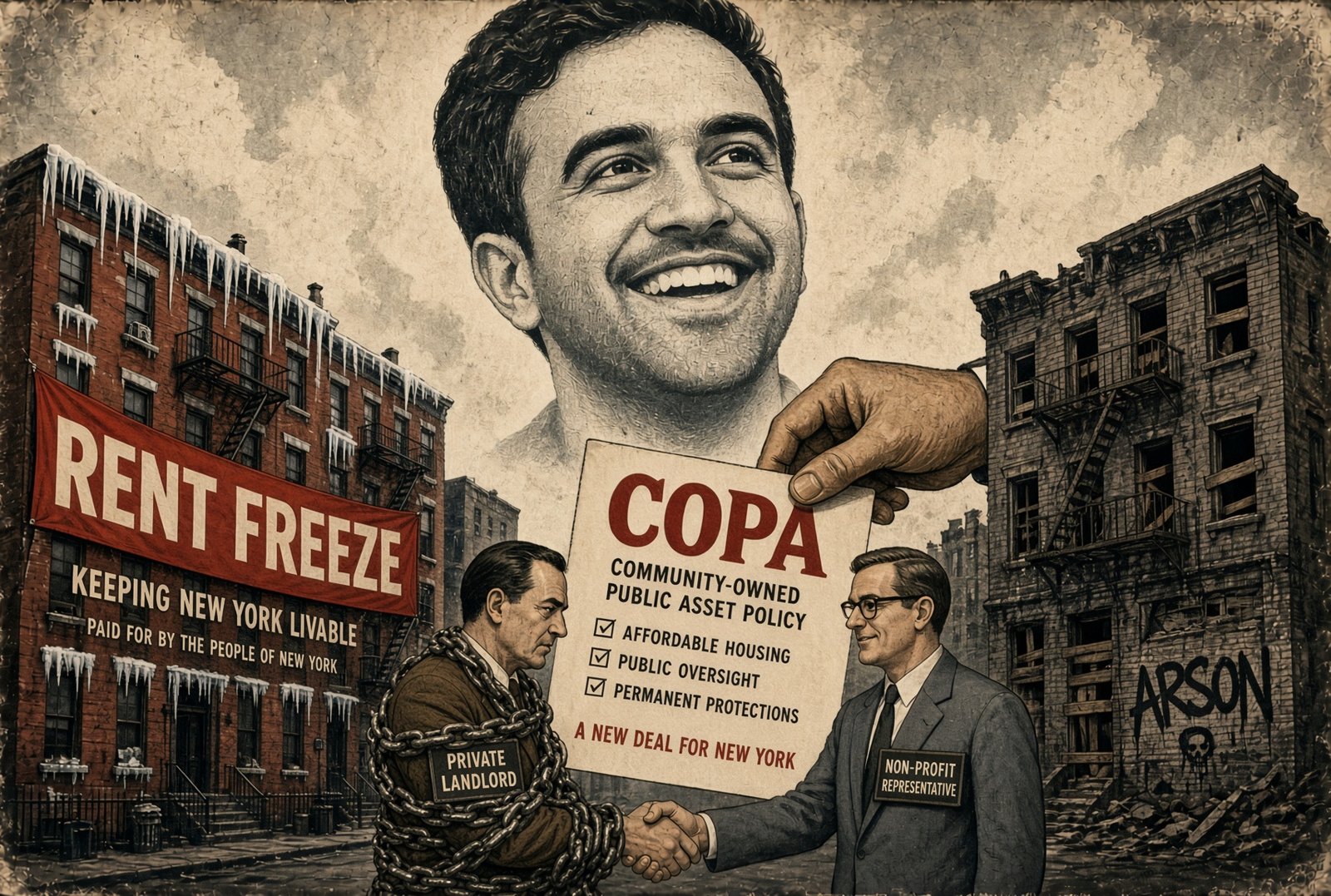
“No longer will City Hall turn a blind eye while New Yorkers suffer, while slumlords abuse tenants with cruel impunity.” — New York City Mayor Mamdani, March 2026.
Decades before Mayor Mamdani vilified and launched a new war against New York City’s landlords, the city had been a model of privately providing affordable housing to millions of immigrants. Private builders and landlords – without government subsidies or public housing – housed successive waves of immigrants. During the late 19th and early 20th century, millions of immigrants in the largest migration in modern history passed through and lived on New York City’s Lower East Side, which became the most densely populated land on earth.
Beginning after the Civil War, these immigrants – Germans, Eastern European Jews, Italians, Irish, and Chinese – were housed in what was innovative new housing of the day, the tenement. The tenement, originally invented in 1824, became the first large-scale, purpose-built multi-family dwelling designed to be affordable and practical for new immigrants with limited means.
This tenement housing was often crowded and rudimentary by today’s standards, but for newly arriving immigrants it was an affordable entry point to the American Dream. On an epic scale, developers built hundreds of thousands of apartments, and rented them to millions of immigrants. They did so without any subsidies. The opportunity to profit gave landlords sufficient reason to supply the housing a rapidly growing city needed.
The Great Depression of the 1930s dried up the flow of immigrants to the city, but a much greater change happened during World War II that followed, which fundamentally changed the economics of housing in New York. This change meant that when the City’s population growth resumed after the war, private developers increasingly were unable, financially, to provide affordable housing like they had before. This development sets the context for the rental housing mess NYC faces now, and sets the stage for Mayor Mamdani’s platform of attacking landlords and freezing rents.
Rent Control Comes to the City
In 1943, the federal government imposed wartime rent control on New York City. It was originally part of a war-time system of price controls across the entire U.S. economy, but when those controls were repealed at the end of the war, NYC kept them in place. The reason was to keep rents low for the thousands of soldiers returning from WWII. Rent
control, in various forms, has been in place ever since, as the City has gone through various cycles of loosening, tightening, and loosening the rules. We are in a severe tightening phase now that began with Mayor DiBlasio’s 2019 tightening of rent restrictions, which is now being tightened further by Mayor Mamdani.
Until Mayor Mamdani’s recently enacted rent freeze effectively brought it back, NYC had abandoned the strict rent control of the 1940s and 1950s, where rents could not change; they were frozen in place. This system of strict rent control had morphed by 1969 into a looser system of periodic rent increases called “rent stabilization.” Today, while that same system exists in name, in practice NYC has returned to strict rent control with Mayor Mamdani’s rent freeze.
But the rent freeze is not really a freeze. Since the landlords’ costs – including property taxes – rise with inflation, in real, inflation-adjusted terms, it is a rent reduction. In its 2026 report, the Rent Guidelines Board’s index of operating costs for buildings containing stabilized apartments rose 5.3 percent. This means that Mayor Mamdani’s rent freeze actually amounts to a 5.3% rent reduction for tenants.
The Iron-Clad Law of Economics: You can’t get something for nothing. Or, to put it another way, you can’t get something for less than it costs to provide. That is true for pizza, as it is true for housing or any other good or service.
Although the rent freeze is still fairly new – it was enacted on June 25, and went into effect on October 1 – it is already putting the squeeze on landlords. One sign of this is the growing number of vacant apartments as landlords no longer find it profitable to renovate and rent out apartments at the low, regulated rents. This pattern actually began during an earlier tightening of the rent rules under Mayor DiBlasio in 2019, who eliminated most of the rent increases landlords could get for renovating dilapidated apartments. Landlords responded by increasingly not renting out – keeping vacant – the older, low-rent units since they could no longer recoup the costs of renovation.
We are at the early stages of a new housing disaster, a disaster set in motion eight decades ago when New York first imposed rent control. It is now made worse by Mayor Mamdani’s rent freeze. If it stays in place unchanged, it will cause a growing number of landlords, not just to hold on to an ever-increasing number of vacant units, but to abandon their buildings altogether.
This is not just economics, but actual history bears this out. New York walked down this path before in the 1970s. NY suffered a catastrophic loss of rental housing and people as landlords abandoned thousands of properties due to the effects of rent control. During the 1970s and early 1980s, inflation rose to more than 10% per year (peaking at 14% in 1980), but the regulated rents were not allowed to keep up.
As their costs began to exceed their rental income, landlords at first turned down the heat to save on fuel costs. Then they delayed maintenance of toilets and leaky pipes. Then they stopped maintenance altogether. When they stopped paying real estate taxes, they simply walked away from their properties en masse and the city took them over. During this time, the city government became the largest landlord, eventually acquiring roughly 100,000 apartments through tax foreclosure.
At the same time, nearly a million people left the city (the population dropped from 7.9 million to 7.1 million in the 1970s), and the city went bankrupt. As the city depopulated due to rent control, neighborhoods across the city – such as the South Bronx, central Brooklyn, Harlem, and the Lower East Side – began to look like bombed-out hellscapes from World War II. The economist Assar Lindbeck characterized this era starkly:
“Next to bombing, rent control seems in many cases to be the most efficient technique so far known for destroying cities.”
New York City is on the same unsustainable path now. The longer New York’s rent freeze is left in place, the sooner it will become the 1970s all over again as landlords stop maintaining their buildings, and eventually abandon them. The early signs are already evident, with the rise in the number of vacant apartments.
Many supporters of Mayor Mamdani cheered when he announced the rent freeze. I am sure many New Yorkers did that too at the beginning of the 1970s. They were no longer cheering when they lost their apartments to neglect and eventual abandonment.
Turning Properties Over to Non-Profits or Tenants Will Not Solve the Problem
The latest salvo in the war against landlords is called COPA, the Community Opportunity to Purchase Act. The purpose of the recently enacted law is to facilitate the transfer of apartment buildings from private landlords to non-profit groups and, ultimately, to the tenants themselves who would own the properties as nonprofit cooperatives.
The law requires that nonprofits get first dibs on small apartment buildings being sold by distressed landlords. While the technical details are not important, in essence the law works by mandating an exclusive offer period during which only non-profits can bid for properties, followed by a lengthy period when they can match any offer the landlord receives. If they match the offer, the law requires that the property must go to the non-profit.
While sounding fairly innocuous, many of its supporters see it as a way that will ultimately facilitate tenants themselves becoming owners. The tenants can set up government-financed non-profit tenant cooperatives and buy their buildings from their landlords.
The law provides extensive taxpayer subsidies to facilitate these purchases (such as low or no-interest loans up to $560,000 per unit) and offers something even more attractive: an exemption for up to 40 years from property taxes.
Now consider that a private landlord gets none of this. All of this largesse only happens when the property is sold to an approved nonprofit entity.
Private capital is being driven out of the rental housing market in New York from two directions, a carrot and a stick.
The stick is rent control, which is driving private capital out of rental housing. Since DiBlasio’s tightening of rent regulations, the market value of regulated apartment buildings has dropped by 45%, and it has continued to fall since Mayor Mamdani was elected on an anti-landlord
platform a year ago. Investors are selling properties and pulling out of the city.
The carrot is given to the non-profits, who receive financial benefits – subsidies and tax benefits – financed by taxpayers that the tax-paying private landlords do not get.
Tenants: Be Careful What You Wish For
The buildings targeted by COPA, some 3,000 initially, are those with the worst finances. The low, regulated rents barely cover costs, which is why many of the owners want to sell.
When title is transferred to non-profit owners or the tenants themselves, the costs of operating these buildings will not change, and the subsidies will not last forever. A subsidy is a transfer from taxpayers to a politically-favored recipient. New Yorkers already face the highest taxes in the country. The political tolerance to extend more subsidies will not last forever.
At the same time, the costs of operation – superintendents’ salaries, heating fuel, electricity, repairs and maintenance, and property taxes –
Originally appeared on Substack.