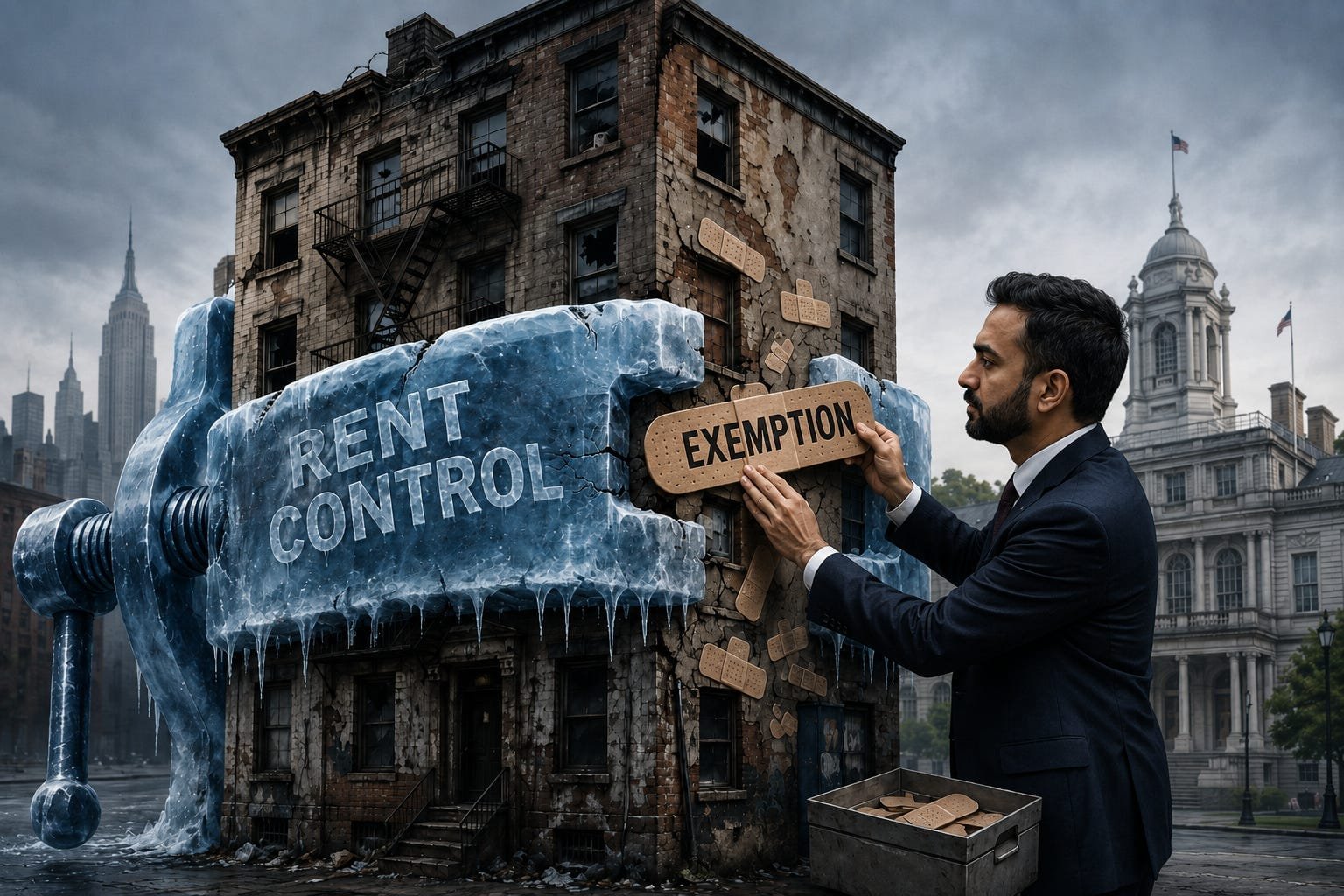
Mayor Zohran Mamdani is already retreating from the logic of his own campaign promise.
He ran on a sweeping four-year rent freeze. Now, faced with reality, he is offering exemptions. His administration is reportedly preparing relief for owners of roughly 300,000 regulated apartments, including case-by-case one-time rent increases on vacant units, easier financing, tax exemptions, help with code violations, and even a city-backed scheme to reduce landlords’ insurance costs.
In other words, the rent freeze has not even fully arrived, yet City Hall is already designing escape hatches from it.
Of course it is.
This is the pattern of rent control everywhere: impose controls, watch the housing stock deteriorate, then carve out exemptions when the damage becomes too obvious to ignore. Freeze rents. Destroy incentives. Starve buildings of maintenance. Then create a new bureaucratic patch to deal with the consequences of the last bureaucratic patch.
New York has been living under some form of rent regulation since 1943. For more than eight decades, instead of allowing rents to be set by supply and demand, the city has tried to have politicians and boards decide the prices landlords could charge.
The result has not been affordable abundance. It has been chronic scarcity.
New York’s rental vacancy rate fell to 1.4 percent in the most recent Housing and Vacancy Survey, a level so low that it amounts to a permanent housing emergency. The vacancy rate for rent-stabilized units was even lower, under 1 percent. By contrast, the national rental vacancy rate, where most rents are not controlled, is above 7 percent.
That is not an accident. That is the result of policy.
Rent Control Creates the Crisis It Claims to Solve
The basic economics are not complicated. When government caps the price of something below the market-clearing level, demand exceeds supply. Shortages result.
Housing is no exception.
Rent control reduces the supply of housing in several ways. Most obviously, it discourages new construction. Why would a developer invest capital in a city where future rents may be determined not by customers, costs, and competition, but by political pressure?
A real-life “natural experiment” demonstrated this in Minnesota’s Twin Cities. St. Paul imposed one of the strictest rent-control laws in the country, capping annual rent increases at 3 percent, even on vacant apartments. Next door Minneapolis did not impose rent control. Instead, it made it easier to build housing, including by loosening land-use restrictions.
The results were dramatic. In St. Paul, permits to build apartments reportedly fell 79 percent in early 2022 compared with the year before. Real-estate investment nearly froze. Developers halted projects as lenders pulled back. Large apartment-building transactions dried up. Some landlords began selling properties. St. Paul (foreshadowing Mayor Mamdani) eventually had to moderate the policy by exempting newer buildings and allowing partial vacancy decontrol.
Meanwhile, Minneapolis kept building. It showed the alternative path: not price controls, but supply. Let builders build, and rents moderate. On other hand, when you cap rents, investment retreats, eventually pushing rents higher on the reduced supply of apartments.
New York’s problem is the same, only older and larger.
Yes, cranes still rise in parts of the city. But for a city this large, this desirable, and this economically important, the quantity of housing being built is far too low. The result is pressure on the portion of the market that remains relatively free: market-rate rentals, condominiums, and co-ops.
That is how rent control raises housing costs. It holds down the legal rent in one part of the market, but the pressure does not disappear. It gets redirected. Like squeezing a balloon, rent control perversely pushes housing prices higher.
Rent Control Locks People In and Locks Others Out
Rent regulation also misallocates the housing that already exists.
The St. Paul example shows this too. Before rent control, some landlords held down rent increases for long-term tenants and adjusted rents when apartments turned over. Once the city capped even vacant units, the incentive changed. Landlords had reason to raise rents by the legal maximum every year rather than risk falling permanently behind rising costs.
That is one of the perverse effects of rent control. It can make landlords less flexible, not more.
New York has its own version of the same problem. A couple who raised three children in a three-bedroom apartment may remain there long after the children have moved out, not because that apartment is the best fit for them, but because the regulated rent is far below the market rent on a smaller apartment. A young family that could use the space cannot get it. A new arrival may not find anything at all. A worker who might have moved to New York for a better job stays away… or moves to Florida.
The city becomes less mobile, less dynamic, and less open to newcomers.
Rent control is often defended as a policy for tenants. But it really is an unjust policy of redistribution. It helps some lucky or politically-connected current tenants by imposing hidden costs on everyone else: young people, growing families, workers moving to the city, employers trying to hire, and tenants trapped in apartments that no longer suit their needs.
It turns housing into a political entitlement attached to a specific unit, rather than a market in which people can easily move, trade, upgrade, downsize, and make choices.
The Bronx Burned Because Economics Was Ignored
 |
|
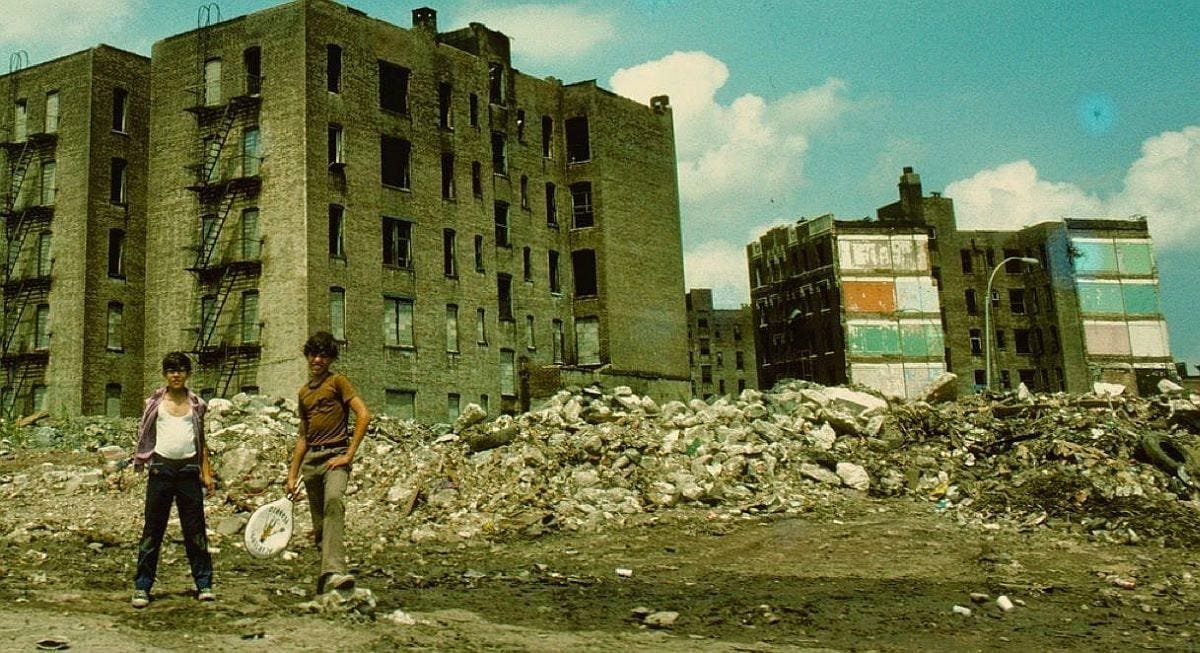
Charlotte Street, The Bronx, NYC, circa 1980. Photo by Steven Siegel.
The most destructive effect of rent control is not merely that it creates shortages. It also destroys the housing stock itself.
During the inflationary 1970s, landlords’ costs rose while regulated rents lagged behind. Taxes, fuel, labor, insurance, repairs, and materials all became more expensive. But landlords could not simply charge the rents needed to cover those costs.
At first, maintenance was deferred. Repairs were delayed. Buildings deteriorated. Heat was reduced. Plumbing went unrepaired. Electrical systems aged. Tenants blamed the landlords.
But the deeper cause was not villainous landlords. It was economic reality.
You cannot force people to provide housing at a loss indefinitely.
Once the legal rent on a building falls below the cost of maintaining it, the building ceases to be an asset. It becomes a liability. That is when owners begin to walk away.
And in New York, they did — first by the hundreds, then by the thousands, then by the tens of thousands. The result was not merely bad maintenance. It was abandonment, arson, vacant lots, and the devastation of entire neighborhoods. The loss of population due to abandonment was so high that nearly a million New Yorkers left the city; during the 1970s, the population of NYC shrank from 7.9 million to 7.1 million people.
“The Bronx is burning” was not just a phrase. It was the visible image of a city that had tried to repeal the laws of economics. The Bronx burned. So did parts of the Lower East Side, the East Village, Bedford-Stuyvesant, Fort Greene, East Harlem, Central Harlem, West Harlem, and other neighborhoods across the city.
That catastrophe was not caused by too much freedom in housing. It was caused by high inflation and decades of political control over housing. Now we face rising inflation again, and if rents are frozen, it will be the 1970s all over again.
Mamdani’s Exemptions Give Away the Game
Mayor Mamdani now appears to recognize at least part of this reality.
His carve-outs are not incidental. They are the whole story. Under the reported plan, some owners of regulated apartments would be allowed to raise rents on vacant units despite the broader freeze. Others would receive easier access to financing, tax relief, assistance clearing housing-code violations, subsidized loans connected to unpaid rent, even a city-backed scheme aimed at lowering insurance costs.
But if landlords truly could absorb frozen rents without consequence, none of this would be necessary. If rent control did not damage buildings, no special relief would be needed. If the policy were sound, it would not require carve-outs, subsidies, tax favors, financing programs, and bureaucratic rescue plans to keep the housing stock from falling apart.
The exemptions are an admission. They concede that costs matter. They concede that landlords need revenue to maintain buildings. They concede that a rigid rent freeze would damage the very housing tenants live in.
But if that is true for some buildings, why is it not true for all buildings? If partial deregulation is necessary to preserve housing, why not deregulate completely?
The answer is political, not economic. Politicians want the applause that comes from promising cheap housing without admitting the cost of producing it. Rent control lets them pose as champions of tenants while shifting the damage into the future.
Then, when the damage arrives, they blame landlords and propose another intervention.
The solution is not another subsidy, which further raises the tax burden on everyone. It is not subsidized insurance for landlords. It is not another complicated relief program. It is not another round of selective exemptions administered by political discretion (along with the attendant lobbying and corruption).
The Alternative Is Abundance
The solution is to get the government out of the business of setting rents.
If landlords and developers could be confident that rents would be governed by supply and demand rather than political pressure, New York would attract far more investment in rental housing. Existing buildings would be better maintained. Marginal buildings would become worth repairing. And many obsolete buildings would be replaced entirely with new, abundant, modern housing.
This matters enormously in New York, where so much of the rental stock is old, expensive to maintain, and ill-suited to modern living. Many 150-year-old walk-up tenements lack elevators, modern layouts, adequate systems, and the amenities people expect in a wealthy city. Under a freer housing market, many of these buildings would be upgraded, expanded, or replaced by better housing.
The city would not merely have more apartments. It would have better apartments.
That is the housing future New York should want: more units, better units, lower market rents, better mobility, and less political favoritism.
Some existing New Yorkers paying artificially-low controlled rents would face higher rents. But they would also experience a resurgent housing market with higher quality, and more realistic choices at sustainable rents. Meanwhile, the many New Yorkers now paying extreme prices in the small market-rate portion of the city’s housing stock would benefit from increased supply and lower rents.
Future New Yorkers would benefit most of all.
A city with abundant housing would be easier to move to, easier to work in, easier to start a family in, and easier to build a business in. Employers would find it easier to hire. Workers would find it easier to live near opportunity. The tax burden could eventually fall as the city stopped trying to subsidize its way out of a shortage it created. The tax base would expand as people and businesses began moving again into the city.
End the Control, End the Crisis
Rent control is not a solution to New York’s housing crisis. It is the central cause of it.
It creates scarcity, misallocates apartments, discourages construction, damages maintenance, raises prices in the uncontrolled market, and turns housing into a political spoils system.
Mayor Mamdani’s retreat from a pure rent freeze is therefore revealing. His own policy cannot survive contact with reality. Once he admits that some landlords need relief from the freeze, he has admitted the principle: rent control damages housing by preventing rents from covering costs.
The only question is how much damage New Yorkers are willing to tolerate before they demand that their leaders do the right thing. Mayor Mamdani should stop offering piecemeal exemptions from a destructive system. He should end the system.
End rent control. Legalize housing investment. Let prices tell the truth. Let builders build. Let landlords maintain their buildings. Let tenants freely move. Let New York grow again.