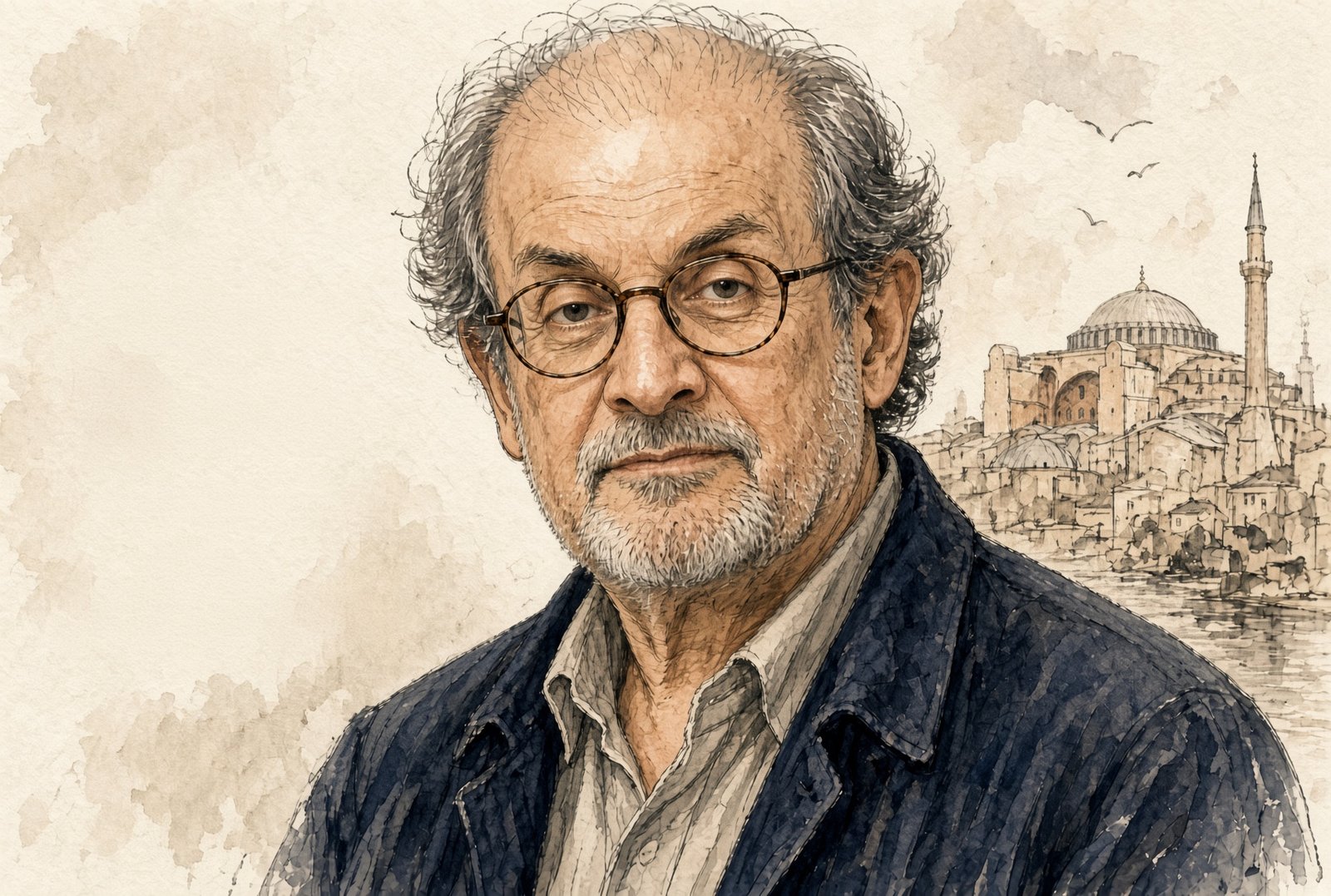
Knife: Meditations After an Attempted Murder by Salman Rushdie recounts an unavenged American horror story—arguably another act of war on America here in the U.S. Indeed, the assassin was charged and convicted with terrorism by the U.S.
By reading this account of a forgotten or marginalized assassination attempt, you can learn how to cope with what’s coming closer to becoming a fact of your life—incessant savagery by radical Moslems—with fortitude, passion and love. To this end, Knife ought to be read by teens and adults across the U.S.A.
Scott Holleran interviewed Carnegie Hero medal winner Henry Reese, who saved Salman Rushdie from an Islamic assassin attempting to execute Iran’s death decree on this date in 2022.
Rushdie was targeted by Iran for assassination in 1989. He was attacked by an Islamic assassin on today’s date in 2022. And he dedicates his courageous memoir, released in hardcover in 2024 and published as a Random House paperback edition in 2025, to “the men and women who saved my life.”
I review this book as the only journalist to meet and (twice) interview Rushdie’s principal savior, 2025 Carnegie Hero medalist Henry Reese, about the attempted assassination; Reese fought, tackled and was injured by the Moslem.
At a quarter to 11 on August 12, 2022, on a sunny Friday morning in upstate New York, I was attacked and almost killed by a young man with a knife, just after I came out on stage at the amphitheater in Chautauqua, to talk about the importance of keeping writers safe from harm.”
Rushdie’s Knife memoir is as straight and factual as the excerpt above. His conclusions are skewed by his philosophy, best described as a hodgepodge of relativism and pragmatism with a streak of avoidance. “The assassin didn’t bother to inform himself about the man he had decided to kill,” he writes in a section that, having studied and reported on the 1989 Rushdie affair and subsequent sieges, caught my attention. “By his own admission, he read barely two pages of my writing, and watched a couple of YouTube videos of me, and that was all he needed. From this, we can deduce that whatever the attack was about, it wasn’t about The Satanic Verses.”
Salman Rushdie is wrong on this point. His planned August 12, 2022 assassination was made possible by his novel, The Satanic Verses, which was denounced by Islamic mystics, and he was sentenced to die by Iran’s chief mystic—its dictator—in an order driven by the novel which is still in effect. (Factor this horrific fact into our boastful president’s Iran Deal 2—at any point, President Trump can and ought to make renunciation of the assassination order of an American citizen a pre-condition of any negotiation for Iran’s surrender).
By attempting to carry out Iran’s death decree, the assassin sought to serve and spread Islamic jihad—it means “holy war”—an ayatollah and a supernatural being. This is what proves that the Islamic order to assassinate Salman Rushdie is based on altruism, i.e., otherism. The novel Rushdie wrote for which he’s condemned to be murdered is inextricable from the assassin’s motive.
“I will try to understand what it was about in this book,” the author pledges. Will you, Mr. Rushdie? I wondered as I read this absorbing and brave, bold account. I had my doubts. He doesn’t try to understand why he was almost murdered, frankly, which does not detract from the value of the memoir. That he dares to write—let alone with the candor, depth and insight he demonstrates here—after being downed by a savage deserves unequivocal praise. Many victims of jihad Islam’s deadly reach hide if they live. Rushdie was granted no protection by the U.S. yet he chose to write this.
Rushdie remembers being death-sentenced—with everyone and anyone associated with his novel (many were then maimed, bombed and murdered)—by Iran:
It had been 33 and a half years since the Ayatollah Ruhollah Khomeini’s notorious death order against me and all those involved in the publication of The Satanic Verses. And during those years, I confess, I had sometimes imagined my assassin rising up in some public forum or other and coming for me in just this way. So my first thought, when I saw this murderous shape rushing toward me, was: So it’s you. Here you are.”
He notes that the assassin was offered a “reward by an organization in Iran.” He also observes that “[t]here was no visible security in the amphitheater that morning,” yet he never addresses or demands to know why—“[the assassin] had a clear run at me”—another lost opportunity to explore the Left’s, the West’s and America’s fundamental, civilizational denial and delusion which contaminates President Trump, too.
Knife does not reckon with the topic of assassination, which Rushdie apparently is unable to bring himself to do. Indeed, Rushdie admits he didn’t want to appear at the event at all; he did so for the money:
I don’t want to go,’ I told [his wife] Eliza. But people were depending on me—Henry Reese was depending on me. The event had been advertised for some time. Tickets had been sold. And I was to be paid generously for showing up. As it happened, we had some big domestic bills to pay up. Our home’s whole air conditioning system was old, on the edge of breaking down and needed to be renewed. So the money would be very handy. ‘I’d better go,’ I said.”
That a struggling American artist targeted for death by Iran could be in this position could easily be the topic of a whole book. Rushdie, thoughtfully citing others’ work including William Ernest Henley’s Invictus and Robert M. Persig’s Zen and the Art of Motorcycle Maintenance, focuses on his recovery, thoughts and wider implications.
Treating words as concepts, he often defines and clarifies, starting with the place where his murder was pre-meditated, “…Chautauqua, the lakeside town, which Theodore Roosevelt called ‘the most American thing in America.’” Giving credit where it’s due, Rushdie justly acknowledges his savior Henry Reese: “His courage is a consequence of who he is”—and he’s frequently cogent and powerful such as what he writes about his early conscious thoughts: “Some part of me whispering, live, live.”
I learned about the writer’s background. After graduating from Cambridge in the late Sixties, Rushdie went to live with his parents in Pakistan, where he was put in charge of English-language TV programming in the Islamic nation’s largest city, which was then showing reruns of Bonanza and Hawaii Five-O. Rushdie proposed a production of Edward Albee’s one-act, suicide-themed play, The Zoo Story. “[In the] climax of the play, his character had to impale himself on a knife…”
Readers will need toughness to read gruesome details of his injuries and recovery. I decided that, similar to scholarship based on mass murder of Jews in Nazi Germany, experiencing horror is integral to study, learn and know the truth.
Salman Rushdie’s is vital testimony:
“My neck and cheek on the right side had been slashed open by the knife. And they could see the two sides of the cut being held together by metal staples. There was a long horizontal gash along my neck, under my chin, and that was being held together by staples, too. They could see that the whole neck area was grotesquely swollen and darkly bloodied. They could see that the dried blood of the wound in my left hand looked almost like stigmata. Around the wound were bandages, and the hand was held stiffly in a splint. And when the nurse came in to tend to my ruined eye, Eliza and the others saw what looked like a sci-fi movie special effect, the eye hugely distended, bulging out of its socket, and hanging down on my face like a large, soft boiled egg. The swelling was so bad that the doctors didn’t even know, in those first days, if I still had an eyelid. I did.
…
“[T]his was perhaps the greatest good fortune of all, and that the blade that had penetrated so deep failed by perhaps a millimeter to cripple my mental capacities. which meant that, as I recovered, I could go on being me.”
Summarizing his fiction as essentially absurdist, Rushdie rightly wants to be judged by the merits of his art, not merely known for being targeted for death. Knife is not a literary journal; it’s a story about finding a post-traumatic way to live and love. As such, it’s rich in honest resilience:
“[T]he eye was lost. I was trying to come to terms with that. The optic nerve had been damaged, and that was that. He didn’t get me, the assassin, but he got my eye. Even now, writing this, I still haven’t come to terms with the loss. It’s difficult physically—to be unable to see a whole quadrant of one’s normal field of vision, is hard to handle, also to lose two-eyed perspective, so that when I try to pour water into a glass, it’s easy to miss the glass—but it’s even more difficult emotionally. To accept that this is how it’s going to be for the rest of my life…”
Reading Knife can be depressing but not for long. Rushdie remains uniquely humored and undaunted, despite “at least six assassination plots against me”: “I didn’t want to repair any motorcycles. But I learned that through literature, I could repair myself.” He relishes moving to America—New York City—in 2000 as “an integral part” of his vitality, “because in America, there was no governmental authority insisting on keeping me inside the fist of the security forces. I could make my own choices.”
Like any honest Western intellectual, Rushdie implicitly accepts that America is, as Ayn Rand, Ronald Reagan, Rush Limbaugh, Leonard Peikoff and myself have forecast, the West’s last best hope. Rushdie is no exception. He knows this is it.
Occasionally, his emotions get the best of him, as when he refuses to give, let alone cite with source, examples when denouncing people he hates, whom he calls “the people who ought to regret their lives—Donald Trump, Boris Johnson, Adolf Eichmann, Harvey Weinstein” claiming (without evidence) that “they have no regrets.” Rushdie, preposterously putting Trump, a British prime minister and Weinstein in Nazi company, commits the same error he accuses his assassin of making about him.
Rushdie’s recollections capture the autonomy unique to the American experience:
“That afternoon the city had suddenly felt different, as if it now belonged to me or I to it. That had been a powerful feeling. This was even bigger, and I made myself a promise while we floated through the New York night, I’m going to take back as much of my life here as possible. As soon as I possibly can…I thought, I’m free. I’m alive, and I’m free.”
In this thought, and throughout Knife, Rushdie appreciates his humanity: “As for feeling, it wasn’t a whole lot better. The thumb and index finger were fine; the little finger had improved feeling; the other two—not so much. But what was called “protective feeling” had returned even to those fingers. I could feel heat, so I wouldn’t burn myself, and I could feel sharpness, so I wouldn’t cut myself. These were always the first feelings that returned, I was told. How intelligent the human body was, I thought, admiringly. What a wonder it is, this thing we all inhabit. What a piece of work is a man.”
Rushdie, who cedes that literary scholars view his fiction as “magical realism,” a term he apparently disdains, grudgingly implies that he knows being “objective” is an asset. When he turns his focus in the sixth chapter to the 24 year-old Islamic assassin and the history of knifed writers and assassinations, the memoir becomes a potent historical reminder. Referring to 82 year-old Nobel Prize-winning Egyptian writer Naguib Mahfouz, who was repeatedly stabbed in the neck on October 14, 1994, by an Islamic terrorist, he puts his dilemma into today’s wider context.* (*Read my historical note).
Iran and other state sponsors of terrorism lie in wait. Given the author’s philosophy, Knife is unable to advise how to protect, prepare and defend yourself. Knife merely, gently stresses that here in America Islamic terrorists are—here they’ve come to kill the infidel—and Knife’s unwritten theme is: this you need to know.
Rushdie’s imagined 30-page conversation with the assassin (whom he refers to as “the A”) fails for several reasons but chiefly one: Rushdie’s fundamental error since 1989 in judging Iran and its barbarians, savages and mystics. “I know what I know,” Salman Rushdie imagines his Moslem assassin saying. But this goes against the facts; the radical Moslem acts on faith and he does not go by reason; the radical Moslem cannot honestly say he knows what he knows. His belief precludes knowledge—he’s repelled from knowing what’s valuable to know—he’s impelled to act on faith.
Amid perceptual-level fakery (i.e., AI, fake news), Rushdie’s reasoning about how he’s misunderstood—he’s been vilified on the left, particularly by feminists—rings true. Comparing himself to a character in a story by Hans Christian Andersen about a man who separates from his shadow, he addresses the difficulty of countering fake media. The shadow in Andersen’s story becomes more real than the man; the real man is executed for being a fake. That Rushdie himself unjustly maligns people, such as Trump and Ayn Rand, using innuendo in his writing doesn’t detract from his point that being smeared is character assassination:
I have learned a lot about demonization, that’s true. I know that it is possible to construct an image of a man, a second self, that bears very little resemblance to the first self, but this second self gains credibility because it is repeated over and over again, until it begins to feel real, more real than the first self.”
Rushdie as Iran’s and radical Islam’s appeaser appears in his support for plans to build a mosque near the Ground Zero site where Moslems downed the Twin Towers, which he cites to show his tolerance. A proposed Ground Zero mosque, opposed by New Yorkers before the election of Moslem Mamdani as New York City mayor, represents another part of Islamic jihad in America, a fact which Rushdie ignores or evades.
“A poem will not stop a bullet. A novel cannot defuse a bomb,” Rushdie writes. “Not all our satirists are heroes. But we are not helpless.” Bravo, I wrote in the margin. He continues: “We must work to overcome the false narratives of tyrants…The battleground is not only on the battlefield…we can emulate Orpheus and sing on in the face of horror and not stop singing until the tide turns. And a better day begins.”
New knowledge, besides pithy literary references, abounds in Salman Rushdie’s Knife. For example, I learned that on January 7, 1938, in Paris, “when almost all his major works, with the exception of More Pricks than Kicks, remained unwritten, and when he was working on his novel, Murphy, Samuel Beckett was walking down the Avenue de la Porte-D’Orleans on his way home from a movie, when he was confronted by a pimp named Prudent, who wanted money from him.”
Beckett pushed Prudent away, whereupon the pimp pulled out a knife and stabbed the author in the chest, narrowly missing the left lung and the heart. Beckett was taken to the nearest hospital…bleeding heavily, and only just survived; James Joyce paid for the costs of a private room for him in the hospital.”
The assassin’s attack on Salman Rushdie four years ago today and his chosen response to it strikes close for the artist or intellectual—especially if you’re Jewish or know that you’re vulnerable as the freethinker or infidel in some way just for being who you are—such as a liberated woman or liberated gay, white male (or black freethinker) or someone who’s older—all types who are often targeted for persecution. In a way I can’t fully explain if you don’t already know how deep and ingrained is the memory and shock at the sudden, stark awareness that you’re in chronic danger and you know who you are, the artist is most vulnerable to attack. So, I knew I ought to read this memoir for extremely personal reasons, which is why it took weeks to read what Salman Rushdie wrote; I knew reading this book would be an emotional challenge.
Rushdie doesn’t sugarcoat. He’s direct. He cites history over and over as if it’s because he wants you to know that they’re coming for you, too. Everyone can benefit from this memoir and from the lessons of his experience. You can learn from his exercise of free will and free speech under siege that you can be strong, angry, loving and kind at once and that, while it’s sad that it’s come to this, it’s come to this. And you mustn’t lose the capacity to love, as he proves when he writes about the Best of New York:
New Yorkers are good at not intruding too much. They wave and then jog on, they smile broadly and then get on with their own lives, they make two-thumbs-up gestures, they call out happy, encouraging words. They don’t stop. They don’t bother you. They move on. I loved being there, in the park with my fellow citizens, all of us celebrating life in our own fashions.”
New York City, our once-gloriously American city depicted in the exalted ending of Ayn Rand’s 1943 novel The Fountainhead and in the cautionary ending of her 1957 masterpiece Atlas Shrugged, comes to mind in Knife’s eighth chapter, Closure? Rushdie evokes both great novels as he addresses his armed assassin that:
“[i]f I think of you at all in the future, it will be with a dismissive shrug…I don’t forgive you. I don’t notforgive you. You are simply irrelevant to me. And from now on, for the rest of your days, you will be irrelevant to everyone else. I’m glad I have my life, and not yours. And my life will go on. Perhaps in the incarcerated decades that stretch out before you, you will learn introspection, and come to understand that you did something wrong. But you know what? I don’t care. This, I think, is what I have come to this courtroom to say to you. I don’t care about you…I have my life, and my work, and there are people who love me.”
He’s wrong, of course, that the assassin “poorly” represents Islam—the assassin represents and practices Islam—though he’s partly right that “the groupthink-manufacturing giants, YouTube, Facebook, [pre-Elon Musk-owned] Twitter, and violent video games were [the assassin’s] teachers. Added to what appeared to be a malleable personality which found in the groupthink of radical Islam a structure for the identity it needed, they produced a self that almost became a murderer.”
Knife rightly suggests that the enemy spawns from Woke media and its sanction of nihilism, including radical Islam.
“We are other, no longer what we were before the calamity of yesterday.”
—Samuel Beckett
This is the first line of Knife. Beckett’s quote echoes the truth of trauma’s aftermath: that you’re irrevocably changed. Whether act of war or assassination, mass shooting, heartbreak, death, diagnosis or debacle, such as a child’s forced isolation during pandemic or the simplest injury—mental, physical—or other cataclysm born of or exacerbated by today’s irrationalism, Knife cuts to that which hurts and heals.
The self-described “godless bastard,” despite his contradictions, remains the defiant infidel who, thanks to Western medicine and his inner strength, is the lucky one—so far. He wants the Knife reader to know that, as he stands with his beloved, a burden “lifted from me somehow. And the best word I could find for what I was feeling was lightness.”
It’s true that Rushdie’s assassin failed in carrying out Iran’s assassination and was caught, tried and convicted. The death cult from which he spawned—radical Islam and its state sponsor, Iran—spreads faster, farther and higher up in America’s state. Knife reminds the reader that, like our nation’s Islamic mass murderers in 2001, they’re here to slit the infidel’s throats—they are planted everywhere amongst us—and around the world—and they’re rising in power as they seek to destroy. His point that it cuts both ways is devoid of meaning to those who choose death over life. Rushdie‘S choice to credit and love his wife and his life can and ought to encourage you, dear reader. Just know that Rushdie sidesteps that you’re running out of time.
Notes
*The Islamic siege on America and the West does not cease:
- The Garland, Texas arts contest siege
- Manhattan 2017 truck attack on bike path in Manhattan
- Boston Marathon bombing
- Assassination of filmmaker Theo van Gogh, the Dutch director who collaborated with Ayaan Hirsi Ali on the 2004 short film Submission. He was murdered in Amsterdam later that year; a note threatening Hirsi Ali was left on his body
- Paris massacre by Moslems at the satirical free press Charlie Hebdo
- Moslem Nidal Hasan’s attack at Fort Hood
- Islamic LAX terrorism at El Al counter
- Pulse nightclub slaughter of gays by Islamic terrorist in Orlando, Florida
- Moslem terrorists’ San Bernardino siege in 2015
- Islamic terrorist Mohammed Alshamrani murdering three sailors
- New Year’s Day attack in Manhattan
- New Year’s Day attack in New Orleans
- The shoe bomber
- Moslem Washington, DC mass murder sniper John Muhammad and accomplice