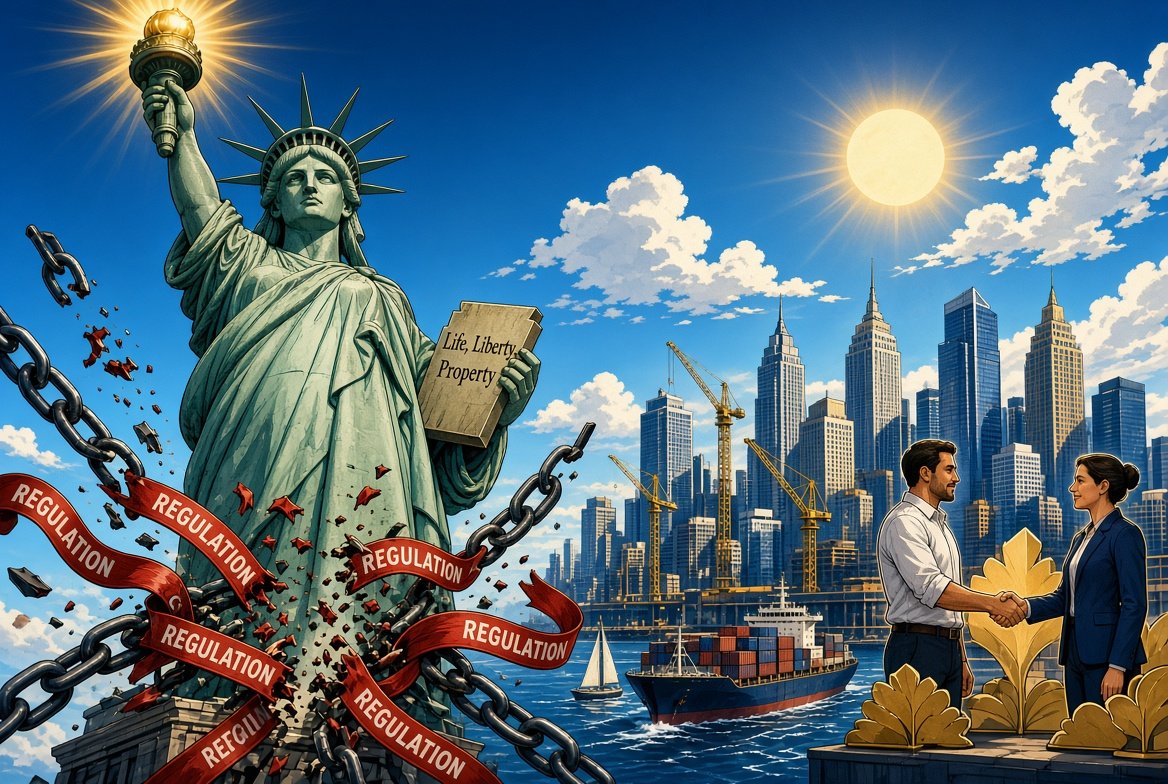
The Republicans’ sweeping defeat on Tuesday raises a question that goes beyond which party controls Congress: Which political party supports capitalism and free markets?
The answer is: neither.
Capital Thoughts is a journal devoted to capitalism and free markets. From that perspective, we support the rejection of MAGA Republicanism (for reasons described below), but the Democrats are no answer, either. Replacing one set of politicians with another will not secure economic freedom unless we understand what that freedom requires, and demand it from whoever holds office.
A capitalist agenda would give individuals greater freedom to produce, trade, invest, and build. It would protect that freedom by rules that apply equally to everyone, regardless of political connections. That provides a standard by which to judge both parties, and a direction for what should come next.
What capitalism requires
Capitalism is the political-economic system of private property and voluntary exchange. Its moral foundation is the individual’s right to live for his or her own sake. Your life is yours. You should be free to choose your work, keep what you earn, and use your property to pursue your own happiness, while respecting those same rights in others.
The Declaration of Independence identifies the rights to “Life, Liberty and the pursuit of Happiness” and explains the purpose of government: “That to secure these rights, Governments are instituted among Men.” Economic freedom follows from that principle. To direct your own life, you must be free to earn a living, acquire property, and use what you produce. The government’s job is to protect those rights.
That qualification sets a limit: don’t violate the rights of others. Freedom of enterprise does not include a right to defraud a customer, steal a competitor’s property, or dump waste onto a neighbor’s land. Government has a vital job: protecting rights, enforcing contracts, and providing impartial courts. A market needs the rule of law, and that must be provided by government.
And guess what? People who are free to pursue their own interests have powerful reasons to discover what other people need. An entrepreneur earns a profit by persuading customers that a product is worth buying. A competitor can win those customers by offering something better or cheaper.
Think of electric power, refrigeration, Amazon, smartphones, and the businesses now developing artificial intelligence. Behind each advance are entrepreneurs who see possibilities others overlook and organize the people, capital, and knowledge needed to make them real. A discovery in a laboratory does not build a factory, create a distribution network, or put an affordable product in a customer’s hands. Entrepreneurs undertake those tasks, risk their own and their investors’ capital, and earn profits only when customers choose what they offer. Their productive judgment turns knowledge into a higher standard of living.
The gains have been enormous. The World Bank’s June 2025 estimates show that about 1.5 billion people escaped extreme poverty between 1990 and 2022. That achievement shows the enormous value of expanding productive opportunity rather than treating the world’s wealth as a fixed pie to be redistributed.
Three conditions are central: secure property rights, including pricing freedom, and the rule of law. Together, they allow people to make plans, discover opportunities, and commit their savings to an uncertain future. Neither Republicans nor Democrats are upholding these foundations of economic freedom. Each claims the power to override individual rights in pursuit of their own variety of populism.
MAGA’s economic populism promises to protect Americans from foreign competition through tariffs, trade restrictions, and thwarting immigration. Democratic economic populism promises to protect ordinary people from the alleged threat of billionaires and corporate profits through wealth taxes and price controls. Both political parties claim that protecting “the people” requires giving politicians more power over individual economic choices.
Freedom means: no cronyism
A government can hand a company money and protect the company from competitors. When it does so, it is undermining capitalism. It can protect a manufacturer from imports, subsidize a favored industry, or make entry so expensive that established firms face little competition. The recipients may prosper. Consumers, taxpayers, and would-be competitors pay the bill.
The question is whether everyone has equal freedom under the law. A business owner who wants a subsidy or a tariff against a rival is asking the government to restrict someone else’s freedom. A politician who grants that request is distributing a privilege, not protecting a right.
That is why the rule of law is essential. A person investing in a factory needs confidence that contracts will be enforced impartially and property will remain secure. If success depends on securing a politician’s favor, resources flow into influence-seeking. The incentive becomes getting a better deal from Washington instead of offering a better deal to customers. I propose a legislative and constitutional way to remove the incentives for this political favoritism in “How to End Cronyism.”
Where the parties fall short
MAGA failed this test dramatically and fundamentally on January 6, 2021. The attack on the Capitol sought to stop Congress from certifying the presidential election. The House January 6 committee documented the broader effort, driven by Donald Trump, to overturn the 2020 result and block the lawful transfer of power. This was part of a concerted effort to substitute continued rule by the defeated president in place of his constitutionally elected successor. That is a profound denial of the rule of law, and the harbinger of dictatorship. Fortunately, the attempt was defeated.
That failure goes to the foundations of capitalism. If a president may set aside an election to remain in office, what assurance does anyone have that he will respect a court judgment, a contract, or a property right when it stands in his way? A smattering of tax cuts and deregulation, which the Republicans offered, cannot compensate for undermining the constitutional order that makes economic freedom secure. A movement that will not accept losing power cannot be trusted to keep that power within lawful bounds. And without free elections, there is no way to remove government officials that don’t respect rights.
Republicans have often offered modestly useful policies on taxes and regulation. But Trump destroyed these benefits with his massive and arbitrary tariff increases. Those policies restrict Americans’ freedom to buy from willing sellers abroad. They are a major reason the Republicans lost the election.
For their part, the Democrats’ 2024 platform actually recognizes that increasing housing supply can lower costs. It proposes cutting red tape to help builders obtain federal financing. Yet it also proposed conditioning a federal tax benefit for corporate landlords on limiting annual rent increases to 5 percent for two years. In New York City, Democratic politicians, led by Mayor Mamdani, enacted a rent freeze. I discuss the free market alternative to rent freezes in “What Would Happen If NYC Ended Its Rent Control?”
These proposals illustrate the tension: trying to have housing while eating it, too. By denying a property developer the freedom to set rents, these proposals undercut the incentive to produce more housing. A temporary benefit for existing tenants (rent control) will mean higher rents and less availability for future tenants looking for a home.
Democrats also attack the right to accumulate wealth. Prominent Democrats increasingly treat the size of a fortune as a reason for imposing special taxes on its owner. In March 2026, Elizabeth Warren, Pramila Jayapal, and Brendan Boyle renewed their proposal for an annual wealth tax: 2 percent on net worth above $50 million, with an additional percentage point on wealth above $1 billion. This is a proposal to tax the stock of wealth year after year, even when it produces no current income.
Fortunately, California voters defeated Democratic-sponsored Proposition 40, a proposed one-time 5 percent tax on billionaires’ net worth. That rejection shows that support for taxing great fortunes cannot simply be assumed, even in a Democratic stronghold.
A wealthy person has the same rights to life, liberty, property, and the pursuit of happiness as anyone else. Those rights do not disappear because a person is more productive than his neighbors. A fortune earned by creating products that millions of people willingly buy belongs to its owner; its size gives politicians no moral claim to seize it. In “Celebrate Entrepreneurs, Don’t Guillotine Them,” I argued that we should recognize the extraordinary productive ability behind honestly earned entrepreneurial fortunes. Success at serving customers is an achievement to celebrate, not a reason to suspend the achiever’s rights.
Neither major political party is advancing economic freedom. MAGA Republicanism has attacked the constitutional underpinnings of capitalism and freedom of trade. Democrats seek greater control over prices and new claims on privately accumulated wealth. Both parties reserve the power to distribute favors to cronies and dictate economic choices that morally belong to individuals. A capitalist agenda requires rejecting that power, whichever party exercises it.
A capitalist policy agenda
So what would a capitalist agenda look like? Its guiding goal should be a complete separation of state and economy, initially through legislation and ultimately through a constitutional amendment. In “How to End Cronyism,” I argued that the First Amendment provides the model: deny government the power to grant economic privileges, just as it is denied the power to establish a favored religion. Remove the powers that make favors valuable, and businesses will have less reason to seek them.
Government should protect rights, enforce contracts, punish fraud and coercion, and provide impartial courts. Independent courts, free elections, and the peaceful transfer of power would secure the political framework. No president should be able to override an election or punish a business for opposing him.
Phase out rent control and other price controls. Restore freedom to trade by rolling back tariffs and eliminating import quotas. Congress should reclaim the tariff powers it unwisely delegated to the president over the past century, which President Trump has so egregiously abused. No future president should have the power to unilaterally raise taxes without the explicit consent of Congress. Americans should be free to choose their suppliers and customers, at home and abroad.
Re-open markets to newcomers, including immigrants. Remove licensing barriers that protect incumbents, simplify business formation, and replace discretionary permission with clear laws protecting individual rights. Expand opportunities to immigrate, work, start businesses, and invest.
Make saving and investment easier through simpler and flatter tax rates. Reject wealth taxes and taxes on unrealized gains, which unjustly penalize entrepreneurial success. Pair reform with spending cuts, including the elimination of corporate subsidies.
End cronyism and corporate welfare across industries. Let owners bear business losses rather than shifting them to taxpayers. Every business should receive the same basic assurance: your property and contracts will be protected. You and your competitors will be free to compete. And your success is yours, as far as you can take it.
A standard for the next political debate
The test for either party is straightforward: Does a particular proposal protect individual rights and expand the freedom to produce and trade? Does it remove privileges… or create them? What opportunities does it open for someone without a lobbyist or a political connection? Every regulatory or legislative proposal – regardless of which party originates it – must be evaluated individually by these criteria.
Tuesday’s rejection of MAGA ended a severe populist threat to capitalism and liberty, but now the Democrats will feel empowered to stand against capitalism in the name of “progressivism.” The sad truth is that both parties remain anti-capitalistic at their cores. America’s prosperity depends on people being free to build something, offer it to others, and keep the rewards when they succeed. A party willing to defend that freedom would give voters a clear capitalist alternative. Until such a party emerges, we must scrutinize every policy on its own merits, giving no benefit of the doubt or unearned loyalty to any political party.