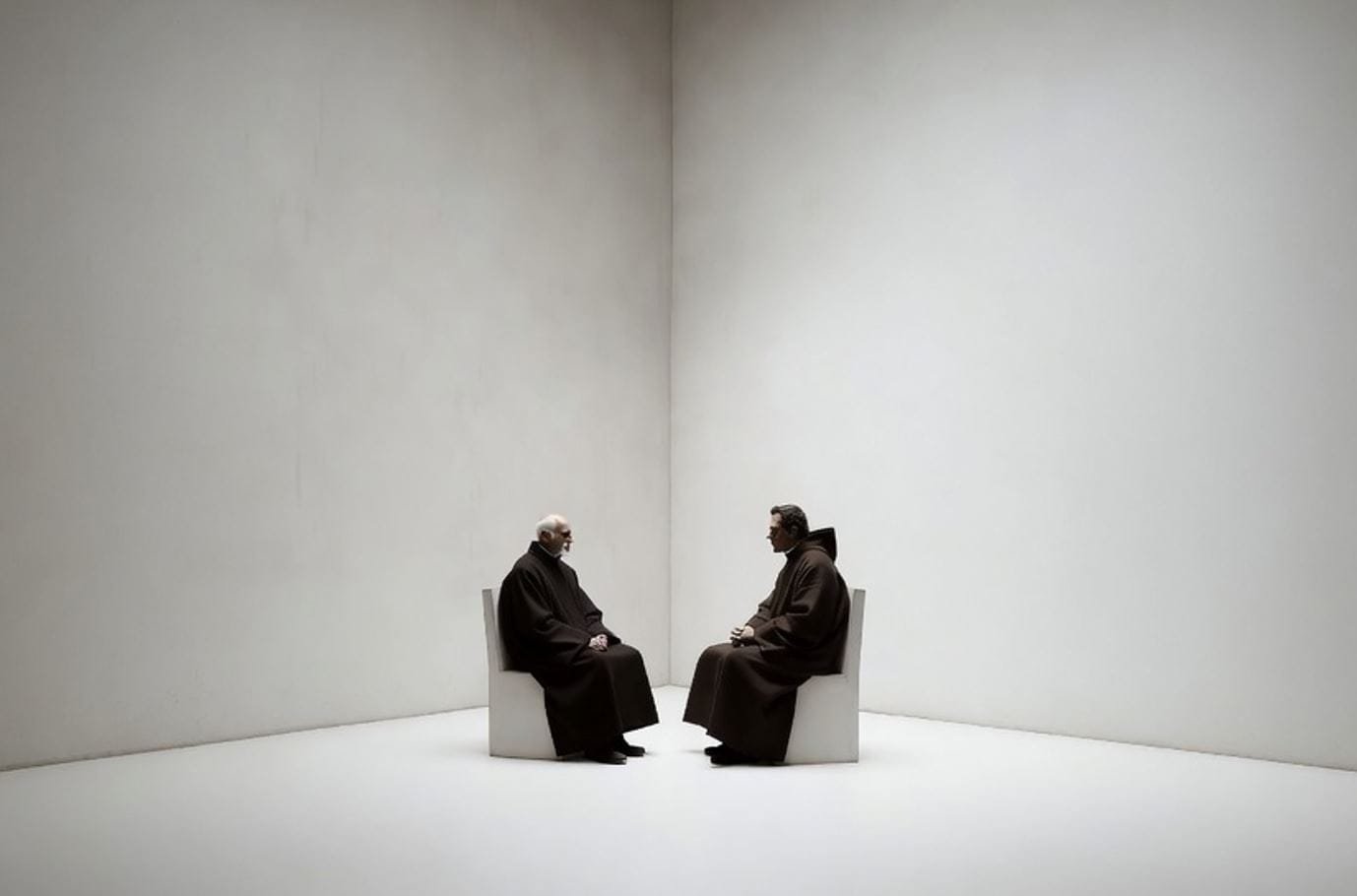
There is a category of intellectual failure more intractable than dishonesty. The dishonest analyst knows what he is doing. He can, in principle, stop. The analyst who has replaced thinking with retrieval—who has trained himself to experience the internal consistency of a closed system as contact with reality—cannot stop, because he cannot see the gap between what he believes and what the evidence shows. He performs the gestures of inquiry. He cites sources. He invokes principles. He reaches conclusions with the confidence of someone who has looked carefully at the world.
He has not looked carefully at the world. He has looked carefully at his prior conclusions and found them confirmed.
In an essay titled “The Closed Room,” I diagnosed this as the defining pathology of institutionalized Objectivism—the gradual replacement of Ayn Rand’s method with her conclusions, her process with her product, her way of thinking with the results of her thinking. The essay traced how a movement built on the primacy of independent perception slowly made retrieval from the canon the test of good reasoning, how it trained successive participants to experience borrowed certainty as personal conviction, how it produced analyses that were internally consistent, confidently stated, and increasingly disconnected from the reality they claimed to describe.
Elan Journo and Ben Bayer in their podcast “The Dramatic Injustice of the January 6th Pardons,” produced the output of a closed room applied to a contested political event with enormous human stakes—a verdict reached before the evidence was examined, confirmed by selective attention to what fit, and insulated from everything that didn’t. They called it philosophy. It was retrieval. The cost of that retrieval was paid not in intellectual currency but in human lives—including three people I know.
What They Claimed
The podcast’s argument is not subtle. Ben Bayer calls January 6th “an outrageous attack on the Constitution and on American values and on the lives of police officers and congressmen.” Elan Journo calls it “a domestic terrorist attack” aimed at “nudging election results.” Both characterize Trump’s blanket pardons as an attempt to “rewrite reality,” to “erase important historical facts,” to make “a mockery of justice.”
These are serious charges. Charges this serious require serious engagement with the full evidentiary record—not selective deployment of the most damning cases while the rest of the record goes unexamined. Journo and Bayer named the worst actors: Stewart Rhodes of the Oath Keepers, Proud Boys members, the assailants of Officer Michael Fanone. They then used those actors as a brush to paint 1,500 defendants, thousands of attendees, and an entire political movement.
The blanket pardon was condemned as a blanket injustice because the blanket prosecution was treated as a blanket truth.
What Journo and Bayer could not do—what the closed room structurally prevents—was make the distinctions that objective examination demands. Not every person present was Stewart Rhodes. Not every conviction reflected individual guilt proportionate to individual conduct. Not every plea deal was a confession. These distinctions are not peripheral to justice. They are its substance. A mind reasoning freshly from evidence would have been forced to make them. A mind reasoning from a prior conclusion—that January 6th was a domestic terrorist attack, that its participants were nihilists, that the prosecutorial response was legitimate—sorted the evidence by whether it confirmed the story and stopped there.
The Closed Room in Operation
To understand what happened in that podcast, you have to understand what rationalism looks like from the inside—because from the inside, it feels like rigor.
The institutionalized Objectivist starts from abstractions already established by the canon and moves downward to concretes—sorting them, classifying them, rendering verdicts on them, all with the confidence of someone who possesses a master key.
Applied to January 6th, the master key was cut before the event occurred. The philosophical categories were in place: the initiation of force, the threat to constitutional order, the nature of political violence, the requirements of rule of law. What the event needed, from inside the closed room, was not fresh examination but correct classification. Was this political violence aimed at disrupting the constitutional process? Yes. Did it threaten the peaceful transfer of power? Yes. Does Objectivism condemn the initiation of force? Yes. Verdict rendered. Pardons condemned.
The evidentiary record that complicated this classification—the institutional failures, the charging disparities, the coerced pleas, the withheld exculpatory footage, the FBI whistleblowers, the specific individuals whose actual conduct bore no resemblance to the violence being described—was not examined and rejected. It was not examined. A mind operating from prior conclusions does not go looking for evidence that might challenge them. It looks for evidence that confirms, and mistakes the confirmation for proof.
This is not a conscious choice. That is the point. The closed room is invisible from inside it. Journo and Bayer genuinely believed they were applying reason to evidence. They were applying conclusions to a narrative. The distinction was invisible to them precisely because the method that would have revealed it—starting from perception, looking at the full record, following the evidence into uncomfortable territory—was the method the institution had spent decades training out of its participants.
What makes this specifically pathetic is that they had better tools available. Rand built them. Every essay she wrote demonstrated the alternative: look carefully at the evidence, resist the pull of prior classification, build the abstraction from the ground up. She created a philosophy specifically designed to prevent exactly what her institutional inheritors did with it.
They had the tools. They chose the closed room. The people who paid for that choice were not abstractions.
The Record They Chose Not to See
Any honest analysis of January 6th conducted after 2022 had access to evidence that fundamentally complicated the official narrative. The question is not whether Journo and Bayer had access to it. The question is whether a mind operating from prior conclusions was capable of engaging it.
Start with the institutions whose account Journo and Bayer trusted.
The Select Committee Report that Journo and Bayer treat as a reliable evidentiary foundation was, per the Loudermilk Subcommittee Interim Report released December 17, 2024, exempted from standard archiving rules, responsible for the deletion or non-provision of more than one terabyte of data and 900-plus interview materials, and engaged in promoting testimony later contradicted by other witnesses while suppressing systematic evidence of institutional failures.
The Loudermilk Report concludes that January 6th resulted from “a series of intelligence, security, and leadership failures at several levels and numerous entities,” driven by “excessive political influence on critical decisions, and a greater concern over the optics than for protecting life and property.” It characterized the committee’s output as a “false, pre-determined narrative.”
A philosophy built on epistemic independence and the questioning of official narratives should have approached this Select Committee’s work with deep suspicion from the start. Journo and Bayer cited it as authority.
The FBI’s own internal critics tell a parallel story.
Washington Field Office whistleblowers alleged that January 6th case files were deliberately manipulated to overstate the nationwide threat of domestic violent extremism—that instead of treating the Capitol events as a singular incident, cases were categorized to create false statistics showing a surge in DVE threats across the country, serving administration narrative priorities. Agent Stephen Friend was suspended without pay after objecting to SWAT team deployments for non-violent January 6th subjects and raising concerns about pressure to open cases lacking sufficient predicates. The Boston Field Office was allegedly pressured by WFO to open investigations on approximately 138 people solely for riding buses to Washington with two individuals who had entered restricted areas—people against whom there was no evidence of criminality, people whose presence at a political rally was constitutionally protected. When Boston requested the video evidence that would have justified those investigations, WFO allegedly hesitated, citing risks of exposing undercover sources.
Then there is the footage shot by Alexandra Pelosi—obtained by the Loudermilk Subcommittee from HBO and released in 2024—of Speaker Pelosi on January 6th itself, saying: “We have totally failed. We have to take some responsibility for not holding the security accountable for what could have happened. I feel responsible. Why weren’t the National Guard there to begin with?” She discusses shifting blame as a “diversionary tactic.”
Former Capitol Police Chief Steven Sund testified that his requests for National Guard support were denied over concerns about “politics and optics.” An anonymous high-ranking former Capitol Police official sent a 16-page whistleblower complaint to Congress accusing senior leadership of failing to share a late-December 2020 intelligence report warning of potential violence—intelligence the whistleblower said “would have changed the paradigm of that day”—and of failing to assist officers who were “literally fighting for their lives” during the riot itself. Multiple intelligence analysts within the Capitol Police alleged mismanagement, unauthorized reorganization, and retaliation against those who flagged risks. At least five employees reportedly faced termination or discipline after raising these concerns.
Army Secretary Ryan McCarthy delayed National Guard deployment despite approval at 3:04 PM, then told leaders at 3:18 PM that forces were moving when they were not.
The Supreme Court’s 2024 ruling in Fischer v. United States narrowed the obstruction charges applied to hundreds of defendants—a judicial determination that the charges had been legally overreaching. Journo and Bayer never mention it.
Approximately 418 of the 1,500-plus defendants faced assault or resistance charges. Yet there is ample evidence to doubt the veracity of many, if not most, of the charges, as I will demonstrate. The majority were charged only with misdemeanors: parading, trespassing, disorderly conduct. Many entered through areas where barriers had already fallen or through doors that Capitol Police officers had opened or stood aside to allow—documented on video, presented in trials, acknowledged in subsequent reporting. Tear gas was deployed behind crowds at multiple points, a tactic that pushes people forward rather than back, creating a volatile and dangerous stampede situation of crowds who were until then peaceful and orderly, into the confrontations it is supposedly designed to prevent.
This is the record Journo and Bayer did not engage. Not because they lacked access. Because the closed room sorted it automatically: the Select Committee Report confirmed the conclusion, so the Select Committee was authoritative. The FBI’s characterization of the event confirmed the conclusion, so the FBI was authoritative. The whistleblowers who challenged both were noise to be ignored. The Fischer ruling was noise. The charging composition was noise. The Pelosi admission was noise.
A philosophy that began by demanding independence from official narratives ended by ratifying the most politically convenient official narrative of the decade. That is not ironic. It is the closed room’s predictable destination.
Todd
As I wrote in the article “A Neighbor’s Journey Through January 6,” my neighbor spent two decades as a law enforcement officer. He drove to Washington on January 6th to hear a presidential speech—his president’s final address before leaving office. He stood so far from the stage he couldn’t see or hear it. He walked toward the Capitol ahead of the crowd, not rushing toward confrontation but simply covering ground, arriving earlier because he had less distance to travel.
What followed was documented on video footage that Todd, his wife, defense team, and I spent dozens of collective hours locating, timestamping, and presenting at trial in the summer of 2024. I flew to Washington to watch.
He picked up a Capitol Police officer’s belt clip from the ground and returned it to an officer at the barricade. Then a baseball cap. On the stand, a Capitol Police officer testified he had lost his equipment that day—losing issued gear meant extensive paperwork and potential career consequences. The video showed Todd picking it up, carrying it to the line, handing it over. This evidence appeared nowhere in the government’s narrative, in the FBI’s presentation during his arrest, or in any of the news coverage that characterized him as being “among the first to breach” police lines.
The photographs the FBI showed him at arrest—stills extracted from video—showed his face contorted, his fist raised, his posture aggressive. The video showed him yelling “Hold the line!” toward another section of the perimeter where he thought a breach was developing, trying to warn officers to maintain their position. The still image, stripped of audio and context, looked like rage directed at police. The video showed someone trying to help them.
The barricade breach that formed the center of the government’s case: the video showed thousands of pounds of crowd pressure from behind buckling the bike rack, Todd reaching out for less than one second to steady himself, the barrier falling, Todd stepping across it because the alternative was being trampled. The prosecution photographs showed what looked like deliberate, violent action. The video showed crowd physics and a man trying to stay on his feet.
He entered the Capitol to find a restroom to wash away teargas residue, walked a hallway, ended up briefly in the Rotunda where perhaps a hundred people stood taking photographs, took a photograph himself, pushed back through the incoming crowd, and left. Six minutes total. No violence. No property destruction. No confrontation with police.
He was charged with two felonies carrying potential sentences of twenty years or more. No plea deal was offered despite his clean record and decades of law enforcement service. Federal prosecutors sought eleven months in prison at sentencing, arguing that deterrence demanded it. The judge—who saw the full video evidence at trial—acquitted him of both felonies and sentenced him to probation.
His legal defense cost hundreds of thousands of dollars. He could afford it. Most January 6th defendants could not. Most took plea deals—not because they were guilty of what they were charged with, but because the alternative was pretrial detention in conditions defense attorneys characterized as deliberately punitive, trial before Washington D.C. juries in cases saturated with political meaning, and conviction rates that had more to do with venue than with evidence. You sign what they put in front of you. You go home to your family. You carry the conviction forever.
The D.C. jail conditions during this period were not hypothetical hardship. The U.S. Marshals Service’s own inspection found “systemic failure”: standing sewage in toilets, water shut off for days as punishment, mold, pests, and inadequate food. Defendants spent twenty-two to twenty-three hours a day in cells. Medical care was denied by documented court order—Judge Royce Lamberth held the D.C. Corrections director in civil contempt after a defendant’s broken wrist went untreated for months.
This pattern was not incidental to the prosecution. It was the mechanism of the prosecution. Stephen Friend—the FBI agent suspended for objecting to SWAT deployments for non-violent January 6th subjects—raised precisely these concerns internally: that charging strategies were designed to maximize plea pressure rather than reflect individual culpability, that the machinery was running on deterrence logic rather than justice logic. He was suspended. The machinery continued.
A friend of mine was a highly decorated FBI senior-level special agent. When he similarly objected like agent Friend, his supervisor told him to either comply or find another job. He retired in disgust.
Todd is the concrete that the closed room erased. He is not an abstraction about prosecutorial overreach. He is a specific man whose specific conduct was documented on specific video that the government possessed and selectively deployed. He is the individual that rationalism—which entertains ideas at the expense of reality—structurally cannot see. The closed room renders verdicts on categories. Todd was a category: January 6th defendant. The category had been classified. The verdict followed automatically.
That is the mechanism. That is what it cost.
Joe
Joseph Bolanos was my neighbor on the Upper West Side in Manhattan. For twenty-three years he served as his block association president—the unglamorous, necessary civic work of someone who believed in his community and showed up for it. He was sixty-nine years old. He went to the January 6th rally. He was at the JW Marriott hotel when the Capitol was breached. He told the New York Post directly: “I do not condone the criminality and violence on [Jan. 6] whatsoever.”
In February 2021, an FBI anti-terrorism task force raided his apartment and his elderly mother’s home in Washington Heights. A neighbor had called a tip line. Agents drew guns on him and handcuffed him, held him for three hours, photographed and rifled through everything in both homes, and left with boxes of materials. No charges were ever filed. He had committed no crime. He attended a political rally, returned to his hotel, and went home.
His neighbors shunned him. A man who had spent twenty-three years serving his community became, in the minds of people who had known him for years, a suspected domestic terrorist. His devices were held for months. His reputation, built across decades of genuine service, was destroyed by an accusation that never produced a charge.
His case is not unique. It is the tip-line mechanism operating exactly as designed. The Washington Field Office allegedly pressured the Boston Field Office to open investigations on 138 people for riding buses to Washington with individuals who entered restricted areas. No evidence of criminality. No individual assessment of conduct. Presence at a political event, proximity to others who may have done something wrong—sufficient predicate for federal investigation.
The language that fed this machinery came from everywhere the “domestic terrorist attack” framing was amplified and repeated by credentialed voices. Every formulation that placed January 6th attendees collectively in the category of existential threat made tip-line calls about neighbors seem not just permissible but patriotic. ARI was one of those credentialed voices. “Domestic terrorist attack.” “Outrageous evil.” “Nihilists.” Repeated with the authority of a philosophical institution whose founder built her career on the danger of collective condemnation.
Joe paid for that language with two strokes and years of his life. He was never charged.
Journo and Bayer expressed no concern about Joe. They expressed no concern about the tip-line culture. They expressed no concern about the 138 people in Boston investigated for riding a bus. The individuals swept up not just in prosecutions but in the broader machinery of accusation are simply absent from their moral universe—which is a remarkable omission for philosophers who claim to center individual rights against state power.
The Human Ledger
Journo and Bayer speak of “outrageous evil.” Here is what they do not speak of.
Among January 6th defendants, multiple individuals took their own lives during the years of prosecution. One was Matthew Lawrence Perna, thirty-seven years old, who had turned himself in willingly and pleaded guilty to a misdemeanor, died by suicide on February 25, 2022, exactly one year after his indictment, while awaiting sentencing. His obituary said he “died of a broken heart.” His family said the justice system killed his spirit.
I have gotten to know other families who thanked me for my article about Todd; they described variations of the same mechanism. Pretrial detention used as leverage. Years of legal limbo. Financial devastation from legal costs that most could not sustain. The loss of careers, businesses, marriages—not as sentences imposed by courts but as collateral damage from the process itself, from public accusation in a climate that had been told by credentialed voices that these people were domestic terrorists. Social destruction preceding any verdict. Some could not survive it.
Their deaths are the human endpoint of the prosecutorial logic Journo and Bayer defended: the logic that deterrence justifies aggressive charging, that the category overrides the individual, that the machinery of federal prosecution can be run at scale against people whose specific conduct the evidence, examined fully, would not have supported punishing. Prosecutors sought eleven months in prison for Todd Henderson’s misdemeanors. For people without Todd’s resources, without his attorney, without his twenty hours of video footage—the pressure was total. Some broke under it.
Ashli Babbitt, an unarmed veteran, was shot and killed by a Capitol Police officer. Brian Sicknick, whose murder was reported breathlessly by the media and Democrats, died of natural causes—strokes, per the medical examiner.
What the closed room produces, applied to human beings, is a selective ledger: the suffering that confirms the narrative is visible; the suffering that complicates it is not. The officers’ injuries fit. The defendants’ malicious prosecutions, suicides, and a murder, do not. The sorting is automatic, below the level of conscious decision, performed not by a mind examining evidence but by a prior conclusion filtering for confirmation.
The result is a moral accounting so selective it constitutes a structural lie—one built into the method, invisible to those practicing it. Acknowledging all the suffering is not both-sidesism. It is the minimum requirement of honest moral analysis. Journo and Bayer did not meet it. Could not meet it. The room admitted only those whose pain confirmed the story already told.
Joe’s two strokes are outside the room. Todd’s legal bill is outside the room. Matthew Perna’s and Ashli Babbitt’s obituary is outside the room. The room is warm, consistent, and sealed against all of them.
The Standard They Refuse to Apply
The test of whether an analyst has principles rather than preferences is simple: apply the framework consistently across comparable cases and observe what happens.
The 2020 unrest involved between 7,750 and 10,600-plus incidents across the country. Nineteen to thirty-one deaths linked to the unrest. Hundreds of police officers injured cumulatively across months of sustained violence. Between one and two billion dollars in property damage. Federal buildings attacked in multiple cities. A police precinct with trapped officers was set afire and abandoned. An autonomous zone established and maintained for weeks in Seattle.
Federal prosecution was minimal by comparison. Locally, arrest-to-prosecution ratios were dramatically lower than for January 6th defendants. Many charges were dropped. The aggressive geofence warrants, the years-later arrests at gunpoint, the tip-line operations, the SWAT deployments for non-violent subjects, the pressure to open cases on bus riders—none of this characterized the federal response to violence that exceeded January 6th in duration, geographic scope, deaths, injuries, and property destruction.
This is the disparity the FBI’s own whistleblowers named. Stephen Friend and others described a bureau that had developed what they characterized as an obsession with January 6th cases while deprioritizing other violent crime—running its investigative machinery at full force against one political tribe while comparable violence of 2020 received a categorically different response. This was not an outside accusation. It was an inside one, made by agents who watched it happen and faced suspension for saying so.
Journo and Bayer raise the 2020 comparison in the podcast, dismisses it as evasion, and moves on. But the comparison is not raised to excuse January 6th. It is raised to test whether they are doing analysis or doing politics. Analysis requires consistent standards. The moment you apply the “domestic terrorist attack” framework to one set of events and refuse to apply it to comparable events by a different political tribe, you have left honest inquiry and entered advocacy.
There is no rational explanation for the orders-of-magnitude difference in federal prosecutorial response. It does not explain why tip-line investigations swept up people who attended a rally versus people who firebombed a federal courthouse. It does not explain the SWAT teams for non-violent misdemeanants, the geofence warrants, the bus riders. A philosophy committed to consistent principles is obligated to explain what the distinction actually justifies—not simply assert that it justifies everything.
Journo and Bayer did not attempt that explanation. A mind starting from the conclusion that January 6th was uniquely, existentially threatening does not need to. The prior conclusion has already classified 2020 differently. The disparity is invisible. The closed room processes everything as confirmation, including the silence where an inconsistency should be.
Collective Punishment
Strip away the philosophical vocabulary and what Journo and Bayer endorsed is collective punishment—one of the oldest violations of liberal values, condemned across every serious tradition that has ever thought carefully about justice.
The liberal tradition that produced habeas corpus, the adversarial trial, the presumption of innocence, the requirement that the state prove individual guilt before imposing individual punishment, rests on a hard-won insight: collective condemnation is always easier than individual examination, and always more dangerous. You do not punish the crowd for the actions of some within it. You identify who did what, prove it with evidence, and impose consequences proportionate to the proven conduct. This is not a technicality. It is the foundation of every justice system that deserves the name.
Journo and Bayer endorsed the opposite. They took the genuine crimes of a small subset—the specific individuals who beat officers and smashed windows—and used those crimes to justify a prosecution apparatus that swept up 1,500 people, pressured hundreds into plea deals for conduct that bore no resemblance to what they described, and destroyed lives that the full evidentiary record would not have supported destroying.
The FBI whistleblowers documented how this happened at the institutional level: statistical manipulation to inflate the DVE threat, pressure on field offices to open cases lacking adequate predicates, SWAT deployments for non-violent subjects, investigation of people for attending a rally. The machinery was not calibrated to individual conduct. It was calibrated to category membership. January 6th attendee. January 6th defendant. The category did the work. The individual was irrelevant.
Journo and Bayer provided the vocabulary for this. “Domestic terrorist attack”—a category so grave that anyone associated with the event fell within its moral gravity. The category then justified everything done to everyone else. That is collective punishment, conducted in the language of individual rights, by people who claim to champion individual rights. Ayn Rand herself wrote that “It is moral to let ten guilty men go free rather than execute one innocent man.”
The pardons were a blunt instrument. Individual review, in an uncorrupted process, would have been better—separating the genuinely violent from the merely present, the intentional from the accidental, the dangerous from the person who walked through an open door and took a photograph. But the process was corrupted. The incredibly biased Washington D.C. venue, the pretrial detention used as leverage, the selective evidence presentation documented in case after case, the FBI whistleblowers describing institutional pressure to pursue cases regardless of individual predicate—these produced outcomes bearing no reliable relationship to individual guilt. Individual review administered by this process would have been the problem repeated.
Blanket pardons were controversial within the Trump Administration: Kash Patel told the Senate, “”I do not agree with the commutation of any sentence of any individual who committed violence against law enforcement.”
The blanket pardon acknowledged what honest examination of the record makes unavoidable: the taint was systemic. The remedy had to be systemic. Journo and Bayer called this a mockery of justice while defending the mockery that preceded it—while using the vocabulary of individual rights to endorse collective punishment at scale.
The fact is that innocent people’s lives were still being harmed. Todd was still on parole and wearing an ankle bracelet. Others were in jails and in prisons. Any delay in freeing the innocent is a wicked moral crime.
The Malpractice
Intellectual malpractice is not merely wrong. It is failing to meet the basic obligations of honest inquiry—examining the full evidentiary record, applying standards consistently, acknowledging uncertainty where it exists, following evidence into uncomfortable territory rather than stopping where it confirms what you already believe.
Journo and Bayer met none of the obligations. They built their case on a Select Committee Report produced by a politically controlled process with documented evidence suppression—the kind of institutional narrative that their own philosophical framework, properly applied, should have made them deeply suspicious of. They cited the FBI’s characterization of the threat while FBI whistleblowers were being suspended for challenging that characterization internally. They invoked DVE statistics that WFO whistleblowers alleged were deliberately manipulated. They spoke of the primacy of existence—facing facts as they are—while declining to face the facts that were inconvenient.
They trusted the authorities. For philosophers who built careers allegedly on the virtue of independent thinking, on the danger of accepting official narratives without scrutiny, on the primacy of individual perception over social consensus—this is not a minor irony. It is a comprehensive one. Ayn Rand most certainly did not grant the benefit of the doubt to governments, as her life history and work proves decisively.
Journo and Bayer used the credibility of Rand’s exceptional reputation for seriousness and objectivity, to do the precise opposite: to ratify an official narrative produced by a politically compromised process, to endorse collective condemnation of 1,500 people on the basis of the worst actors among them, to defend a prosecution apparatus that the apparatus’s own internal critics were risking their careers to challenge.
The people who needed what they should have provided—Todd, Joe, the defendants who couldn’t afford a fight, the families that didn’t survive the ordeal—deserved the rigorous independent analysis Objectivist intellectuals are obligated to provide. What they got instead was the closed room’s verdict, rendered with philosophical confidence from a sealed room, by people who never looked at the full videos, never engaged the whistleblower testimony, never asked what the charging composition actually revealed about the prosecutorial logic they were defending.
Genuine rigor would have examined the Loudermilk findings with the same attention given to the Select Committee Report. It would have asked what the Fischer ruling revealed about the original charging decisions. It would have looked at the 138 people investigated for riding a bus from Boston to Washington and asked what principle justified that. It would have examined what pretrial detention conditions do to the reliability of plea agreements. It would have watched the full video footage, not the stills. It would have made the distinctions that justice requires between the man who beat an officer with a flagpole and the man who walked through an open door and left six minutes later.
It would have seen Todd. It would have seen Joe. It would have seen Perna. It would have seen Babbitt.
It did none of this. The closed room had already rendered the verdict. The evidence was being sorted for confirmation. The individuals—the actual human beings whose actual conduct was documented on actual video, whose actual lives were being destroyed by a process Journo and Bayer were defending—were invisible behind the categories that had already classified them.
The Final Turn of the Screw
Now consider what happened in April 2026.
The Department of Justice—the same federal government that had secured the seditious conspiracy convictions of Stewart Rhodes and Enrique Tarrio, the cases Journo and Bayer held up as proof that January 6th was what they said it was—filed motions in the D.C. Circuit asking courts to vacate those convictions entirely for twelve key figures, seeking dismissal with prejudice. Permanently. Never to be retried.
The government that won these cases has concluded that continued pursuit is not in the interests of justice.
Journo’s and Bayer’s entire moral framework on January 6th rested on those convictions as foundational evidence. The jury verdicts were the reality they were citing. The seditious conspiracy findings were proof that this was an organized domestic terrorist attack on constitutional order—not a chaotic riot compounded by institutional failure, not a protest that became something worse in ways that implicated both the participants and the people responsible for security that day, but a planned conspiracy to overthrow the government. That was the claim. The convictions were the proof.
The proof has now been erased by the institution that created it.
This silence is itself the diagnosis, confirmed. A philosophy built on the primacy of existence—on facing facts as they are, on updating conclusions when reality contradicts them—should have something to say when the factual foundation of its most confident verdict crumbles. The absence of that something is not an oversight. It is the closed room demonstrating that it cannot update. Cannot, not will not. The mechanism that would allow reconsideration—genuine contact with the evidence, genuine willingness to follow it past the point of prior commitment—was never operational. The room was built without it.
The convictions existed. The room treated them as proof. The convictions have been vacated. The room is silent. From inside, this is not even felt as silence. The prior conclusions are intact. The category still fits. The classification still holds. Reality has moved on; the room remains exactly where it was.
The Closing of the Ledger
Journo and Bayer expressed no concern about any of the victims I mentioned. They could not, because the closed room has no mechanism for encountering individuals—only categories, only narratives, only the comfortable internal consistency of conclusions already reached before the looking began. The human beings are outside the room. The room is warm and certain and sealed against them all.
The weapon here was credibility. Decades of it, borrowed from a genuine intellectual tradition, from a philosopher who actually did the work. Journo and Bayer held that credibility and used it—on January 6th, on the pardons, on the human beings whose fates turned partly on whether serious intellectual voices would look carefully at the full record or ratify the state’s story. They ratified. They did so with confidence. They did so without competence—without having examined the evidence that competent analysis required, without having applied the method that their own institution existed to practice.
That is what makes this malpractice rather than mere error. They were not incompetent amateurs who didn’t know better. They were the paid professional custodians of tools specifically designed for exactly this kind of analysis—tools built to cut through official narratives, to defend individuals against collective condemnation, to follow evidence past the point of institutional comfort. They held those tools. They did not use them.
The gap between the authority they projected and the work they actually did is where Joe Bolanos’s health went, where Todd Henderson’s savings went, where Matthew Perna’s and Ashli Babbitt’s lives went.
Recommended Reading: