
Before you carve the turkey this Thanksgiving, consider the people who made your dinner possible.
Someone bred and raised that bird. Someone grew its feed, built the processing equipment, financed the refrigerated trucks, and built the supermarket that put it within reach. Someone manufactured your oven, developed its controls, and built the power plant that supplies your electricity. All of this had to happen months, even years before you started preparing your feast.
Your Thanksgiving feast rests on an extraordinary accumulation of human thought, effort, and capital. So, this Thanksgiving…
THANK THE CAPITALISTS.
By capitalists, I mean the entrepreneurs who conceive and organize businesses, the financiers who invest in them, and the owners who commit productive resources now to an uncertain future. Sometimes all three roles belong to the same person. Sometimes they involve thousands of people cooperating through a business and its suppliers. Their achievement deserves recognition — and their earned wealth deserves respect.
The Countless Decisions Behind Your Dinner
Consider the innumerable decisions involved in producing your Thanksgiving turkey. How many birds should the farmer raise? Which feed will produce healthy birds at an economical cost? What equipment should he buy? How much refrigeration capacity will be needed? When should the birds reach the processor? What will customers be willing to pay when Thanksgiving arrives? Is it enough to cover all these expenses?
The farmer must make those decisions in the face of tremendous future uncertainty long before the grocery shopper stands in front of the freezer case. So must the processor, the trucking company, and the retailer. Each commits resources today in anticipation of what people will want tomorrow.
What makes all of this possible? The freedom to deploy their capital as they choose, and to own the consequences of their actions.
Ownership gives them the authority to act on their judgment. Profit gives them a reason to get it right. Loss gives them a reason to correct their mistakes. These forces are the motivating engine of capitalism, and they bring you your dinner.
On Thanksgiving, the result is an efficiently-produced feast that takes less and less of your working time to purchase.
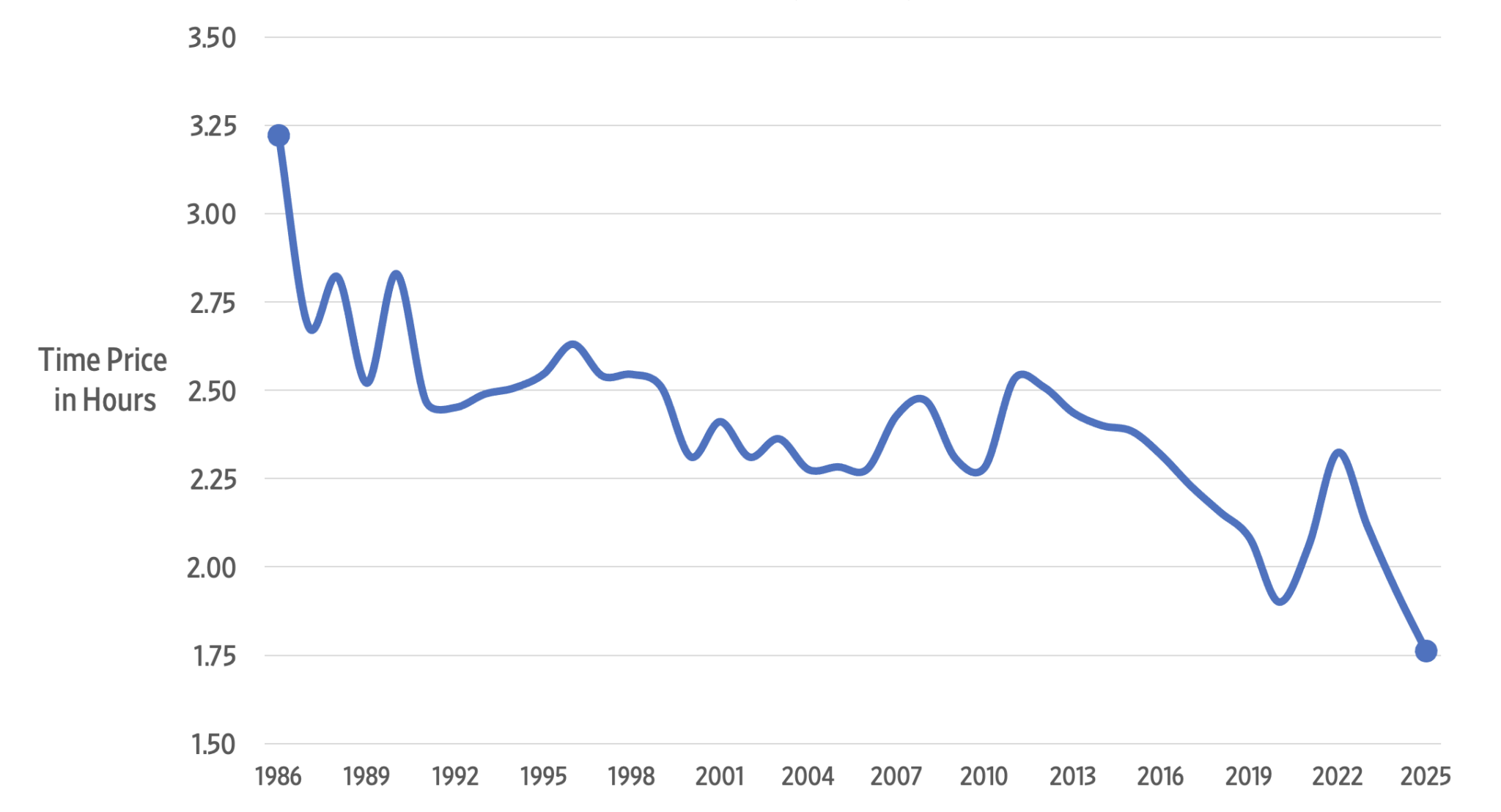
Gale Pooley’s analysis at Human Progress compares the cost of a Thanksgiving dinner for ten people earning a blue-collar hourly wage. In 1986, earning enough to buy that dinner required 3.22 hours of work. By 2025, it required 1.76 hours—a decline of 45.3 percent. Those figures measure the ingredients in the Farm Bureau’s surveyed dinner, purchased with gross hourly earnings. The improvement is substantial: the same working time today buys nearly double the Thanksgiving dinner it would buy 39 years ago.
Chart 1: Thanksgiving dinner measured in hours of work, 1986–2025
Source: Gale L. Pooley, Human Progress
This achievement enriches people with spare purchasing power for other purposes: a better home, a trip, an education, savings, or another evening doing something they enjoy.
The capitalist who earns a profit by making food more affordable has accomplished something worth celebrating.
He wanted to make money. We wanted a good dinner at a reasonable price. Voluntary exchange brings those purposes together. The farmer gains a customer; the customer gains a meal. Neither sacrifices his interests to the other.
There is justice in that relationship. People approach one another as independent traders, each offering something the other person values. The producer earns his payment. The buyer benefits from what he has produced. It is win-win.
What Makes Capital Intelligent?
The Thanksgiving table is only a small part of the achievement.
Look beyond your dining room to all the other goods we take for granted: central heating, electric lighting, reliable transportation, instant Internet communication, comfortable furniture, and appliances such as dishwashing machines and clothes washers & dryers that spare hours of household labor. Each of these achievements required myriad prior discoveries to be developed, equipment to be manufactured, businesses to be organized… and capital to be committed.
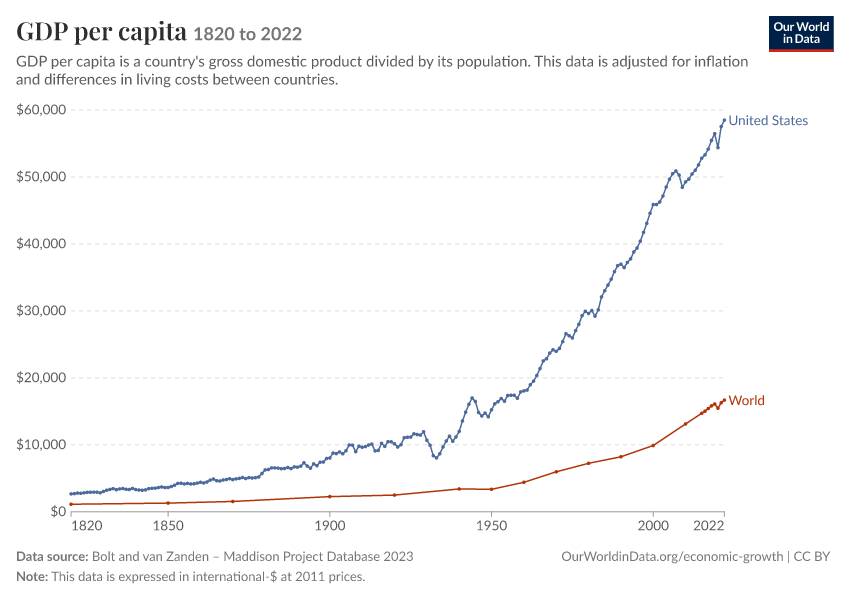
The dramatic rise in output per person since capitalism emerged over 200 years ago gives us a picture of that transformation. The Maddison Project’s historical estimates, presented by Our World in Data, trace economic production across generations while adjusting for inflation and differences in purchasing power. The chart below shows Gross Domestic Product (GDP) per capita — roughly equivalent to average income — for the United States and the world from 1820 through 2022.
Chart 2: Real GDP per capita—United States and world, 1820–2022
Source: Maddison Project Database 2023, presented by Our World in Data
The capitalist era began with factory mass production in the late 18th century. This chart captures the human flourishing achieved by capitalism since then. Behind this rapid increase in production, and incomes, are capitalists continually finding better – more highly valued – uses for resources.
A better machine lets a worker accomplish more in an hour. A better distribution system puts goods where customers want them. A better production process saves materials that can be used elsewhere. An entrepreneur like Thomas Edison with electricity or Steve Jobs with the iPhone discovers a demand that others overlooked and builds a business to meet it, constantly motivated by the incentives of profit and loss.
This is the intelligence of capital in action. Equipment becomes productive through the judgment that chooses it, places it, maintains it, and combines it with human skills. Private ownership – and only private ownership – gives that judgment room to act. Market prices communicate competing demands. Profit and loss test whether the results justify the resources consumed. This is what economist Adam Smith called the “invisible hand,” and it explains how capitalism has powered such an enormous rise in our standard of living.
Even an entrepreneur who correctly anticipates what customers will buy faces a practical question. Who will put up the money to get the business running before the first sale?
A factory must be constructed well in advance before its first product can be sold. Trucks must be purchased before their deliveries earn revenue. Employees and suppliers must be paid while a start-up enterprise is still finding its customers. Investors – financiers – commit savings – accumulated wealth – to bridge that interval, while constantly bearing the risk that the venture will fail.
That is why we should applaud the large earned fortunes along with the businesses that create them. A founder’s fortune represents ownership of an enterprise creating value for millions of customers. As the enterprise becomes more valuable, the founder’s wealth will grow with it. This trade is win-win and, in capitalism, the mutual gains are enormous for everyone.
Success on a large scale earns a large-scale reward.
The owner does not have to surrender his shares (as envisioned in a wealth tax) in order for the public to benefit from the business. Customers already benefit from his products. Workers already receive salaries. Suppliers already have gained by selling to his business. Further capital investment expands all those activities.
But taxing capital destroys it. It does this by reducing or even eliminating the incentive and means for creating large productive enterprises. It does this by dumbing capital down and, ultimately destroying it. Taxing or confiscating capital transfers it to politically-elected cronies and government officials who cannot use it wisely because they lack the incentives of profit and loss. Witness the devastating poverty of every society that tried to take over capital.
The resources involved are the businesses and investments that support production. Transferring them to political authority gives officials command over wealth they did not earn by building those enterprises, and to a party who does not have the ability, knowledge, or incentives to productively deploy them. A bureaucrat destroys; an entrepreneur creates.
An entrepreneur who has created valuable products through voluntary trade has a right to the proceeds. Being successful on a huge scale – which only rare entrepreneurs of great ability can do – does not suddenly invalidate their right to their wealth. Quite the contrary. Why would Thomas Edison, Steve Jobs, or Jeff Bezos lose their right to keep their great fortunes, when the cause of it is beneficial production on an epic scale?
Capitalism Has Doubled Human Lifespans
Adding it up, perhaps the most important indicator of capitalists’ success is human life itself.
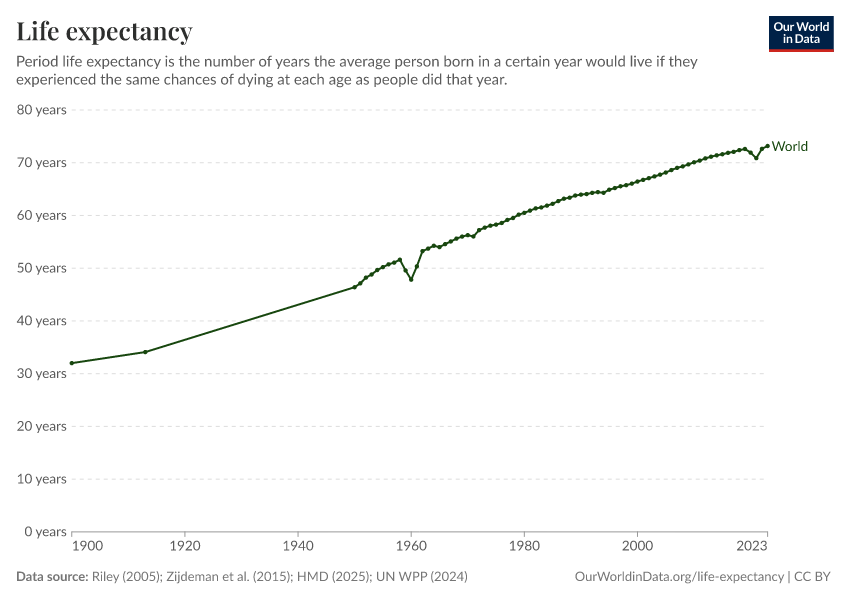
Global life expectancy has more than doubled during less than half of the capitalist era, rising from approximately 32 years in 1900 to 73 years in 2023. That measure summarizes mortality across all ages, including a dramatic decline in infant and child mortality.
Chart 3: Global life expectancy, 1900–2023
Science and public health are central to that achievement, which only a wealthy capitalist society can afford. Putting scientific knowledge to work also requires productive resources: factories that manufacture medicines, refrigeration that preserves food, equipment that treats water, and transportation that delivers supplies. Entrepreneurs and investors – motivated by profit – help turn scientific discoveries into goods and services people can obtain and use.
Greater productive capacity helps sustain longer, healthier lives. It gives people more opportunities to pursue careers, raise families, travel, learn, and enjoy the company of those they love. It gives them more time to live.
At Thanksgiving, those gains are intimately visible. We see them in the extra years we get to spend with our loved ones around the dinner table and in the wider choices our children and grandchildren will enjoy.
So, thank the growers, the drivers, the store employees, and the people preparing your meal. Thank the scientists and engineers whose discoveries and designs support your comfort.
And thank the capitalists: the entrepreneurs, financiers, and owners who committed their judgment, effort, and wealth to making that abundance possible.
They pursued their own ambitions and earned their rewards. We benefit every day from what they built.
This Thanksgiving, thank capitalists — and respect their right to keep what they created.
Made available by Capital Thoughts.