Affordability has been the top buzzword in American political campaigns this year, first deployed successfully by Muslim-socialist Zohran Mamdani to become New York City’s mayor. It’ll also likely influence the results of the upcoming mid-term elections. Astute observers and thoughtful voters should want to know what’s causing widespread unaffordability and how to fix it. Socialism isn’t known for making things affordable, if for no other reason that its price controls make so many things unavailable.
To be accurate, it’s really the unaffordability of so many things that’s bothering so many people these days. But it’s tragic when people attribute perpetually rising prices to price-setters (businesses). That’s the well-known myopic mistake of blaming the messenger for the message.
Things become less affordable due not to goods sellers but to the money issuer
What messages, in fact, do price setters send when they set higher prices? On a microeconomic level – considering only their own industry, company, or products – they’re simply saying that the quantity demanded is exceeding quantity supplied. If so, price must rise, at least near-term, until demand abates, supply revives, or both. That’s basic economics and nothing to get bothered (or angry) about. Yet angst is understandable if people observe nearly all prices rising perpetually. Why are supply and demand not adjusting to reduce prices, they might ask Perhaps markets are failing? Down with capitalism!
Those snap conclusions are as silly and unsubstantiated as the one we all heard a few years ago: “greedflation.” It was the fallacy that prices rise due to sellers’ selfish profit motive, as if such aims are morally vicious and economically variable, that they dissipate periodically when prices move laterally or downward. The fallacy also presumes that pricing is unaffected by the counteracting greed of buyers seeking to pay lower prices, to maximize their own utility.
Economists, politicians, and citizens alike can become easily deluded about the meaning (and morals) of market price dynamics if they’re myopic and stare mainly at things like gas pumps and grocery bills. Their vision can become impaired still more if they are told, as is common today, that inflation is “rising prices.” That makes them believe that they need only consult a handful of the latest, fastest-rising prices to get their “explanation” of current inflation. In fact, such reports on prices explain nothing. At most, they’re a description if things in need of explanation, which could be microeconomic, macroeconomic, or both.
Most good economists classify price changes at the microeconomic level as relative price changes and recognize that these changes can’t possibly translate into a broad, economy-wide, macroeconomic change in what they call “the price level” without changes in the value of the money which denominates all things exchanged. If, for whatever reason, the value of money – its purchasing power – decreases, it’ll take more money units to buy things. That should surprise no one. Consequently, lots of prices, economy-wide, will rise – i.e., inflation – and sellers will be perfectly justified in setting them higher, if only to be justly compensated for the less-valuable money which, by fiat, they must accept. Things become less affordable due not to goods sellers but to the money issuer.
Rarer than the norm of inflation, if the purchasing power of money increases, it takes fewer money units to buy things – i.e., deflation – a condition many economists fear but buyers should welcome, as it means things are more affordable. The cost of living goes down. When many prices decline macroeconomically, across the board, due not to relative shifts in the supply and demand of goods but in the supply and demand of money, sellers are perfectly happy to receive less of the more valuable money, and their profits also can be preserved as long as their costs (a synonym for prices) also decline (as happens amid deflation).
Affordability isn’t only a matter of the price of things, the cost of living, but that cost in relation to incomes earned. In a free economy, one’s income, at every level, reflects not some arbitrary phenomenon or employers’ “exploitation,” but productive prowess, the value an individual adds to the goods and services made and sold at a profitable price. Income inequality naturally reflects inequalities in individuals’ productive prowess and capacity to add value. Now ask, is some mansion affordable? It’ll depend on a would-be buyer’s income. The mansion’s price is the same to all but affordable, say, to a businesswoman but not a bus driver.
In assessing affordability we must consult not only the real purchasing power of money but the real value of incomes, or nominal incomes divided by the price level. Figure One provides a valuable, long-term perspective on affordability in America. Clearly, real wages have stagnated since 1971 – a compounded growth rate of merely 0.2 percent per annum, compared to 2.9 percent per annum from World War I to 1971. Note: it takes only 24 years for real wages to double at that faster rate, but 35 years to double at the slower rate. Real wage growth affects how people experience their standard of living, whether rising, stagnating, or declining. They don’t just feel that standard but pay the price of it, for good (more affordable) or ill (less affordable).
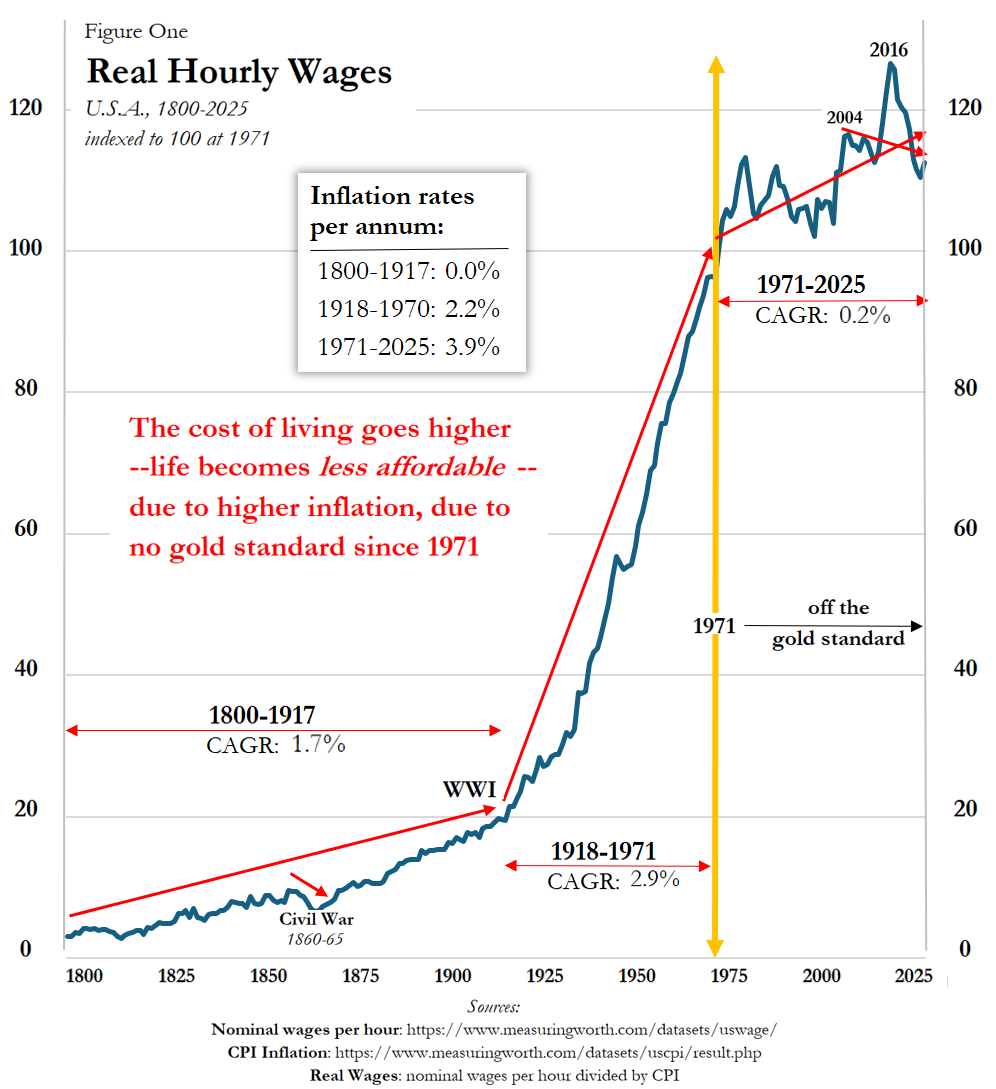
It’s no coincidence that after 1971, average real wages in America stopped rising as fast as they’d been rising previously, for that was the fateful year the US went off the gold standard and launched a multi-decade expansion of federal deficit spending and money-creation – as I recounted in a 2021 essay, “A Tragic Half Century Without Gold Money.”[1] Notice in Figure One that whereas inflation over the long run was nothing from 1800 to 1917, and only 2.2 percent per year thereafter up until 1971, it’s been 3.9 percent per year since then. The U.S money supply (M1) increased by only 4.8 percent per year from 1918 to 1971, barely faster than real GDP growth of 3.6 percent per year, but since 1971, money no longer being tied to gold, its supply has increased 8.5 percent per year, well in excess of the 2.8 percent annual rise in real GDP. In short, since the end of the gold standard in 1971, America has had faster money growth and slower economic growth versus what it enjoyed previously. I documented this in a 2019 essay, illustrating how “The Production of Money Isn’t (Necessarily) the Production of Wealth.”[2]
Some economists contend that U.S. real wages have stagnated since 1971 not mainly because inflation has eroded nominal wages but because nominal wages themselves have stagnated due to a shift in bargaining power from labor to capital. Typically, they cite the decline in the share of the American labor force that’s unionized. But high union membership in the private sector decades ago was boosted by law: the National Labor Relations Act of 1938. “Bargaining power” from one side of the table was enhanced by political power. The 1938 law was offset somewhat, later, by the Taft-Hartley Act of 1947. In consequence, the union share of the private sector labor force peaked in the early 1950s and began a multi-year decline – long before 1971. At the same time, the union share of employment in the public sector has increased. Wages from both sectors, of course, are included in national sums. Is less unionization a main cause of the stagnation in U.S. real wages observable since 1971? Economists have shown that to the extent unions elevate wages for members, they depress them for non-member laborers. This again is a microeconomic metric, specific to a subsector, invoked improperly to try to explain macroeconomic data.
If nominal wages in America had stagnated since 1971 after rising previously, one might sympathize with the thesis about less labor union power depressing nominal wages. But the problem of affordability since 1971 hasn’t come from the private sector, the microeconomic realm – regarding production, nominal wages, prices charged, business profits – but from the public sector, at the macro-monetary level. Nominal wages increased 4.8 percent per year from 1918 to 1971, then 4.1 percent thereafter – not a big difference. Folks have been paid well. The sense of diminishing affordability felt in more recent decades versus previously reflects not cheaper pay packages but cheaper money, with average inflation of 3.9 percent per year since 1971 versus only 2.2. percent per year in the prior decades following 1918. The cause of inflation-based unaffordability in any nation is debasement of its money by the authorities – a statist, not a capitalist phenomenon. Central banking is central planning in the field of money and banking.[3] The Federal Reserve has a monopoly on issuing base money. A government monopoly is not a market phenomenon.
The Cruelest Tax
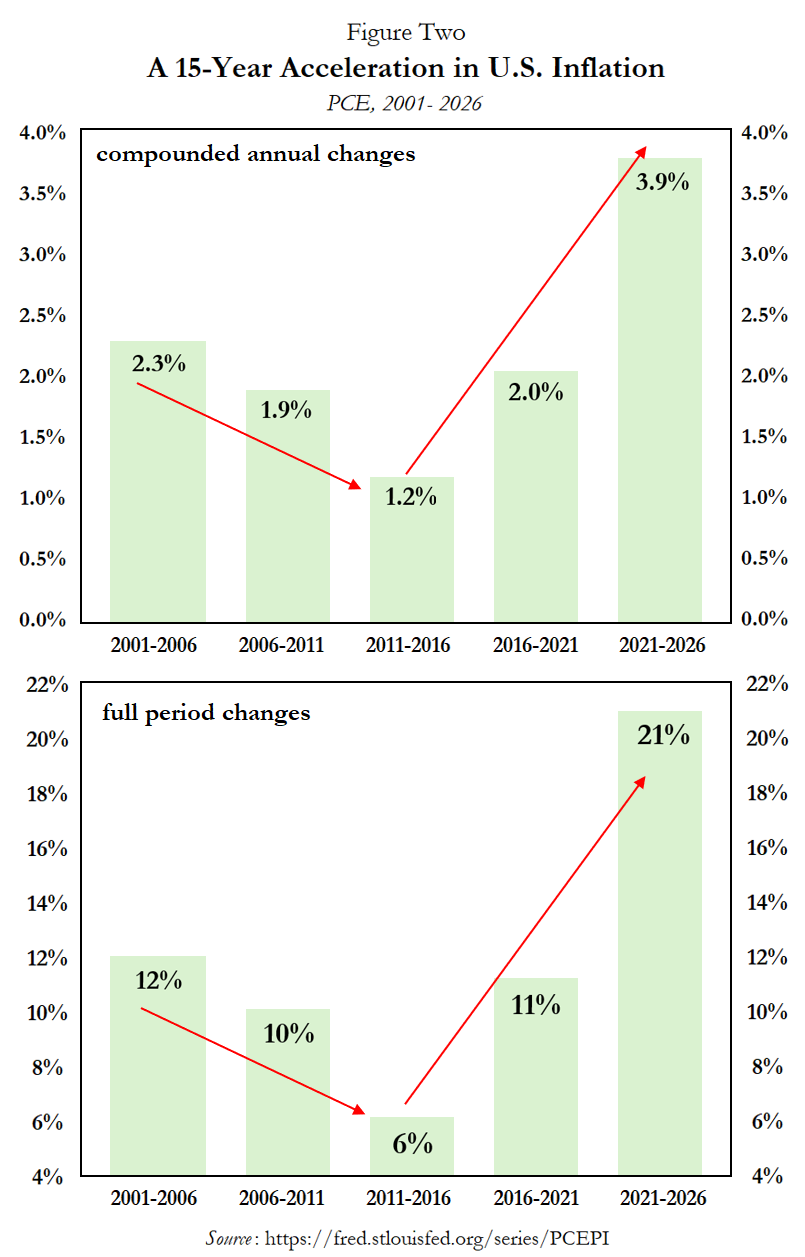
Inflation is sometimes (and rightly) called “the cruelest tax,” since it sidesteps legislative (legalized) funding and surreptitiously takes part of a nation’s cash holdings, making virtually everything less affordable, as do other overt anti-capitalist policies (regulation, confiscatory taxation). All of it impedes firms from paying higher wages. As for recent angst, Figure Two illustrates how inflation has worsened over the past fifteen years, accelerating from an annualized rate of 1.2 percent in 2011-16 to 2.0 percent in 2016-21 and 3.9 percent in 2012-26. These rates may seem trifling, but their cumulative effect has been daunting: a full, five-year rise of 21 percent since 2021, up from 11 percent over the prior five years and 6 percent for the five years before that.
Even if the current U.S. inflation rate (3-4 percent) were to be curbed or stopped overnight – which it won’t – Americans still must pay the stubbornly elevated level of prices caused by past inflation. Even if the inflation rate slowed or hit zero, it’s still not deflation, the decline in prices that would make things more affordable. Amid high inflation rates, people also can’t just hope that gains in their nominal wages will keep up with price gains. A normal economy can’t possibly produce or pay wages at rates sufficient to surpass the rates at which a profligate Congress can spend money, the Treasury can borrow it, or the Fed can print it.
Some argue against a monetary explanation for declining real wages by invoking a “cost-push” thesis. But costs are prices. “Cost-push” inflation is akin to “price-push perpetual-macro-level price increases.” That’s a non-causal, circular argument that says prices raise prices. In fact, less-valued money raises the price level. Even if, of all possible costs, higher labor costs alone or mainly could raise the price level, say by rising 10% as inflation rises by 5% (since other costs could easily rise less or decline), that would entail rising real wage rates – not what data show.
Luxuries into necessities
There’s a broader economic principle behind the phenomenon of increasing affordability: capitalism not only creates new, never-before-seen goods but transforms them from luxuries into necessities. What’s initially a high-cost, high-price, scarce prototype of a product that only the rich can afford, in time becomes a lower-priced good that nearly everyone can afford. Here’s how economist Ludwig von Mises explained the process 1956:
There was in the past a considerable time lag between the emergence of something unheard of before and its becoming an article of everybody’s use. It sometimes took many centuries until an innovation was generally accepted, at least within the orbit of Western civilization. Think of the slow popularization of the use of forks, of soap, of handkerchiefs, and of a great variety of other things. From its beginnings capitalism displayed the tendency to shorten this time lag and finally to eliminate it almost entirely. This is not a merely accidental feature of capitalistic production; it is inherent in its very nature. Capitalism is essentially mass production for the satisfaction of the wants of the masses. Its characteristic mark is big scale production by big business. For big business there cannot be any question of producing limited quantities for the sole satisfaction of a small elite. The bigger big business becomes, the more and the quicker it makes accessible to the whole people the new achievements of technology. What was once a luxury becomes in time a necessity.
The evolution of the motor car from a plaything of wealthy idlers into a universally used means of transportation still required more than twenty years. But nylon stockings became, in this country, an article of every woman’s wear within hardly more than two or three years. There was practically no period in which the enjoyment of such innovations as television or the products of the frozen food industry was restricted to a small minority. The disciples of Marx are anxious to describe in their textbooks the “unspeakable horrors of capitalism” which, as their master has prognosticated, results “with the inexorability of a law of nature” in the progressing impoverishment of the “masses.” Their prejudices prevent them from noticing the fact that capitalism tends, by the instrumentality of big-scale production, to wipe out the striking contrast between the mode of life of a fortunate elite and that of the rest of a nation.[4]
Illustrating this principle – luxuries becoming necessities – Figure Three shows trends in product adoption rates for twenty-two products over the past century or so in America. Observe not only capitalism’s amazing, multi-decade capacity to introduce new products, but to do so initially as expensive luxuries, then, over time, as necessities that more and more folks can afford. Notice how many of these products have gone from 0% to near 100% adoption in only a few decades, some faster than others. That partly reflects rising incomes but it mainly reflects declining prices, which are made possible by lower unit costs, and in turn made possible by mass production (aka, “economies of scale”) by big businesses. How odd it is, then, that most Americans say that they lack confidence in big business but admire and trust small business,[5] for it’s the former not the latter that delivers a cornucopia of affordable goods. Americans have become bigoted against bigness, having accepted the socialist lie that capitalism entails monopolies that underpay employees and price-gouge customers. If that were true we wouldn’t see ever-rising product adoption rates.
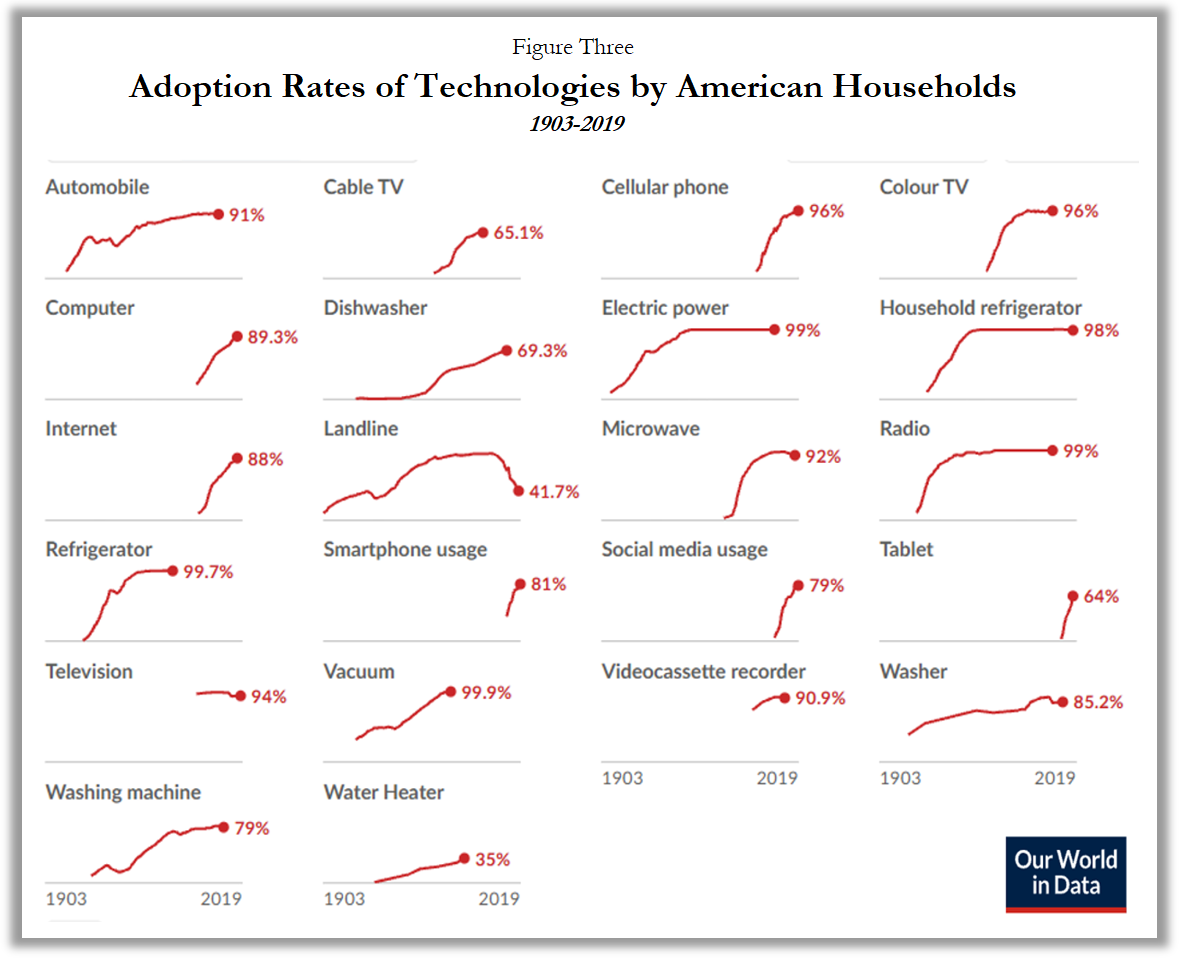
Socialists say they especially despise the biggest businesses under capitalism, claiming that they “exploit” laborers and price-gouge customers, that they make things unaffordable, even though it’s precisely these large firms that exhibit the largest sales and market shares. Every year that they grow, they demonstrate, in an open marketplace, that millions of satisfied customers find their offerings affordable. Socialism instead entails below-market fake pricing that makes things unavailable, hence its notoriety for ubiquitous, near-empty shelves of inferior goods. Socialists try to defy reality and pledge that everything will be “free,” but can’t ensure that anything will be freely available. There’s nothing more unaffordable than that which is unavailable.
The fact that capitalism, entrepreneurial creativity, and the profit motive make lots of things, a variety of things, and things that are more affordable, thus available on a mass scale, also explains why, uniquely in history, the system has engendered what never before had been seen: a vast middle class. Derided by socialists as “bourgeois,” the middle class has always been absent from pure socialist regimes. It’s the minority very rich and powerful dictator class and everyone else at the bottom, unfree and poor. Not much in between. The American middle class was made possible by what we’ve discussed above: capitalism’s “economies of scale” (large enterprises), which reduce per-unit costs and permit robust profitability even at lower, more affordable (for customers) selling prices. Socialism can’t possibly match this, even though it entails a state monopoly that owns and controls the means of production. Some economists measure the American middle class as shrinking in recent decades. According to the Pew Research Center, using government income data, “in 1971, 61% of Americans lived in middle-class households” but “by 2023, the share had fallen to 51%.”[6] Again, we see the importance of 1971 – the year the dollar was no longer as good as gold. To the extent the middle class has been shrinking it’s due not only to so many things becoming less affordable but to America moving away from capitalism. In 2007 the U.S. was less economically free than only three other nations, but today it’s less free than twenty-five other nations.[7]
It’s also a well-established pattern over the past half century in America that prices have risen faster in those sectors that have received trillions of dollars in federal subsidies – food, housing, childcare, health care, and college. Socialists offer two possible remedies: 1) still more subsidies and 2) price controls. The first is a major cause of the existing problem of unaffordability and would make it worse. The second would cause shortages, per elementary economics, making the unaffordable unavailable.
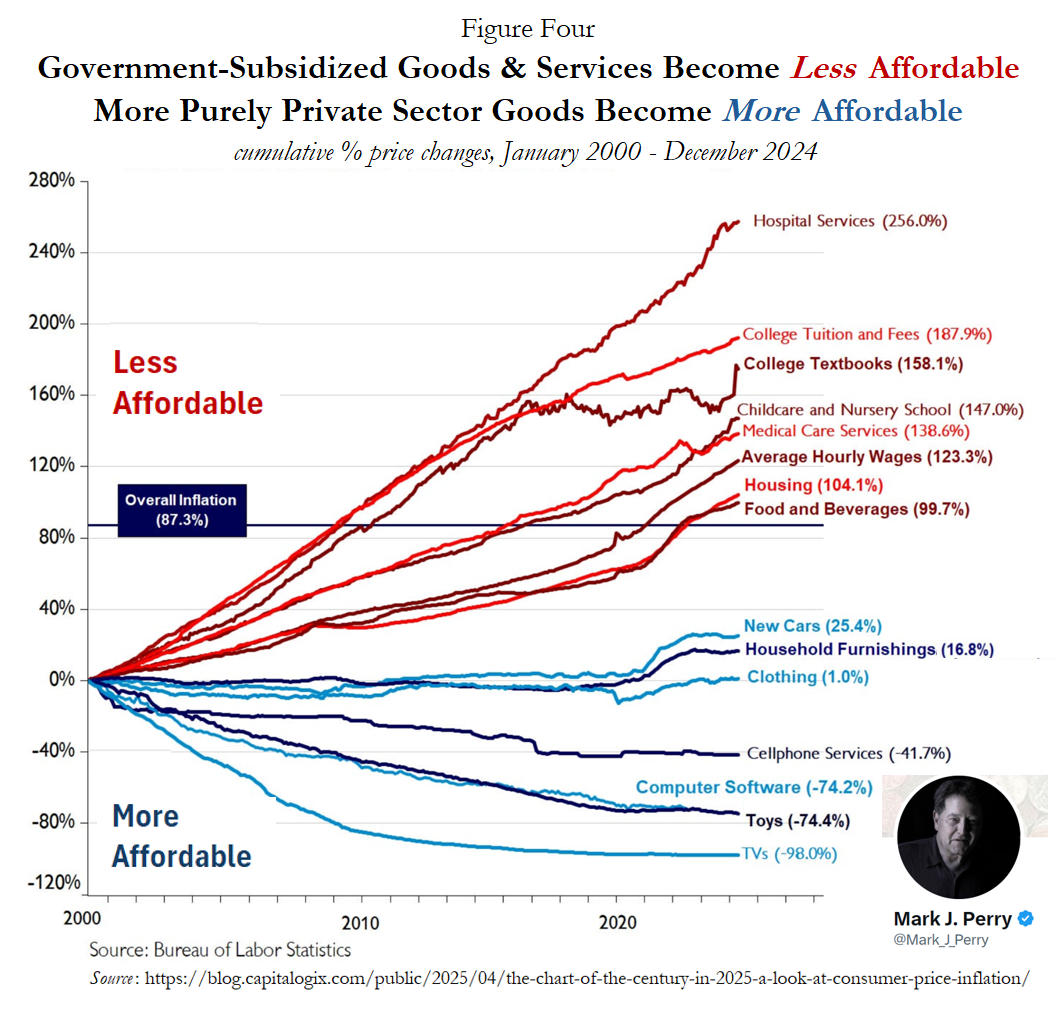
Socialist candidates in American politics today are certainly more vocal than rivals about affordability and more insistent that the problem is microeconomic. But socialist policies won’t cure the problem – and not only because they ignore the macro-monetary perspective. The size and scope of government is already so large as to necessitate the magnitude of deficit-spending and debt monetization that boosts the cost of living. Socialists want a government still larger in size and scope.
Less-discussed, because taken for granted by non-socialists, is the fact that socialists also fully condone state ownership (monopoly) and control of money, its latest iteration being Modern Monetary Theory. They want this unchecked capacity to print their way to permanent power. Socialists know they can’t finance their big government through their preferred system of ever-higher tax rates on the rich, given Hauser’s Law, the empirical corollary to the Laffer Curve which shows that U.S. federal revenues for decades have oscillated narrowly at roughly 20 percent of national income regardless of the height of tax rates. In short, taxable capacity in America is finite. Policymakers can boost statutory tax rates, but not the effective tax rate. Socialists know this, so money printing will be their main means. When prices rise rapidly they’ll blame price setters, impose price controls, cause shortages, and enact politicized rationing. If you want to be fed, clothed, and housed under their system you’ll have to become a good and loyal member of the socialist party. That’s the history. That’s how it works. See if you can afford to live with that.
Given the demise of socialism late last century, it’s utterly pathetic to see it ascendant in America these days, in an increasingly less-affordable nation, because the trend of higher living costs reflects socialist elements already embedded in our mixed system. The remedy for unaffordability, whether viewed at the micro or macro level, isn’t more socialism but more capitalism in the mix.
[1] Richard M. Salsman, “A Tragic Half Century Without Gold Money,” American Institute for Economic Research, August 15, 2021.
[2] Richard M. Salsman, “The Production of Money Isn’t (Necessarily) the Production of Wealth,” American Institute for Economic Research, March 18, 2019.
[3] Richard M. Salsman, Breaking the Banks: Central Banking Problems and Free Banking Solutions (American Institute for Economic Research, 1990).
[4] Ludwig von Mises, “Luxuries Into Necessities,” Foundation for Economic Education, August 1, 1956.
[5] Lydia Saad, “Confidence in U.S. Institutions Remains Near All-Time Low,” Gallup, July 26, 2026. Only 32% of Republicans express confidence in Big Business compared to 79% being confidence in Small Business. The numbers for Independents are 16%/62% and for Democrats, only 8%/65%.
[6] Rakesh Kochhar, “The Sate of the American Middle Class,” Pew Research Center, May 31, 2024.
[7] Richard M. Salsman, “The Multiyear Decline in U.S. Economic Freedom,” American Institute for Economic Research, September 25, 2023. The Heritage Index of Economic Freedom assigned the U.S. a score of 82 (out of 100) in 2007, 75 in 2016-17, and 71 in 2023. For 2026 the score is slightly better at 73.
A version of this article appeared in AIER.org, October 22, 2026. Reposted here by permission of the author.