Regular readers know I have been warning about financial repression for years – not as a possibility, but as an arithmetic certainty. The federal government carries more than forty trillion dollars of debt, on top of a mountain of unfunded future obligations, and those obligations keep rocketing higher. Every sensible person now understands that these debts cannot be paid in money with a stable value.
A few days ago, the President of the United States confirmed the government’s answer to this dilemma. He said it out loud, in public, and on the record: inflation. If you had any doubt that financial repression is coming, this should settle it. The media barely noticed, so here are the details.
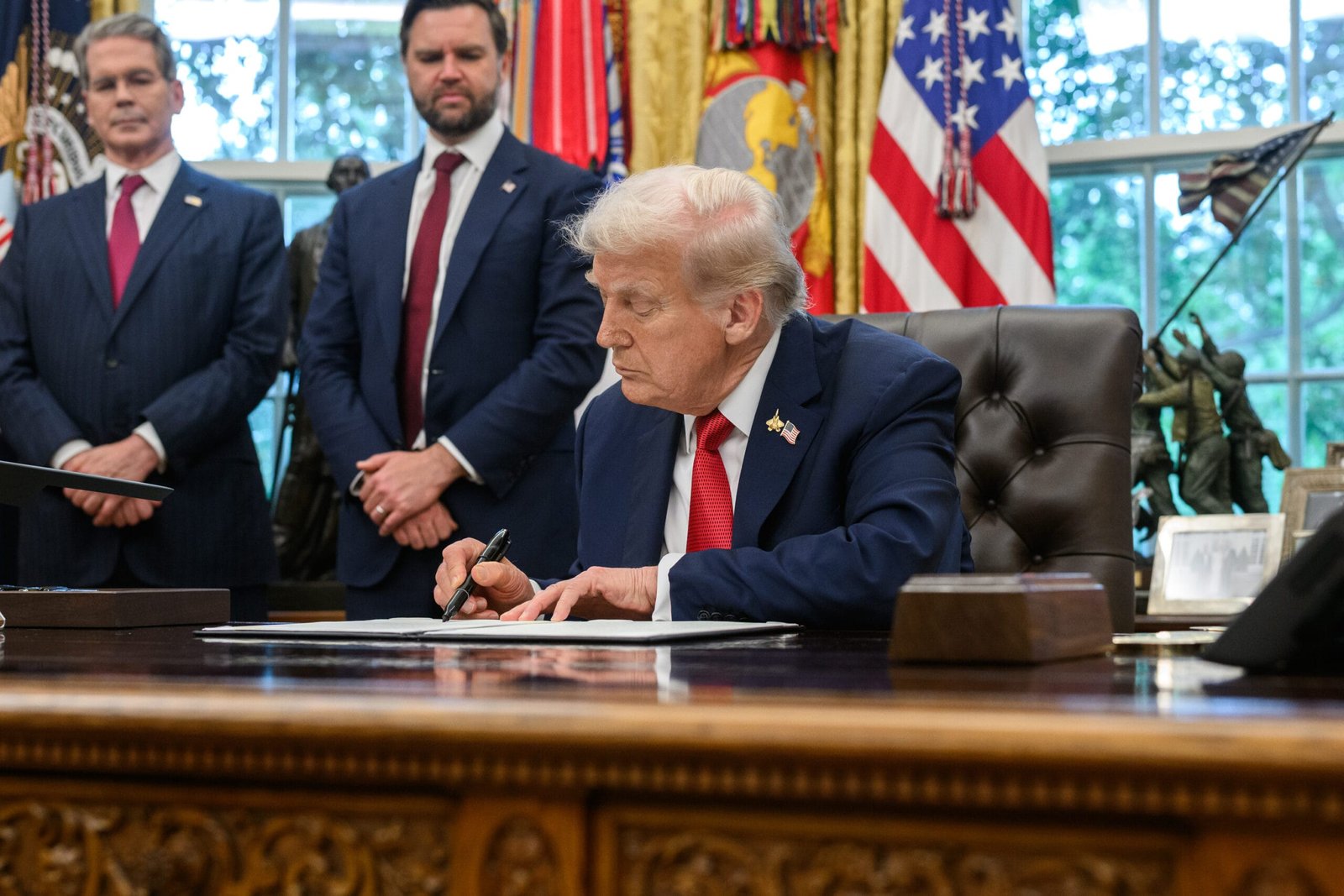
On September 28, Donald Trump sat for an interview with Time. It was published on October 1 and flagged by the Wall Street Journal‘s Nick Timiraos. Asked about the national debt and the growing annual deficit, the President said this:
“Certain levels of inflation will also pay off that debt very rapidly. Very rapidly.”
In the same interview, he said the Federal Reserve’s interest rate policy is hurting the country more than inflation is, and he blamed high rates for making the deficit harder to close. If the Fed keeps raising rates, he asked, how do you ever pay off the debt? Then he added:
“Now, you can do it through other means. I don’t wanna tell you what those means are, but you can pay the debt through other means.”
Read those lines again. The President of the United States has publicly acknowledged that inflation erodes government debt to the government’s advantage. Furthermore, he has “other means” to dissolve the debt.
The other half of the debt equation
What the President did not say, and what the reporter should have asked about, is the other half of the debt equation. Every debt is also somebody’s asset.
Every dollar of real value that inflation strips off the government’s obligations is a dollar stripped off the savings of whoever holds Treasury bonds, notes, and bills. That means pension funds, insurance companies, savings institutions, retirees. That means you.
This debasement of investment value is not a side effect of inflation. It is the mechanism. It is the actual purpose.
There is a strange wrinkle in this interview, and it deserves your attention. Debasement of money works best when nobody announces it. Saying it out loud, on the record, raises the inflation risk premium at every future Treasury auction. That, in turn, raises the very interest rates the President is complaining about.
The bond market is already listening. The ten-year Treasury yield has touched 5.3 percent, a twenty-year high. Lenders hear the inflation danger and are pricing bonds accordingly.
A second contradiction runs through the same interview. The President described inflation as a national catastrophe he inherited, and in the same breath as the tool that will pay off the debt. So which is it, Mr. President? Either it is a disaster or it is the plan. As is often the case, the President wants it both ways.
Fortune picked up the story on October 2. Eleanor Pringle’s piece ran under the headline “Trump just soft-launched higher inflation as the new solution for rebalancing the $40 trillion US national debt.” It opens by noting that dozens of economists had warned this was coming: higher inflation will be tolerated, “consciously or otherwise,” to shrink the real value of the debt.
Consciously or otherwise? Seriously? Does anyone believe that Trump, Treasury Secretary Bessent, and Fed Chairman Warsh are unaware that inflation reduces the real value of government debt?
This is an elementary fact of public finance. Governments have understood this since they first borrowed money. The suggestion that the Treasury Secretary and the Fed Chairman might stumble into debasement by accident insults the reader’s intelligence, and probably Bessent’s and Warsh’s as well. They know this. They have always known it. That is the point of financial repression.
How financial repression works: running the economy hot
If the concept is new to you, here is how it works. A government needs financial repression when it has taken on more debt than it can repay in hard dollars, meaning dollars with stable purchasing power.
In response, the government as a whole (the Treasury, the central bank, Congress, the White House) steers the economy to run hot. That means high nominal GDP growth. The trick is that most of that growth is not real output. It is mostly rising prices, with some real growth mixed in.
Expect the President and his advisors to claim credit for the real growth and blame the Biden administration for the inflation. Again, he wants it both ways – but that is politics, and it is entirely predictable. In reality, neither president deserves the blame or the credit. Today’s inflation comes from runaway spending and the monetization of the runaway debt that pays for it. Congress and the Fed own most of it.
The mechanics of inflation work in the government’s favor by increasing wages, consumer prices, and asset prices. That inflates nominal incomes and capital gains, which inflates the tax base, which inflates government revenue. Inflation is terrible for the population, but excellent for the government. It quietly raises taxes without anyone voting for a tax increase.
How the government keeps its interest bill from swallowing the budget
But inflation also creates a problem for the government. Its costs rise, especially interest payments, as lenders (Treasury bondholders) demand higher interest rates to compensate for inflation. As the debt grows, rising interest costs threaten to swallow the federal budget whole. If rates are not held down, the government ends up borrowing money to pay interest on money it has already borrowed and still falls behind.
Picture yourself in that position. Your credit card balance is so high that your income no longer covers the interest. So you borrow more to make the payments, which adds to the debt, which raises the interest, which forces you to borrow more. No bank would lend to you under those conditions. You would be in bankruptcy court within a year.
Of course, the government will not go to bankruptcy court. Nor will it cut nominal spending, because that means reducing the entitlements politicians have promised their voters. Our political class learned decades ago that entitlements cannot be touched, at least not honestly. And a deficit in any single year has never ended a politician’s career. So to keep funding these rising deficits, the government must keep its interest costs down. There are many ways to do it. Here are the main ones.
Method one: the Fed buys the debt
You have heard of this. It is called quantitative easing, or QE. The Treasury borrows by selling bonds to pension funds, foreign governments, and ordinary investors. Under QE, the Fed steps in and buys those bonds with money that did not exist a moment earlier. It simply instructs the seller’s bank to create a new deposit in the seller’s account.
Follow the consequences. The Treasury still owes interest on those bonds, and pays it dutifully. But the Fed now holds the bonds, so the interest goes to the Fed. By law, the Fed sends nearly all its profits back to the Treasury. The money leaves the Treasury’s pocket, travels across town, and lands back in the Treasury’s pocket. The government is, in effect, paying interest to itself.
Meanwhile, all that buying drives bond prices up. Bond prices and yields move in opposite directions, so the government’s borrowing costs fall across the board, including on all the new debt it still has to issue.
Add it up. The debt has been bought with money conjured out of thin air. The bonds sit off the market in the Fed’s vault. The interest flows back to where it came from. From the Treasury’s point of view, that portion of the debt has been erased.
Nothing comes free, of course. The new money is still out there chasing the same quantity of goods, and eventually it shows up as higher prices and a distorted economy. But that bill arrives later, which, politically, is the whole appeal.
Method two: the Treasury suppresses rates directly
The Treasury has its own tools. One is yield curve control, which has already begun. Another is shifting new borrowing into short-term T-bills, where rates are lower. The Treasury is doing that right now as well.
When things get bad enough, the Treasury will lean on banks, pension funds, and insurers to buy government paper at below-market rates. This is not speculation on my part. The policy of strong-arming domestic savers into buying sovereign debt has ample historical precedent.
Full-blown financial repression has not arrived yet. But take this as a principle: a determined government always finds a way to fund itself. First they ask, then they incentivize, then they require. It starts with a nudge. If they get desperate enough, it ends with a gun.
Here is what to expect. The Fed and the Treasury, with whatever help Congress and the President care to supply, will impose financial repression by degrees. Quietly, incrementally, never once calling it what it is. Yield caps dressed up as market operations. Negative real rates disguised by a manipulated CPI. Your purchasing power confiscated one basis point at a time, and you never cast a single vote for any of it.
Watch what they do, not what they say
Throughout all of this, officials will conduct themselves as though nothing unusual is happening. They will issue financial outlooks. They will parse the inflation rate to one decimal place. With grave composure, they will convene, deliberate, and scan the horizon for signs of trouble. At its regular briefings, the Fed will solemnly warn you about “systemic risk.”
But the Fed, the Treasury, Congress, and the President are the systemic risk. They are the arsonists standing in the driveway, pointing at the smoke and promising to lead the rescue. They lit the fire of inflation by creating too much money. Now they propose to put it out by printing more money to pay down their debt.
Don’t fall for a single word of it. Watch what they do, not what they say.
We stand at the edge of a momentous shift in the world’s monetary order. A financial revolution is a process, not an event. It unfolds quietly over months and years and only looks obvious in hindsight, by which point assets have already repriced. Unless you’re watching for this one, you probably won’t notice it until it’s over.
Hopefully, now you’re watching. A radical change in the monetary system demands an equally radical, non-traditional savings and investment plan. I lay one out in Chapter 8 of my book, A Black Hole in Economics, available in Kindle and paperback on Amazon. If you haven’t read it, pick up a copy today.