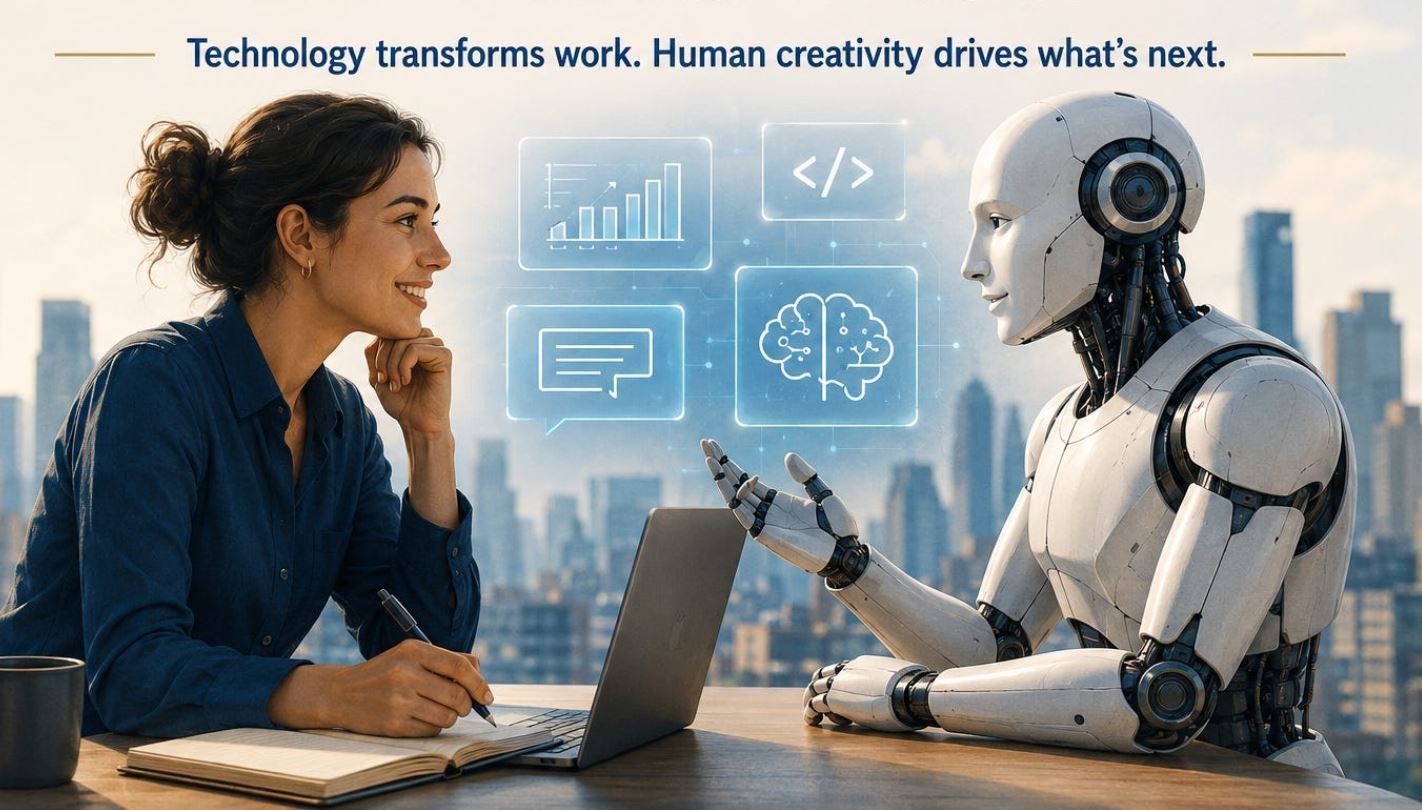
Every generation someone invents a machine that convinces people work itself is about to disappear.
Two centuries ago, it was the power loom. Today it is Artificial Intelligence (AI).
Between those two inventions came the steam engine, the railroad, electricity, the assembly line, the automobile, the personal computer, and the Internet. Each one made workers dramatically more productive. Each one displaced occupations that had existed for generations. And each one inspired confident predictions that this time the machine would permanently replace human work.
Today’s discussion of artificial intelligence sounds remarkably familiar. AI can write essays, draft legal documents, generate software code, create images, answer customer inquiries, analyze financial data, and even perform medical diagnoses. If machines can increasingly perform intellectual work rather than merely physical labor, many conclude that this technological revolution must be fundamentally different from every previous one. If machines can “think”, what will be left for people to do?
It is an important question. But before concluding that AI represents the end of work, let’s begin our analysis with a different question:
Why has every previous prediction of permanent technological unemployment been wrong?
The answer begins not in Silicon Valley but in the textile mills of nineteenth-century England, where the Industrial Revolution began.
Today, calling someone a “Luddite” is a way of saying that they irrationally oppose technological progress. But the Luddites were not ignorant peasants terrified by unfamiliar machinery. They were highly skilled craftsmen whose livelihoods depended on abilities they had spent years acquiring. For generations, handloom weaving had been a respected trade requiring considerable expertise. Skilled weavers enjoyed relatively high wages because producing quality cloth demanded tremendous experience, dexterity, and judgment.
Then, in the late 18th century, the power loom arrived.
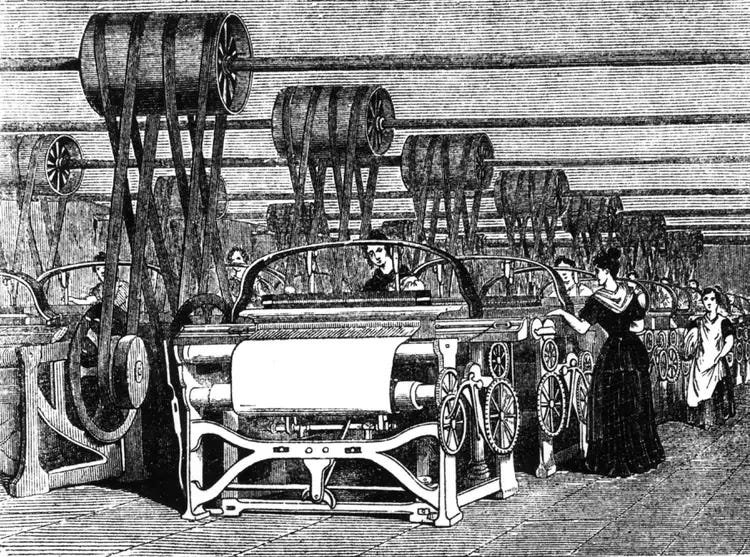
Like artificial intelligence today, the power loom did not merely make workers somewhat more productive. It dramatically changed which skills were economically valuable. Now, a machine operated by just one relatively inexperienced worker could produce cloth more quickly and cheaply than 20 experienced craftsmen working by hand. Factory owners no longer needed nearly as many highly skilled weavers.
The consequences for the handloom weaving profession were devastating. Jobs and wages declined sharply. Families that had relied on weaving for generations saw their incomes disappear. Some found factory employment at lower wages. Others abandoned the trade altogether and sought different work. Many plausibly concluded that the new machines were destroying honest work.
From their own, limited perspective, they were right.
The Luddites understood what the power loom was doing to their jobs. They correctly recognized that technological progress was imposing painful costs on them. The mistake that many observers in that era made was assuming that what was true for the handloom weavers would eventually become true for the economy as a whole: widespread unemployment would follow the mass roll-out of these new labor-saving technologies.
That assumption has resurfaced with nearly every major technological revolution since.
Artificial intelligence feels unprecedented to us because we are living through it, real-time. Every technological revolution feels unique to the people experiencing it. Yet when viewed over the past two and a half centuries, a remarkably consistent pattern emerges.
Since the Industrial Revolution and the rise of capitalism, the world has experienced roughly a dozen major technological revolutions. Some replaced physical labor. Others replaced routine mental work. All dramatically increased productivity. And nearly all of them provoked fears that human labor itself was becoming obsolete.
In every case, history shows us that those fears were unjustified.
Every major labor-saving innovation eliminated jobs that once appeared indispensable. But every one also created entirely new occupations that earlier generations could scarcely have imagined. Workers did not stop working. They shifted into different activities as entrepreneurs discovered new ways to employ labor made available by technological progress.
Two key lessons emerge from the history of technological innovation:
First, every technological revolution destroyed occupations that had once seemed permanent. A blacksmith in 1890 could scarcely imagine a world with few or no horses. A switchboard operator in 1950 might have struggled to envision direct-dial telephones. A typist in 1980 would have had difficulty imagining that nearly every office worker would eventually produce his own documents on a personal computer. Today’s fears about AI fall into this pattern.
Second, every technological revolution created new jobs that were invisible beforehand. No one in 1820 predicted airline pilots. No one in 1900 foresaw software engineers. No one in 1985 anticipated cybersecurity specialists, app developers, or social media managers. The future occupations did not yet exist because the opportunities they served had not yet been discovered.
These observations help explain why predictions of technological unemployment have repeatedly failed. The disappearing jobs are seen; they are obvious to everyone. But the future jobs are unknown and invisible.
The Luddites could easily identify the occupations that the power loom would destroy. They had no way of foreseeing the vast industrial economy that a mechanized textile industry would help create. Likewise, we can already identify many of the occupations that artificial intelligence threatens. At the same time, we cannot yet identify many of the occupations that AI will eventually create.
The above table demonstrates a powerful historical pattern: new productive technologies replace old jobs with new, more productive – and ultimately higher paying – jobs. But it does not explain why this pattern keeps repeating. Why do technologies that save enormous amounts of labor consistently fail to produce permanent unemployment? Why has every wave of labor-saving innovation eventually been followed by new forms of employment and a rising standard of living, rather than mass idleness?
To answer those questions, we must turn from history to economics. More than two hundred years ago, French economist Jean-Baptiste Say offered an insight that became known as Say’s Law.
Say argued that production is the source of demand. Economists often summarize this as “supply creates its own demand” or, simply, “supply is demand.” An equivalent modern way to express Say’s insight is:
Each of us creates our own purchasing power by producing goods and services we sell to others. At the same time, every good or service we consume must first be produced by someone else. Ultimately, we do not pay for goods with money, which is merely the medium of exchange. We pay for goods and services by producing goods and services of our own, and then trading with others for the goods and services we want.
For example, if I am a baker, my demand for a shirt is the 10 loaves of bread that I produce. I sell those loaves for money, which lets me buy the shirt. All of us work in order to produce goods and services that we trade for the things we want (via the medium of money).
This insight changes how we should think about any labor-saving technology.
Imagine that artificial intelligence enables 100 workers to produce twice as much output as they did before. The immediate reaction is almost always the same: if 100 workers can now do the work that previously required 200 workers, won’t the remaining 100 workers now become permanently unemployed?
The question sounds logical because it focuses entirely on production of the current product. It ignores what happens after production.
If businesses can produce more goods and services at lower cost, prices will fall. Consumers can now buy more with the same income. This means that after purchasing the products they already wanted, they still have money left over to spend on entirely different goods and services. At the same time, businesses earning higher profits (due to the greater efficiencies in production) can now invest in new factories, new technologies, new products, and entirely new enterprises. The increased production itself creates the purchasing power that finances additional demand throughout the economy. This is Say’s Law in action: new production => new demand.
In other words, the machine has not merely eliminated specific labor used in production; it has increased society’s real wealth. The quantity and quality of goods and services produced in the economy – Real Gross Domestic Product – has increased.
If the power loom allows society to produce twice as much cloth with the same labor and other resources, society has not become poorer because fewer weavers are needed. It has become richer because the labor and capital that formerly produced expensive cloth are now available to produce something else. The economy has gained additional productive capacity, which also triggers an expansion in the number of jobs, as new industries spring up.
The Industrial Revolution provides the great historical example, not because workers in less efficient industries got displaced, but because it marked the beginning of an unprecedented rise in living standards that is only accelerating today as technological advances, such as the Internet and AI, multiply.
Before the Industrial Revolution, and since the emergence of homo sapiens 300,000 years ago, human life was largely defined by backbreaking work for a subsistence, hand-to-mouth existence. For nearly everyone, except for the few rulers at the top, life was “nasty, brutish, and short.” (As an example, as recently as 1700, just prior to the Industrial Revolution, the average life expectancy was around 35 years. Today, among the industrialized countries, it is around 80 years.)
The technologies of the Industrial Revolution broke that pattern of extreme poverty and early death. Mechanized textile production, steam power, railroads, electricity, chemicals, mass production, automobiles, computers, and the Internet were not isolated disruptions. Taken together, they formed a long wave of productivity growth that dramatically increased output per person, as seen in the “Hockey Stick” chart below.
The increase in prosperity, measured by Real Per Capita GDP, which roughly equates to average income, is so recent and rapid that it is called the “Hockey Stick.” Its shape looks like a hockey stick turned on its side. The Hockey Stick of growth happened only in the past 250 years, with the advent of the Industrial Revolution, and it followed nearly a flat line of extreme poverty for the preceding 300,000 years, ever since humans emerged from the cave.
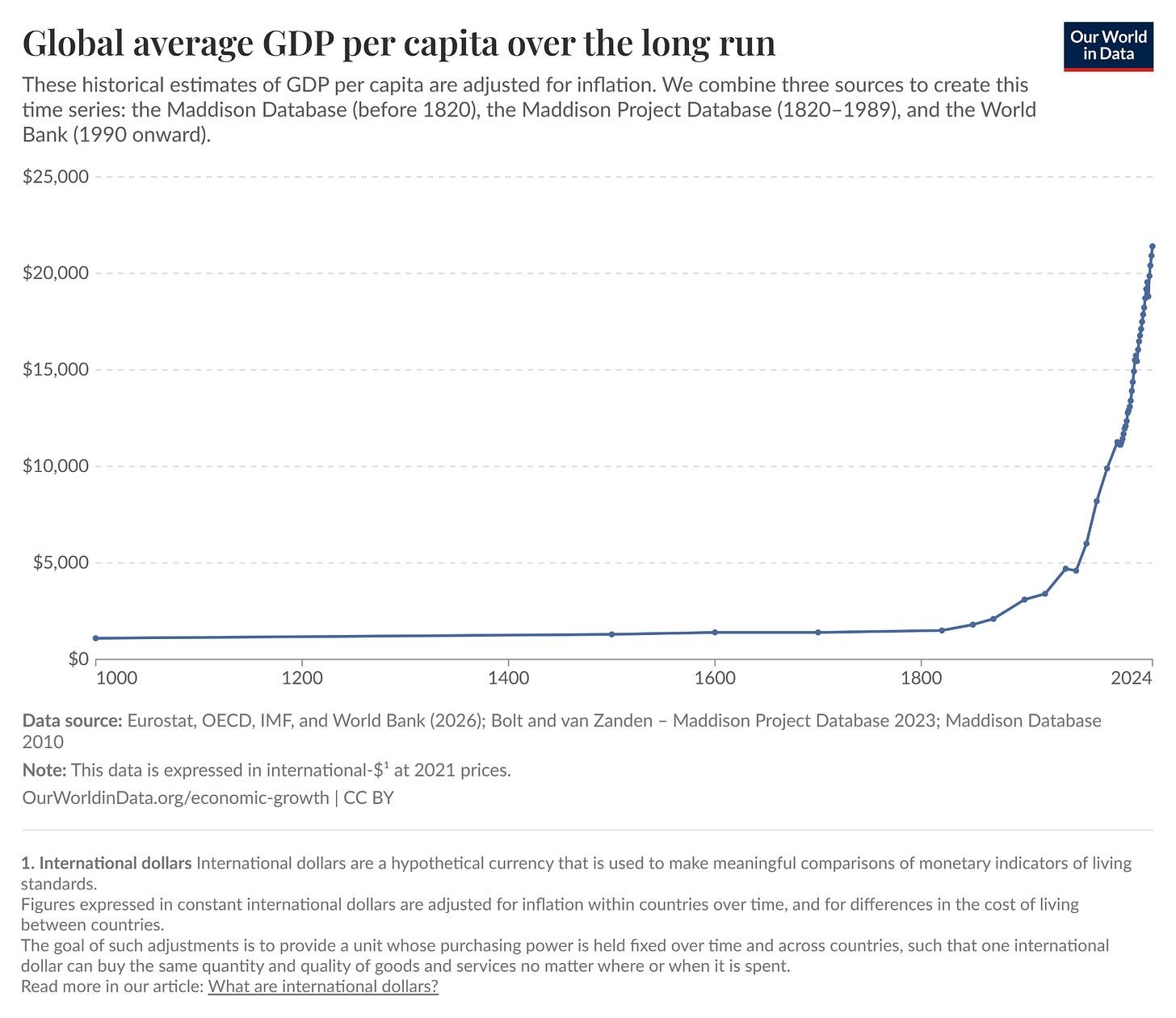
This chart shows what labor-saving technology actually did. It did not merely throw workers out of old occupations; it raised society’s capacity to produce. Cheaper cloth, cheaper transport, cheaper power, cheaper manufactured goods, cheaper communication, and cheaper computation translated over time into higher real incomes.
As Say’s Law explains, that higher productivity became demand for more goods and services: better housing, more varied food, education, books, travel, furnishings, entertainment, medical care, personal services, and eventually entire industries no eighteenth-century worker could have imagined. The rising standard of living from the Industrial Revolution to today was not separate from technological disruption. It was the long-run result of that disruption lowering costs, raising productivity, and expanding demand.
This process has repeated itself throughout the history of capitalism. Mechanized textile production made clothing dramatically less expensive. Families who no longer had to devote such a large share of their income to clothing spent the savings on furniture, books, better housing, education, entertainment, and thousands of other goods. The textile industry employed fewer handloom weavers, but the economy as a whole generated demand elsewhere because consumers had become wealthier in real terms.
The same process occurred with automobiles at the turn of the last century. Cars eliminated countless jobs connected with horses: blacksmiths, stable workers, carriage builders, wagon makers, and feed suppliers. Had we stopped the analysis there, we might have predicted an employment catastrophe. Instead, the automobile freed enormous amounts of labor and capital to build highways, hotels, suburban housing, shopping centers, truck transportation, automobile manufacturing, insurance companies, repair shops, restaurants, and countless businesses that depended upon inexpensive personal transportation. The jobs destroyed were obvious, but the new jobs became the embodiment of our modern, wealthy, industrial civilization.
The computer tells the same story. During the 1960s and 1970s, many economists predicted that office automation would permanently eliminate clerical employment. They were correct: filing clerks, typists, and switchboard operators largely did disappear. What they failed to fully anticipate was the explosion of entirely new occupations: software developers, systems analysts, network engineers, database administrators, cybersecurity specialists, web designers, digital marketers, and dozens of professions that simply did not exist before computers became widespread.
Artificial intelligence is likely to follow the same pattern. We can already identify many of the occupations whose routine tasks AI will increasingly perform. What we cannot yet identify are all of the new industries that will emerge because AI dramatically lowers the cost of creating knowledge, analyzing information, writing software, designing products, and solving problems. History shows us that those new industries will appear, even though it is very difficult to predict them today.
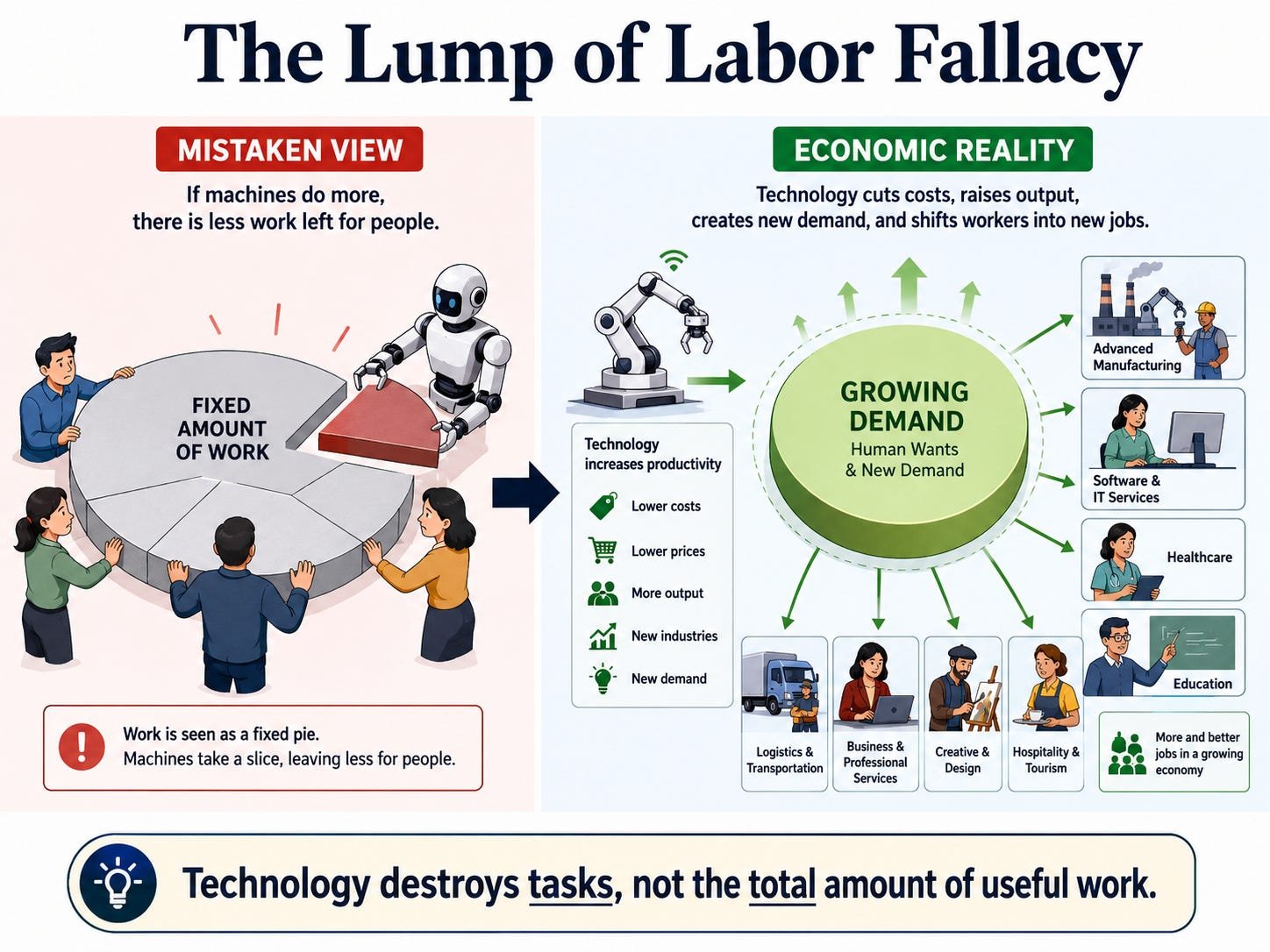
Applying Say’s Law, we can refute a very widespread economic misconception, the “Lump of Labor” fallacy. Every prediction of permanent technological unemployment rests upon an assumption that most of us make without even noticing it. It assumes there is a fixed amount of work to be done.
If that were true, every labor-saving invention would permanently reduce employment. Whenever a machine enabled one worker to accomplish what previously required two, one worker would necessarily become redundant forever. Every improvement in productivity would move society one step closer to universal unemployment.
But that is not how economies work because work is not the ultimate objective. The objective is satisfying human wants.
Human wants are remarkably elastic. Once basic needs are met, people begin demanding better housing, better healthcare, more education, safer automobiles, faster transportation, richer entertainment, cleaner environments, more leisure opportunities, personalized services, and products that previous generations could not even imagine, like the automobile, jet air travel, and the iPhone. Every increase in productivity makes it possible to satisfy wants that previously lay beyond our reach. The scope of human wants that entrepreneurs can satisfy is essentially unlimited.
Economists refer to the belief that there is a fixed quantity of work as the lump of labor fallacy. History provides overwhelming evidence against it. If there were truly a fixed amount of work, the unemployment rate should be more than 90%, given that the global population has expanded nearly 11-fold since the Industrial Revolution began. Instead, the unemployment rate in the U.S. is 4.2%, and across the industrialized world it stands at similar levels. After more than two hundred years of astonishing technological progress and expanding populations, machines should already have eliminated nearly all employment.
Instead, something quite different happened (see Appendix). Productivity, total employment, and real incomes all soared at the same time. Producers created and consumers demanded entirely new goods and services. Employment shifted from agriculture to manufacturing, from manufacturing to services, and from services increasingly toward knowledge work. Each technological revolution reduced the amount of labor needed in one sector while increasing opportunities in others.
As an example, in 1700 in the United States, nearly 90% of people worked subsistence farms to provide food. Today, after the Industrial Revolution and the mechanization of agriculture, that percentage is below 2%, supplying a far larger quantity of food. Where did all those other workers go? The answer is obvious. It is not just that the total number of jobs increased, but the new jobs involved making an abundance of new and better goods that people wanted.
The economy cannot run out of work because it can never run out of human wants.
This insight also explains why technology often eliminates drudgery work, simultaneously making work more meaningful. The development of AI is amplifying this trend.
Karl Marx had famously said that capitalism would result in alienation by creating dehumanizing work. Overwhelmingly, this has proven not to be the case as brute physical labor has been steadily replaced with mechanical labor, and then intellectual labor.
Mechanized textile production replaced endless hours of grueling, repetitive hand weaving. Household appliances eliminated countless hours of backbreaking domestic labor. Computers replaced filing, arithmetic, and repetitive, mindnumbing bookkeeping. And now, AI appears poised to automate many of the routine and often boring cognitive tasks that consume the workday of lawyers, accountants, software developers, and office workers.
Throughout history, technology has tended to move people up the value chain. It replaces the repetitive so that human effort can be devoted to judgment, creativity, problem solving, persuasion, empathy, and discovery. The specific tasks change, but the demand for productive human effort remains because human desires and aspirations continue expanding.
Say’s Law explains why this process does not collapse into permanent unemployment. Increased production creates greater purchasing power, and greater purchasing power finances new forms of demand. Yet one important question remains unanswered.
If entirely new industries eventually emerge, why are they so difficult to predict? Why did no one foresee software engineers in 1900 or app developers in 1980?
To answer that question, we must turn to another economic concept, one that emphasizes not equilibrium, but discovery.
Say’s Law explains why labor-saving technology does not reduce the economy’s purchasing power. As productivity rises, society becomes wealthier, and that additional wealth finances demand for new goods and services. But another question remains.
If technology continually creates new jobs, why can’t anyone predict what they will be?
The answer was discovered much later in the 20th century by economists working in the Austrian School tradition, particularly Friedrich Hayek and Joseph Schumpeter. They argued that markets are not simply mechanisms for allocating known resources among known alternatives. They are discovery processes. Entrepreneurs, guided by the price system, constantly search for opportunities that no one previously recognized.
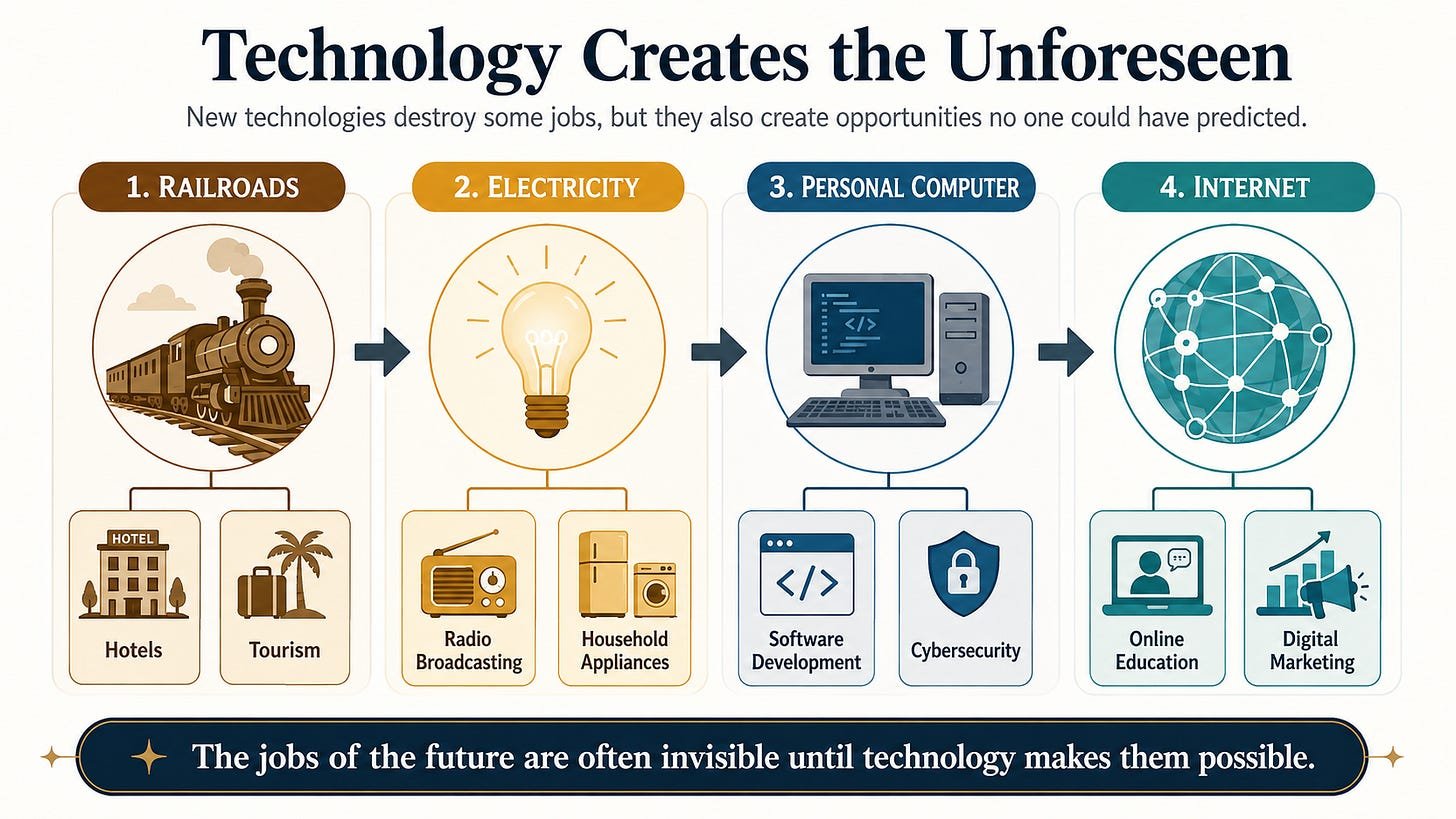
Imagine asking someone in 1820 what occupations would exist because of the railroad. They might have predicted more track workers or locomotive operators. They would almost certainly not have predicted national hotel chains, refrigerated food distribution, suburban commuting, mail-order retailing, or modern tourism, all of which railroads facilitated. Those industries were not merely waiting to be identified. They became possible only because entrepreneurs gradually discovered new profitable opportunities created by inexpensive transportation.
The same was true of electricity. Few people foresaw radio broadcasting, household appliances, or air conditioning. The personal computer gave rise to software developers, website designers, cybersecurity experts, cloud architects, and app developers—occupations that would have sounded like science fiction a century earlier. Likewise, the Internet created YouTubers, social media managers, online educators, digital marketers, ride-sharing platforms, and work outsourcing that depends entirely on global connectivity.
None of these occupations emerged because someone sat down and planned them. They emerged because millions of inventors, financiers, and entrepreneurs, motivated by profit and the love of creating something new, experimented with new ideas, discovered profitable opportunities, abandoned unsuccessful ones, and gradually created entirely new industries.
Artificial intelligence will almost certainly follow the same path.
Today, many commentators, especially in the tech sector, confidently and luridly describe the jobs that AI will eliminate. They can do so because those occupations already exist. Far fewer attempt to list the jobs AI will create, not because they will not emerge, but because they have yet to be discovered. The unforeseen new opportunities depend on technologies that are still evolving, consumer preferences that have not yet changed, complementary innovations that have not yet been invented, and entrepreneurial insights that are only beginning to be developed.
These are the combined insights of Hayek and Schumpeter. Hayek shows that the knowledge needed to predict the future is dispersed among millions of individuals and often does not yet exist. Schumpeter shows that it is discovered through entrepreneurial experimentation, motivated by profit and the love of creating something new. The future labor market cannot be reliably forecasted because it has not yet been discovered. Every prediction of permanent technological unemployment underestimates the creative capacity and drive of entrepreneurs, and the unlimited wants of consumers.
Finally, we come back to the objection that previous technologies primarily replaced physical labor, while artificial intelligence replaces intellectual labor. Doesn’t that make it different?
It certainly changes the kinds of jobs affected. But it does not change the underlying economics.
The power loom replaced one form of human skill. The personal computer replaced another. Artificial intelligence replaces yet another. The common feature is not whether the task is physical or intellectual. The common feature is that the new technology makes people more productive.
Suppose AI enables an architect to prepare conceptual designs in half the time. The immediate effect may be that fewer hours are required for each project. But lower costs also make architectural services affordable for clients who previously could not justify them. Some firms will design more buildings. Others will undertake renovations that had been too expensive. Still others will use the savings to purchase different professional services. The economy expands because lower costs change what consumers and businesses find worthwhile.
The same principle applies across countless occupations. Artificial intelligence may reduce the demand for routine legal research, software coding, graphic design, accounting, and administrative work. Yet by lowering the cost of these activities, AI will also encourage their use in applications that previously made little economic sense, and may even increase demand in the original professions because of lowered costs. Entirely new products, services, and business models will emerge because the economics have changed.
Both the history and economics of capitalism demonstrate that technological revolutions, like the AI revolution, expand the scope of human activity and raise society’s standard of living.
This does not imply that technological progress is painless.
Many workers in the less efficient industries may get displaced. The Luddites were not irrational because they feared losing their livelihoods. They feared exactly what happened. Many skilled weavers experienced declining wages and economic insecurity. Some never recovered.
Every major technological revolution has produced similar transitions, although the transitions today happen much faster than in the 1700s. Farmers displaced by mechanized agriculture did not instantly become factory workers. Factory workers displaced by automation did not automatically become computer programmers. Today’s workers whose occupations are transformed by artificial intelligence will likewise face difficult adjustments. Some will retrain. Others will change careers or move to where the new jobs are. Some may retire earlier than planned.
These are genuine human costs, but even these displaced workers benefit from the rising standard of living that a capitalist society filled with unrestrained technological advances provides. A worker at a buggy whip factory may have lost his job when Henry Ford began mass producing automobiles but, often very quickly, he began driving a new Ford on his way to his new job as a machinist. The answer for workers is not to demand stasis, passively decrying their lost jobs, but to actively seek work as the new opportunities open up. In the meantime, they benefit from the innovations occurring all around them.
Looking back over more than two centuries of technological progress launched by the Industrial Revolution, one conclusion stands out. Every generation believes its new technology is fundamentally different than all others.
- The handloom weaver believed the power loom was different.
- The blacksmith believed the automobile was different.
- The typist believed the personal computer was different.
- Today we believe artificial intelligence is different.
AI may ultimately prove more transformative than any previous technology. It may alter the organization of work more profoundly than the steam engine or the computer. It may eliminate occupations that today appear indispensable.
But before concluding that AI will permanently end work, we should ask a simple question.
Why has every previous prediction of technological unemployment been wrong?
The historical answer is remarkably consistent. Labor-saving technology destroys particular jobs, but it also lowers costs, raises real incomes, stimulates new investment, encourages entrepreneurial discovery, and creates opportunities that no one previously imagined. Machines eliminate tasks. They do not eliminate human wants. Ultimately, they expand the number of jobs and incomes.
As long as people continue desiring better health, better education, better entertainment, better transportation, better communication, better housing, and products that have not yet been invented, entrepreneurs will find it profitable to discover new ways to satisfy those wants – and workers will continue finding productive jobs making it happen.
Artificial intelligence will not become the first technology that permanently reduces humanity’s need for work. This time will not be different, even if AI radically revolutionizes work. The AI boom is just the latest chapter in mankind’s upward rise that began with the Industrial Revolution and the power loom more than two centuries ago.
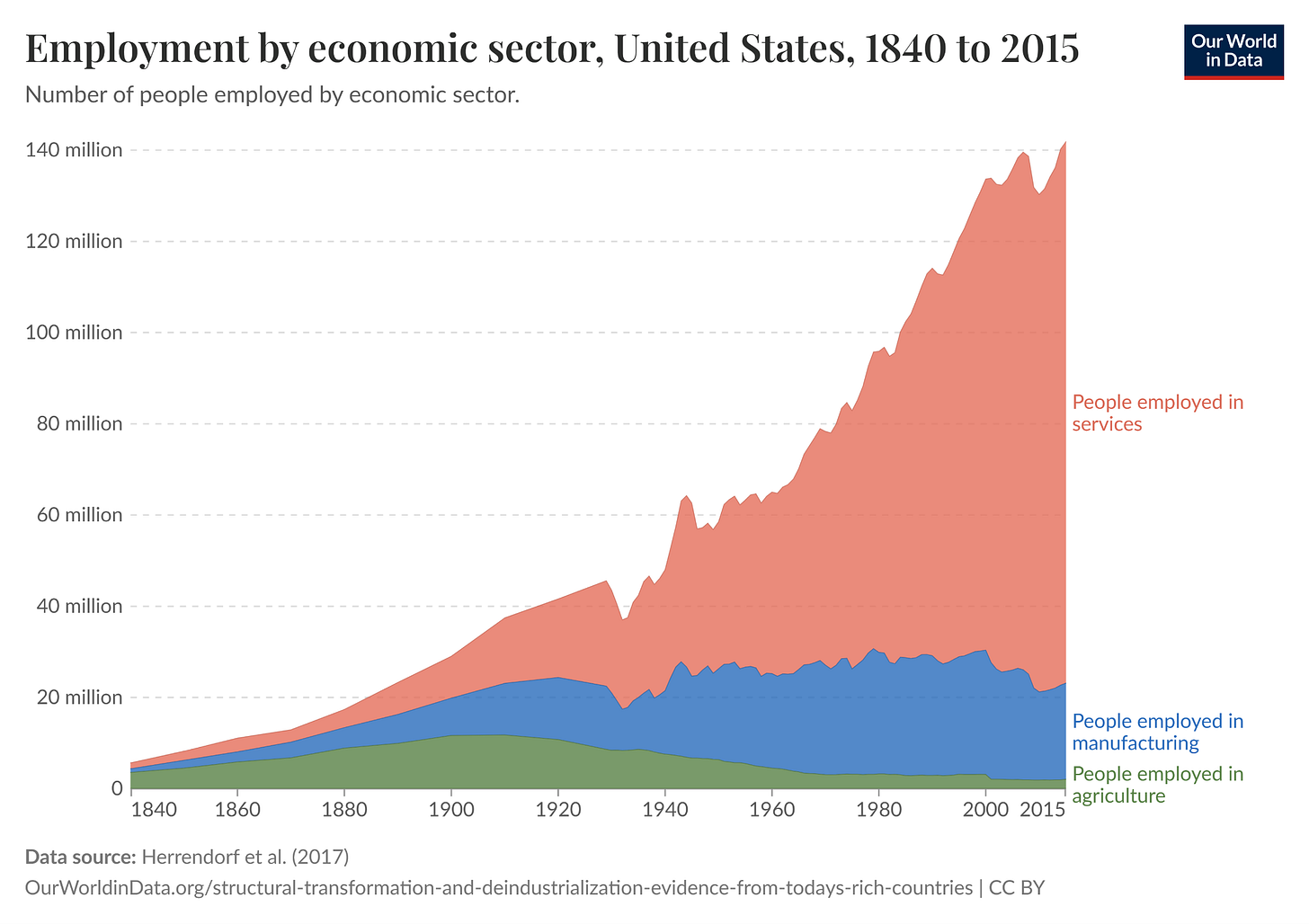
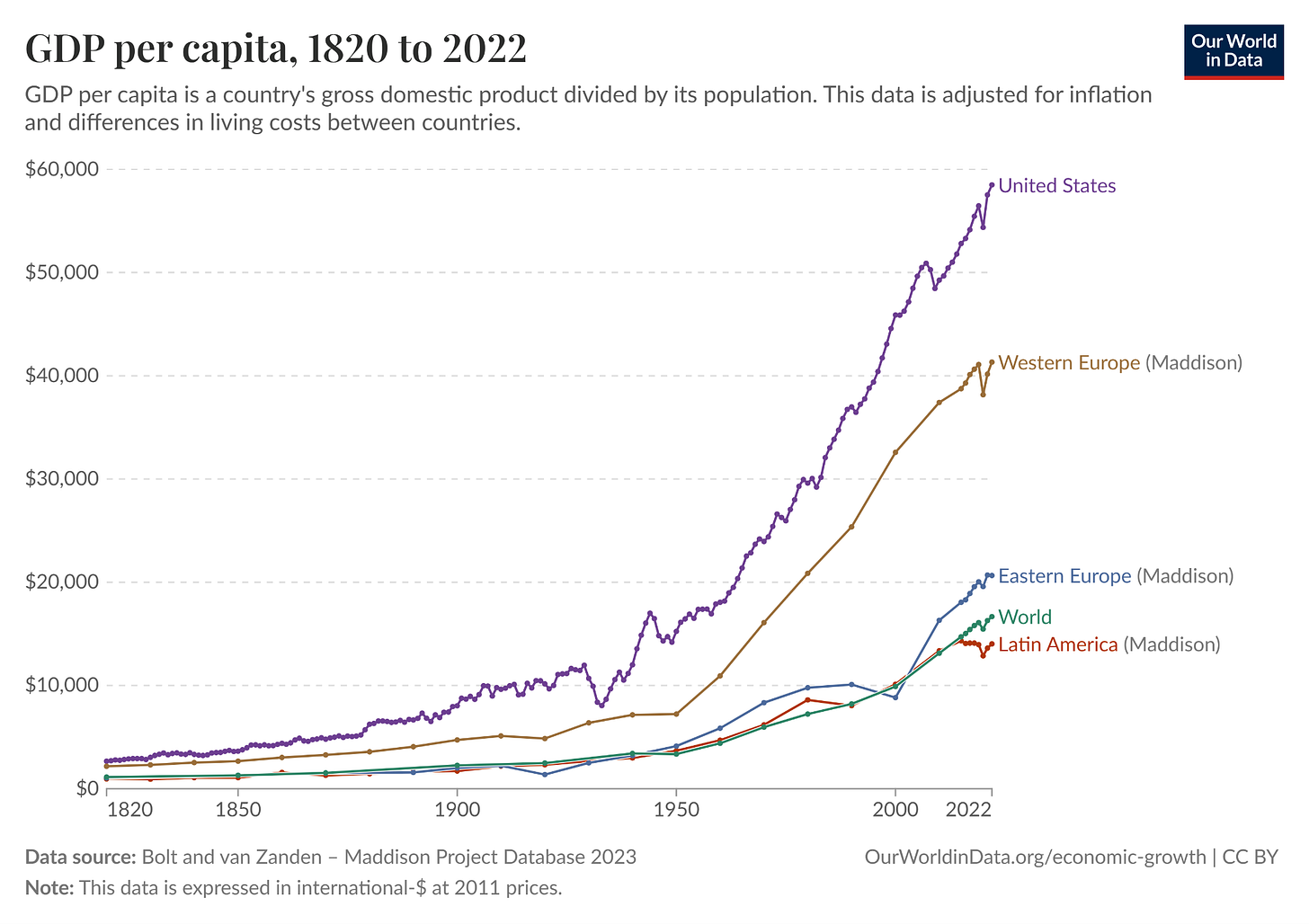
If new technologies, like AI, simply destroyed jobs, both the total number of jobs and average incomes should have trended downward since the Industrial Revolution. Instead, both move upward. Moreover, average incomes are moving upward at an even faster rate in the 20th and 21st centuries as the pace of technological advances quickens and spreads throughout the world.