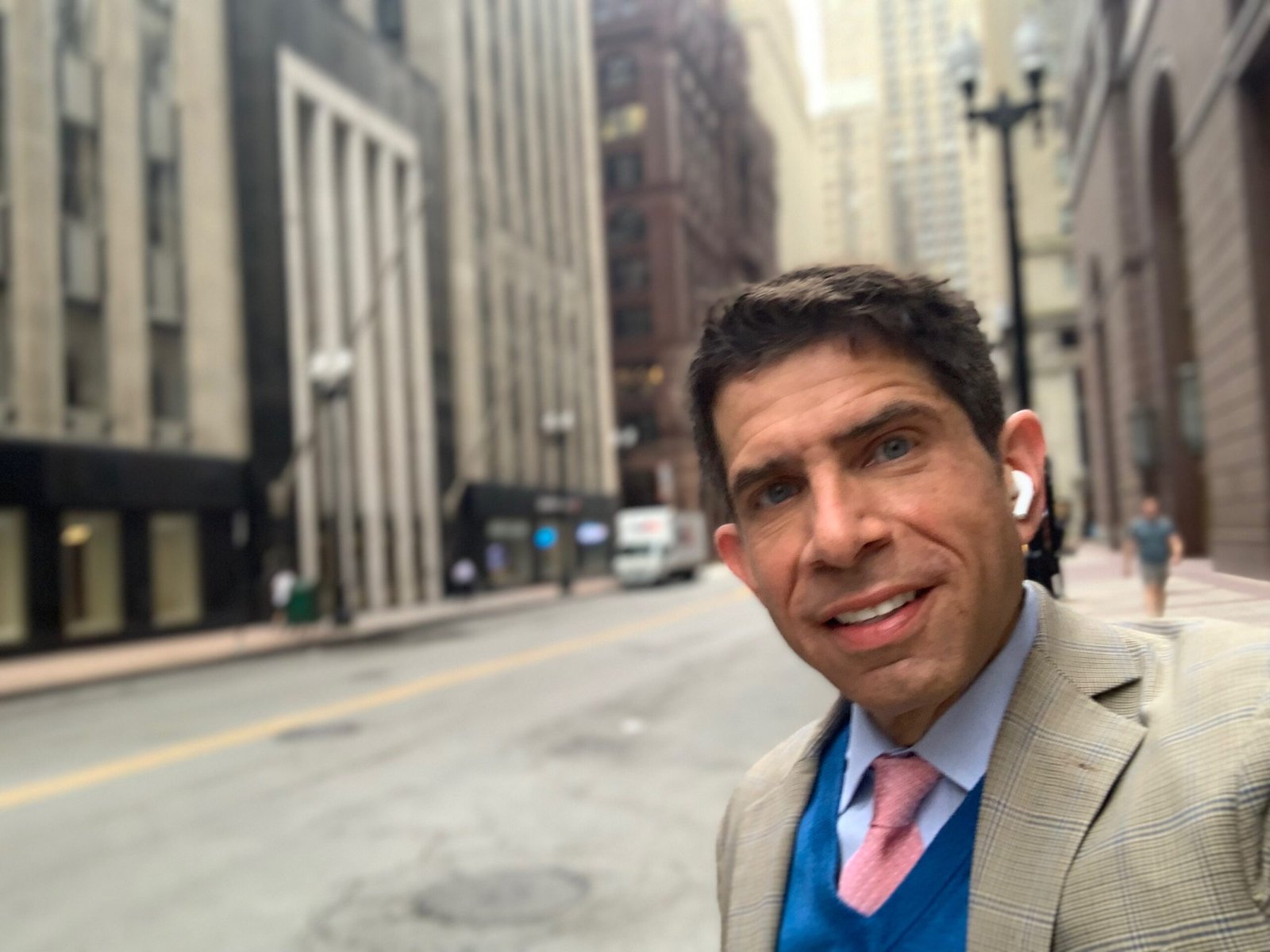
American author, investor and Fox Business contributor Jonathan Hoenig created Capitalist Pig Asset Management. The former trader at the Chicago Board of Trade and Fox News commentator predicates his support for laissez-faire capitalism on his philosophy, Objectivism. Hoenig briefly attended Northwestern University.
I first met Jonathan, with whom I’d been acquainted through mutual interest in Ayn Rand’s philosophy, in Chicago’s Greektown in 2015. We discussed media, Chicago and potential projects and he later contracted me for various editorial work. I attended his lecture on Chicago’s futures exchanges at an Objectivist Conference on Chicago’s Magnificent Mile.
We’ve since become friends. After my Classic Chicago Magazine interview last year with Atlas Shrugged admirer Terry Savage, I decided to ask Jonathan to discuss his ideas, career and passion for Chicago, the first city where Ayn Rand lived when she escaped to America. We conducted this recent interview by telephone.
Scott Holleran: What is the best part of living in Chicago?
Jonathan Hoenig: The architecture. Chicago’s is so distinctive—like a magnificent urban garden. Having lived in the city’s skyscrapers, you see these incredible historic artifices in different lighting in different weather; sometimes, they’re covered in fog, other times they’re in the blinding sun. They not only become part of life—they become like an old friend you’re delighted to see after a while. The Board of Trade, certainly the Inland Steel Building, the Rookery, Marina City [towers] really define the city. Walking tours are a great opportunity for tourists—even for jaded locals who have forgotten what an amazing resource is literally at their feet.
What I love about these Chicago buildings is that they’re working each day, even with work from home and occupancies that aren’t necessarily what they used to be, but each day these buildings come alive—full of people, mechanics, energy, computers and technology, companies with money and decisions being made. It’s still exciting in Chicago knowing these skyscrapers are by and large filled with powerful men and women leading big industrial businesses and corporations that have tentacles all over the world. So the fact that they’re productive too—not just aesthetically beautiful—these are places of power. That’s still fun to see.
Scott Holleran: What are the top sites to visit in Chicago?
Jonathan Hoenig: The lakefront trail is such a gift to the citizens and to the city—[Architect Daniel] Burnham’s plan of the lakefront remaining open and, though I can’t say that it would be my politics that would lead to those decisions, it did result in this incredible value people should take advantage of.
People should go visit the [financial] exchanges and watch the trading in action. Unfortunately, as you know, over the last decade now, they have basically been eliminated. All open trading—and certainly the visitors’ galleries that used to exist—[is gone]. The Board of Trade did recently open a museum in the base of the building. So, that’s a good excuse to get down to Jackson and LaSalle. They do a great job of kind of running people through the history of how it evolved, what it meant and how it went down. I’ve seen the exhibits. They’re absolutely worth checking out—this is something that you can’t see anymore, all the trading. It’s a great short, free trip down memory lane.

Scott Holleran: You started working as a trader—after you quit studying philosophy at Northwestern University—on the floor of the Chicago Board of Trade, which celebrates its anniversary this spring. You lectured for an Objectivist Conference in Chicago on the history of Chicago finance. What are your thoughts on Chicago’s history in American finance and are you bullish on Chicago’s future?
Jonathan Hoenig: Yeah. Chicago’s influence in finance, particularly in futures, options and derivatives, that’s where there’s been so much growth in markets in recent years. Chicago pioneered that. So much of what Chicago did East Coast [types] said couldn’t be done. The results of Chicago’s contributions to financial markets are better—much better—markets worldwide. Thanks to Chicago, people can protect themselves from all types of business risk, everything from the economy slowing to crops failing and weather events. Chicago’s always had that reputation—that reality of being a pioneer in helping people manage risk. Hedging and trading futures is commonplace now. Chicago led the way at a time few thought it would catch on. So, yeah, I am bullish on Chicago.
What makes a place successful isn’t [intrinsic]; it’s not that water is different in Pyongyang [Communist Korea]. It’s the same. It is politics, policies—this is not partisan—and I do worry that Chicago’s leaders are driving out businesses. They’re driving out entrepreneurs. They’re making it extremely expensive to live and do business in the city. And you need only look to recent tax hikes or the driving surcharges—they put a ring around the Loop, and if you take an Uber into the Loop, you’ll pay an extra $1.50—so everything has been nickeled and dimed in terms of expenses, not only living in the city, but operating businesses in the city. I get frustrated by leaders who just expect that everyone will pay and come to Chicago, but we’ve seen a lot of successful Chicagoans take off and Ken Griffin among them. And you know, he was a wonderful employer and asset to the city—and policies of the government scared him off so he left. I do worry about that because the history of the wealth created here and the innovations created here is inspiring. I would hate that to reverse in the decades to come for generations to come.
Scott Holleran: What is absolute return investing?
Jonathan Hoenig: The idea of absolute return gets to the heart of the reason to make money—to invest to make money—to consistently compound over time, even if the economy or the market is bad, even if interest rates go up or even if there’s a credit crisis. The idea of absolute return is that, in every market environment, we’re going to aim to make money for our investors determined by their goals, [while] navigating the zigs and zags as they come. Most people, if the market is down 12 percent and they’re only down by 10 percent, will say ‘this is great, we’re outperforming by two percent, we’re doing better than the market.’
My perspective is that, [in that example], you’re still down 10 precent, so I aim to be up by two or three percent, though no type of return can be guaranteed. The idea—like a doctor taking an oath to do no harm—is: don’t lose money. As I said, it’s different for every investor. Everyone has different goals and time horizons. I’m proud that many of the worst years for stocks—2008, for example—were some of the best years for clients.
Scott Holleran: You’re an outspoken opponent of the Trump administration’s economic policies and you opposed Biden’s and Obama’s policies, because, as you’ve pointed out, you’re independent. Does any presidential administration within your lifetime or in recent times satisfy your criteria for rational economic policy?
Jonathan Hoenig: Many politicians might enact good policy even for bad reasons. For example, Trump, in his first term, had a policy that was called the Right to Try—basically opening up, as I understand it, experimental medication to people with terminal illness with no other options. People have a right to their own bodies, so they have a right to try a medication if they want—if [they think] it serves serves their interests, [promotes] their health, gives them a [chance to live]. I am always aghast that government would [intervene as] you’re dying and [mandate that] you can’t try something [that might save your life or alleviate your pain and suffering] even when certain scientists think you can have a shot. I’m outraged by that. [President George W.] Bush had a policy called Ownership Society which he promoted as the idea that patients have control over their health care decisions—and parents have control over their children’s education—workers over their retirement.
I remember thinking, what a novel and great idea to promote to Americans; a society of private ownership—of rights—where you have decisions to make—rights and responsibilities—and it did not get traction, which is too bad, especially considering health care now, which is so solidly within the grasp of government. If Ownership Society had taken off, maybe by now people would be saying, ‘I don’t want government involved in my health care—I want my own [free choice in medicine]—I’m sorry Bush’s Ownership Society didn’t get the [support] it [deserves].
Scott Holleran: Are you saying that people’s acceptance of ideas determines the future, not any single president or government official?
Jonathan Hoenig: Well, I mean, even in my first couple of decades on cable news, audiences were receptive and excited about free market ideas—you might even say what they used to call the Chicago school [of economics] which was the free market—Milton Friedman and they [intellectuals at University of Chicago] were the Chicago boys. That really has changed in the population now. I don’t think there is a yearning or an interest or trust of free markets like there once was—[let alone] an idealization. Young people, especially now, have been taught: free markets are why your dad lost his job or free markets are why the environment is terrible—which is [preposterous]—so, yeah, the Chicago school needs to become popular once again. We need a free market revolution. We really do.
Scott Holleran: In one sentence, what’s your general advice for today’s individual investor?
Jonathan Hoenig: As difficult as it is, live beneath your means. What I’ve generally seen is that most people’s problem isn’t that they have a bad stock, even if they invest at the wrong time—it’s that they spend more than they make, and they don’t make saving a priority—they don’t make investing a priority. They always think there’s going to be another $100 or $1000 around the next turn. So, they find themselves in their forties or even later [in distress]. As early as possible, habitualize saving— habitualize putting something away for the future, and I know it’s especially difficult to do that now. I know everything is expensive. Life is expensive, but that’s what I would say.
I definitely credit my grandmother, who was not a professional investor. She was born at the turn of the 20th century. She was certainly a Depression era woman. She always stressed savings. She used to say if you have a dollar you should save 25 percent or if you have five dollars you should save two dollars and she was always encouraging that. She was my mom’s mom—a lifelong Chicagoan and Hyde Parker—so some good habits developed early and I think that, for a lot of people, that’s a great first step. It’s frustrating that the average household is something on the order of $12,000 in credit card debt. [It’s harder to] get ahead as long as you’re carrying [heavy debt] so, for most people, just get a positive balance and six months of living expenses and you’ll be better off than you are now. Start saving. Start thinking long-term.
Scott Holleran: Do you oppose benchmarking to the stock market?
Jonathan Hoenig: No, I don’t oppose it. I just think it’s deceptive because, while we talk about the long term in the market—periods of 30, 40, 50 years—for most people, when they say they’re in it for the long term, they’re not in it for the next 30 years, maybe the next five or six. I think of something like Intel, which, I remember in 2000, people bought [stock in] and said, ‘I’m in it for the long term.’ Recently, Intel finally eclipsed the price that it traded at 26 years ago. So, if you had literally bought at the top [price] 26 years ago, you’ve now you’ve finally gotten [your money] back. So most people who say they’re in it for the long term are not in it for that long of a term—our time horizons [vary]—and that’s the danger of benchmarking. Most of our time horizons aren’t 25 or 35 or 40 years. If you’re in your twenties or thirties, it is, but, you know, most of my customers might be in their 50s or 70s, and their time horizons are much shorter—just by the function of age, so their portfolio isn’t likely to be completely exposed to stocks. That means the S&P isn’t necessarily the best benchmark.
Scott Holleran: That’s Standard and Poor’s. Is there a better benchmark than Standard and Poor’s?
Jonathan Hoenig: If you’re evaluating stocks, that’s what you look at, but I bring it back to this idea of absolute return—this idea of outpacing the [consumer price index or CPI] of beating inflation. By that measure of beating inflation, even earning two percent is admirable—but if inflation is running at 4.5 or 5 percent, as it was under Biden, you’re not even beating the cost of capital. So, the reason to invest is to consistently beat inflation—compound interest—over time.
I often think that might be a better benchmark for a lot of people [whose] portfolios are in a sense on autopilot and there’s nothing nothing wrong with that. They [may] have index funds and they’re in their twenties and they’re all in and that’s appropriate; they’re working and they’re not gonna need the money. But I often talk to or meet people who show me their portfolios and I’m amazed that men in their eighties have lots of stock exposure—they might have 80 or 85 percent of their portfolio in stocks, which I think is too risky given their situation.
It’s also reality that it has been a bull market for basically a decade. People have made great fortunes and that’s why we invest but having been through bull and bear markets, I’ve become maybe a bit more numb, so I don’t get so giddy on the up days anymore and I don’t get so down on down days anymore. I appreciate that [Ayn] Rand studied history because, when you start to study financial market history, [you learn] fascinating moments of incredible moves up and down.
Chicago, in fact, was at the center of some of those, such as the 1987 stock market crash. My belief is that what caused it was that the government announced that they were going to shut down the stock trading and, especially in all the Chicago futures that were seen as kind of causing the crash, it was like, why would you buy something if you know that, in 15 minutes, you can’t get out?
So, my understanding of the ‘87 crash was that [the stock market] had gone down so much that [the government] shut down trading and things like the futures. It’s the threat that caused a panic because what was the incentive to step in and buy something if you know that in 10 minutes you’re not gonna be [free to choose to buy, sell or trade and be] able to get out at any price?
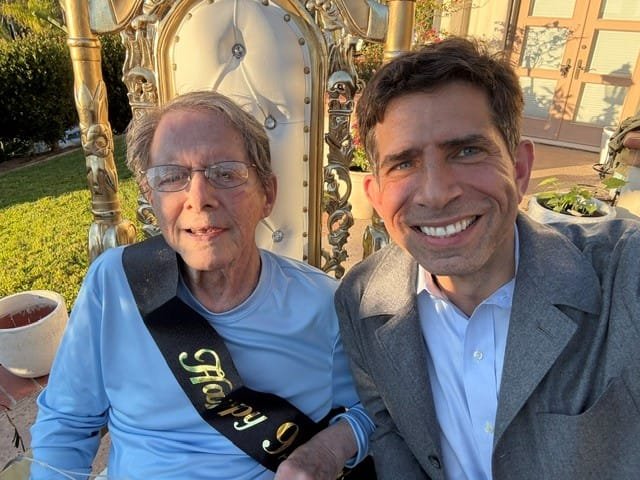
Hoenig with retired philosopher Leonard Peikoff co-author of Can You Really Love a Dog?
Scott Holleran: I’ve read that the rate of return from your investments is as high as 30 percent. Is this true?
Jonathan Hoenig: When I had my fund, I had years that [yielded] 30 percent sure, yeah, definitely, and I’m proud about the times I’ve made money for clients, but also proud about the times that I avoided losing [money]. No matter what you think of politics or the [presidential] administration, JP Morgan, the banker, famously said the market is gonna be volatile. It always will be. The market has since come back up to new highs, but when it was recently down about 10 or 12 percent, my clients were actually up for the year. In moments like that, I’m most proud of being able to not just make gains, but hold on to them even in down markets.
Scott Holleran: You’re author, editor and publisher of several books ranging from pet stories to stories about Chicago’s financial pit. How many books have you published and what’s next?
Jonathan Hoenig: I think I’ve done five in total: Price is Primary, Greed is Good, The Pit, A New Textbook of Americanism: The Politics of Ayn Rand, and Can You Really Love a Dog? What’s next? I have a few interests I’m exploring. Nothing to announce though I definitely have interests I want to suss out and learn and maybe one day write about. Right now I’m focused on building my business over the summer. I have a love for Ravinia [music theater in Highland Park, Illinois] which I’ve kind of rediscovered and I know that there’s music downtown in Chicago in what they call Millennium Park now as well, but Ravinia—my grandmother went there in the 1920s, so the fact that it’s here—this amazing, beautiful place—for 100 years, there’s something nostalgic about that and beautiful.
Scott Holleran: What does your credo ‘price is primary’ mean?
Jonathan Hoenig: My creed that price is primary means that when evaluating markets price price should be the primary input with which you estimate and evaluate markets. For most people, price is a byproduct of something; they think it’s not the primary—that it’s a byproduct of a primary. The school [of economic thought] is known as technical analysis; that you study not the business of a company, for example, but the chart of the company to search for the clues as to how it might perform in the future. So, even something like Spirit Airlines is a great example: it didn’t go to 18 cents in one day, you know, it went from $10 to $9.09 dollars to $8.08 dollars to $7. Oftentimes in markets, and I write and talk about this a lot, people evade reality; they buy it at 50 and they’re still buying more at 35 because they just know that XYZ is a winner. But, as I look at it, they’re evading, the reality that, while they might think XYZ is a winner, the market price is not confirming their outlook.
So, you know, there’s that line I know that Ayn Rand cites that, nature, to be commanded, must be obeyed. And it’s the same thing in markets; to command markets, you have to obey them. You have to obey and respect price for what it is. You can’t deny it and it’s self-evident. People buy something at 50, it goes to 40, they say, if I liked it at 50, I should love it at 40. But, if I buy it at 50, and it goes to 40, I’m instead thinking to myself, wait a minute, what’s wrong here? I thought it was a buy to 50, and now it’s 10 points lower. This doesn’t necessarily mean I think you [ought to] sell that day, but you have to acknowledge that, at least for now, you’re on the wrong track. So price is what I analyze; that’s what I look at.
Scott Holleran: What’s your firm’s minimum investment?
Jonathan Hoenig: Generally $100,000.
Scott Holleran: What’s the origin of the name Capitalist Pig Asset Management?
Jonathan Hoenig: It started as the name of my radio show. As a student at Northwestern I was involved with the radio station WNUR. This was in the late Nineties. I started a show that was basically teaching finance to young people—at the time Generation X. So I wanted a name that was a little bit in your face and a little different than Merrill Lynch or Goldman Sachs. Capitalist Pig is an idea based on one of the most famous Chicagoans when it comes to finance—a guy by the name of Leo Melamed, who basically invented financial futures—who revolutionized the financial markets. Leo was the first one who said, ‘we already trade futures on corn—why don’t we do it on currencies—why don’t we do it on stock indices?’ In interviews, he would say things to the effect that, ‘you know, I think being a capitalist pig is OK.’ He was very pro-capitalist, so I did it in my mind too as a nod to Leo who as a great Chicagoan who said that, to wanna make money—to be a capitalist pig—is good and he was right.

Scott Holleran: You were born in Chicago. Where did you grow up?
Jonathan Hoenig: I was born in Michael Reese Hospital—now I think it’s just pile of rocks, I think it was literally knocked down—and I grew up in Glencoe. My grandmother stayed in the city. During my youth, we would come to the city at least twice a month. So I was comfortable going to Water Tower [Place], walking on Michigan Avenue. I used to get my haircut in the city as a child, so we were often in the city and I felt comfortable here and downtown. Now, there has been an uptick in crime in recent years. I’m sad to see it. I feel a little less safe than I used to walking around the city, which is too bad.
Later, I was in Syracuse for a year. They say Disneyland is the happiest place on earth. I think Syracuse might be the unhappiest on earth. It was a city on the way down—all the industry had left, was driven out or was leaving. I remember thinking, I live in a bustling city. Why am I not there? I had worked at a local radio station, which was a big deal for me, and I’d worked at Channel 11 a bit and I was already a part of local media on a tiny scale. I resolved to get back to Chicago.
Scott Holleran: What did you do at WTTW?
Jonathan Hoenig: I was a teenage movie reviewer on the [PBS affiliate WTTW-based] show that was called Sneak Previews, which originally featured [Chicago Tribune movie critic Gene] Siskel and [Chicago Sun-Times movie critic Roger] Ebert but when they left and [syndicated] their own show, it featured Jeffrey Lyons and Michael Medved. Once a month, as a high school kid, we would go to the TV channel or we would go to [Lettuce Entertain You restaurant chain’s] Ed Debevic’s and we’d film four or five segments they would kind of insert them into the backend of their program. The idea was: let’s get some young voices, let’s get some unique opinions. So it was my first time in front of a TV camera. It was exciting and fun. Terrific producers made it comfortable.
Scott Holleran: What other movies did you review for Sneak Previews?
Jonathan Hoenig: Hot Shots [with Charlie Sheen]. One of the movies was Casablanca. It had been re-released—or maybe it had gone to video—and I think the [TV] producers wanted a young [person’s] take on it. I don’t remember thinking like this has changed my life. It’s frustrating that I think I grew up seeing things black and white automatically puts a strike against it—that they have to fight doubly hard because my brain is almost saying: ‘this is antiquated.’ I think I’m more well-rounded now, but when I was a kid, if it was in black and white, I thought: that’s old. I felt the same way about The Three Stooges.
Scott Holleran: Did you grow up with a general orientation to history; for example, to the Holocaust, Nazi Germany and World War 2, and what was the role of history in your upbringing in Glencoe?
Jonathan Hoenig: I had known of the Holocaust and been taught the Holocaust—the history of the Holocaust—since I was a child in religious school, in public school and I went to Hebrew school. I did. My mother was a founding docent at the Illinois Holocaust Museum in Skokie. She had to take a college course to do that and she did it for many years. Just her knowledge and discussion of that period of history was around in our house while growing up. I was very young when it happened, but [I recall the] reverberations from the Nazi march in Skokie in 1977. I was young but it was being talked about.
Scott Holleran: So you had an awareness of free speech and history?
Jonathan Hoenig: Definitely. Also, while growing up, we watched the TV news. As a boy, I would watch the news with my parents—Bill Kurtis and Walter Jacobson [on WBBM, the CBS affiliate in Chicago] with the Channel 2 News and, often, Terry Savage.
Scott Holleran: Who else did you watch?
Jonathan Hoenig: Wall Street Week [on PBS] with Louis Rukeyser, which was on Friday evenings on WTTW. Later, I had the chance interview him—I think it’s on YouTube as well—but he was such an optimist on the American system, on the American entrepreneur, and he was infectious even on terrible days or months for the market or the economy; he had an optimism and the spirit of production that the country represents and he treated me with respect. I was blown away. Wall Street Week with Louis Rukeyser is probably the number one influence.
Scott Holleran: Do you still live in Chicago?
Jonathan Hoenig: I recently moved to Lincoln Park. Lincoln Park is beautiful. At one point, [I know we worked on a new] edition of Frank Norris’s book, The Pit [The Pit: Photographic Portrait of the Chicago Trading Floor], which is all about financial speculating in Chicago. There’s a scene in the book where one of the female characters goes on a horse-drawn carriage ride through Lincoln Park. It’s a vivid, beautifully written passage. I love now that I walk those paths and streets here in Lincoln Park. Part of what’s fun about Chicago is the history here and knowing how many people have enjoyed this particularly beautiful spot. Especially as a dog owner and lover, Lincoln Park is a beautiful part of the city. Property prices reflect that.
Scott Holleran: Do you still ride a bicycle in Chicago?
Jonathan Hoenig: I gave up on the bike. Frankly, I had too many [bikes] stolen. I lived in the Loop and whenever I tempted fate by leaving my bike locked up for an hour, it was stolen. I lost two, maybe three, bikes and I was just like, alright, I’ll go to the gym [instead]. They weren’t four-figure [cost] bikes but I’m sure they were three-figure and Chicago is still a city. It’s too bad. That’s the reality.
Scott Holleran: Thieves cut through the lock?
Jonathan Hoenig: I assume so. The bikes would be gone, yeah. I locked them up and, yeah, it doesn’t stop them.
Scott Holleran: Do you drive a car in Chicago?
Jonathan Hoenig: I don’t. I use a lot of [private car services such as Lyft and Uber].
Scott Holleran: How else do you get around Chicago? Do you take the L, the Metra, taxi, bus?
Jonathan Hoenig: I have family Lyft, Uber [plans]. I don’t have a preference. I do have a family member’s car I can use if I really need to use a car. [Transportation] isn’t great public relations for the city, particularly the L, which really concerns me. It’s been years since I rode the L. I’ve heard and seen too many stories about violence on the L. It’s frustrating. [Uber and Lyft offer] what public transportation should. I have to have to say I remember when Uber first started in Chicago, it was so cheap. If you look now, because of the regulatory fees the rides that used to be $5 or $6 are now $9 or $13.
Scott Holleran: You often appear on media in New York City. Do you fly out of O’Hare? What are your thoughts on air transportation in Chicago because you travel for business?
Jonathan Hoenig: I favor O’Hare only because the airlines and flights I favor tend to go there. I still think air travel could be improved by being privatized—security, air traffic control and routing of planes—and we’re already seeing [potential for improvement]. You and I both know [Boom Supersonic founder] Blake [Scholl], who’s innovating supersonic jet travel—
Scott Holleran: —Boom Supersonic deals with United Airlines in Chicago—
Jonathan Hoenig: —Yes, so I’m optimistic about air travel, in particular. At one point, Chicago was the railroad capital and I’m still optimistic. Air travel is one of those miracles we’ve gotten so used to that we’ve forgotten how incredible it is. Flying is safer than walking down the street and it’s better [than ever].
Scott Holleran: There’s been a recent report that United and American airlines are considering a merger. Do you think that’s a possibility?
Jonathan Hoenig: I heard that rumor as well. I hope that, if it’s something shareholders want to do, they’re permitted to—I would hate to see it held up by antitrust regulations. [Commercial aviation is] definitely a business of scale, so for sure it might benefit them, But I don’t have any comment as to whether it should or will go through. The Spirit Airlines demise should be of no surprise. I mean, respectfully to its former owners, no one liked that airline.
Scott Holleran: What’s your thought on financing sports stadiums, particularly in Chicagoland?
Jonathan Hoenig: Certainly it should be completely private. Government doesn’t need a sports stadium. There’s no civic need for government to own and operate a sports stadium. I think it should be completely privately owned. And if the park district still owns Soldier Field, I think it should be sold—they sold the parking—why won’t they sell the stadium? I’d love to see new stadiums developed. There’s one that’s being talked about on the near South Side now to replace Comiskey Park. If it’s privately done, I’m all for it. But I don’t want to see deals, favors, patronage.
Scott Holleran: What’s the most exciting business story in Chicago?
Jonathan Hoenig: That is a good question. What exciting things are happening in Chicago business? Probably the one that comes to mind is Google taking over what was known as the State of Illinois Building and then the [Governor Jim] Thompson Center. [Google] completely gutted it and they’re going to make it their [Chicago] headquarters—right in the middle of the Loop by Daley Plaza. It’s across the street from City Hall. If they’re investing money, they could really bring in technology talent and make Chicago a technology or advertising hub. I’m glad to see [this] at a time when a lot of companies are leaving Chicago. I was happy to see Google not only just commit to stay but to preserve [Helmut Jahn’s] architecture which surely would have been lost. I do remember that [the architecture of the State of Illinois Building was considered a boondoggle and, from what I can see, all the glass has been replaced.
Scott Holleran: Are you happy working with Fox Business and Fox News?
Jonathan Hoenig: What’s especially fun now that’s still relatively new is the interactivity. Previously, I just went on and did a song and dance and that was it. But, now the minute the cameraman or director says cut, there’s already three or four people who’ve [posted] that either they hate or love the point you’re making, the tie you’re wearing or [they’re expressing whether] they agree or disagree and think you’re full of s*** or wisdom. So it’s really turned it into much more of a conversation, which is fun.

Scott Holleran: Is it rejuvenating and revitalizing for you?
Jonathan Hoenig: It is. It’s a huge honor. With live news, you never know what’s gonna happen. So, while I’ve been on the air, news about the war [with Iran], tariffs or the market breaks live. So it’s still fun. I still get surprised quite frequently.
Scott Holleran: On February 19th, 2009, CNBC Chicago financial reporter Rick Santelli, referencing your favorite novel, Atlas Shrugged, appeared on the Chicago Mercantile Exchange floor during the government bailout controversy to express his support for capitalism and opposition to government intervention, which is credited with inspiring the Tea Party movement. Do you know Rick and have you discussed Atlas Shrugged and his historic Chicago commentary?
Jonathan Hoenig: I know Rick, though I don’t think we’ve talked about Atlas Shrugged. I did speak at that first year tax day Tea Party that Rick inspired, which I thought was really positive—at Daley Plaza, which was filled. That was a real positive sign at the time of people who wanted less government in their lives and more economic freedom. So Rick really inspired an entire political movement that had [momentum] because of a match that he lit.
Scott Holleran: Have you been to the top of every Chicago skyscraper—including the Standard Oil Building—which one is your favorite and why?
Jonathan Hoenig: I don’t think I’ve been to the top of the Standard Oil Building—now known as Aon Center—but it’s a beautiful building. It’s such an elegant building. There’s a lot of new tall buildings in Chicago. There’s a building called the St. Regis. There’s one near the South Side. I’ve been to dinner in the St. Regis. The John Hancock Building is interesting. They’re redoing it. You remember there used to be [a restaurant called] the 95th, right? The 95th went out with [the bar] Images and they are remaking that [space] into a double-deck viewing center. Those are my favorite views. I remember having many nice meals at the 95th restaurant as well. That was always a fun treat. In fact, one of my favorite memories was there and I have a photo of meeting Skip Hayes who sang the song “Lake Shore Drive”. Remember that hit from Aliotta Haynes Jeremiah? I was trying to buy the rights to the song, the royalties, and he wasn’t down for that. But we [met and] had a nice meal and we were able to look out on Lake Shore Drive. That’s one of my favorite songs—anything about the city—it’s such a pretty song.