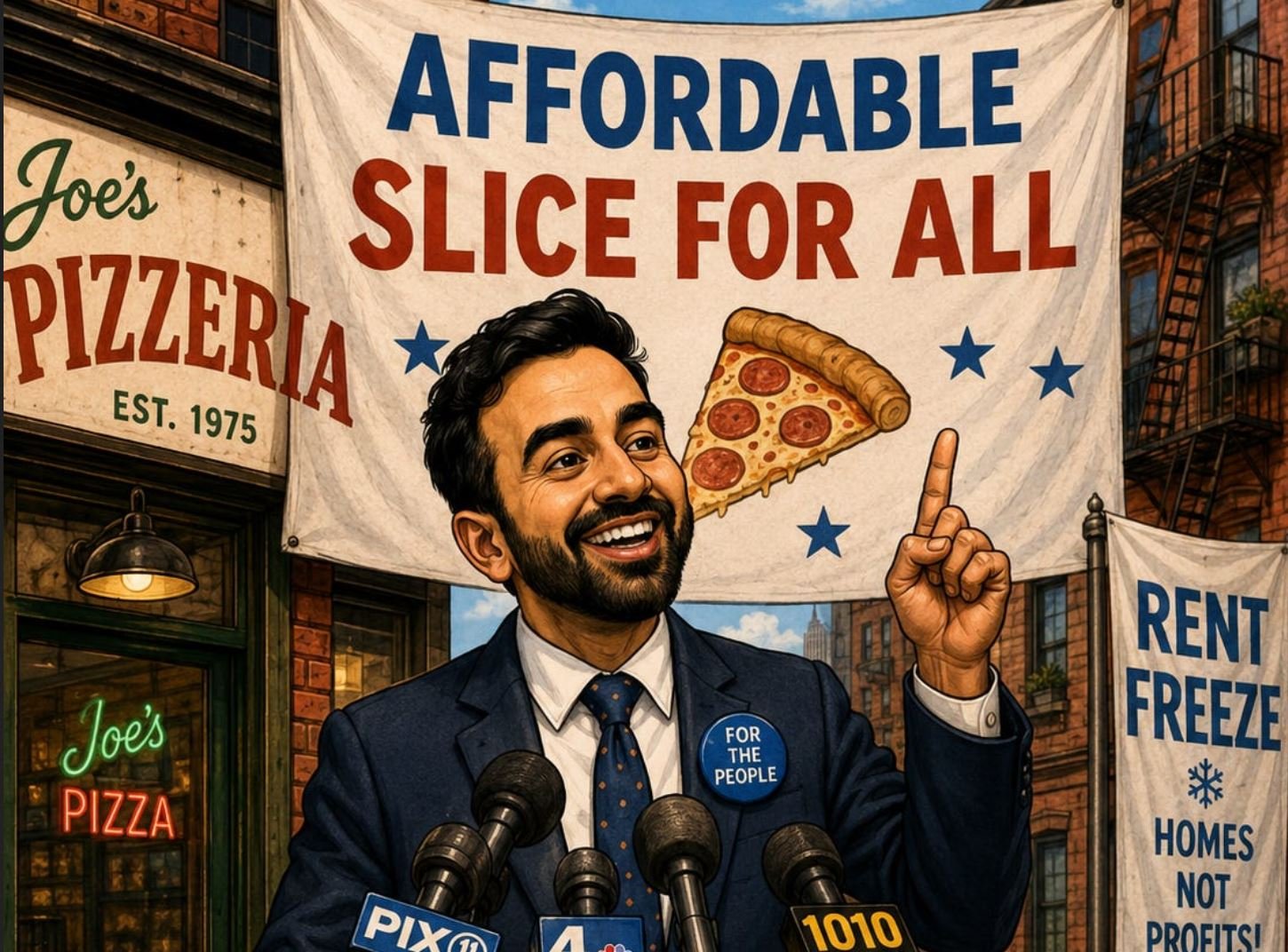
Mayor Mamdani, congratulations! Because of you, New York City has finally discovered the secret of affordability: when something becomes too expensive, forbid its price from rising.
Your Rent Guidelines Board has frozen rents on rent-stabilized apartments, delivering what you have called long-overdue relief to working New Yorkers. But your historic achievement raises a troubling question.
Why have you abandoned pizza?
Housing may be a human right, but pizza is a New York right. A person can leave New York and find housing almost anywhere. But a proper New York slice – thin enough to fold, hot enough to burn the roof of your mouth, and greasy enough to require emergency deployment of a paper plate – is irreplaceable.
Pizza is a New York institution.
Yet pizza prices continue to rise. Poor and working-class New Yorkers are being forced to choose between rent, groceries, and an extra topping. Some children may grow up believing that pepperoni is only for the rich.
This injustice must end.
We beseech you: Freeze the price of pizza!
Naturally, pizzeria owners will complain. They will say that the prices of flour, mozzarella, tomato sauce, labor, electricity, insurance, taxes, and storefront rent have not been frozen, and continue to rise with inflation. They will wave invoices around and insist that arithmetic prevents them from selling pizza at the fair price determined by City Hall.
We have heard this kind of excuse before.
Prosecute them.
Your program will be a spectacular success. Every regulated slice will cost exactly the same as it did before. Yes, over time the slices may become slightly smaller. The cheese may become slightly thinner. The tomato sauce may contain somewhat less tomato. A few establishments may begin charging a mandatory $6 “plate maintenance fee.”
These are not consequences of price controls financially squeezing pizzeria owners. They are evidence of greedy pizza profiteering!
Prosecute them again.
Some controlled pizzerias will sell out their regulated $1.00 slices early in the day. Customers may have to stand in line beginning at six in the morning, and newcomers to the city may wait years for access to a price-stabilized slice. Fortunately, the city can establish a Pizza Connect website through which New Yorkers may apply for affordable pizza lotteries.
The city should mandate that each new luxury pizzeria will reserve several affordable slices for qualifying low income households. The lucky winners will receive pizza for $1.00 per slice… for life! If the remaining customers who subsidize those cheap pizzas pay $17.50, that simply proves that the private sector is incapable of providing affordable pizza.
A few grumpy economists may predict that investors will stop opening pizzerias in New York. Why spend money on an oven, hire employees, or sign a commercial lease when the city may later dictate the price of every slice?
This is merely another manifestation of greed.
And if some pizzerias close, claiming that revenues no longer cover their costs, the city must act decisively:
Prosecute them, confiscate their ovens, and take over their pizzerias. The city will give us our pizza! It’s our right!
It has all worked out so well for housing.
Mayor Mamdani, save New Yorkers. Protect our right to pizza by freezing the price of a slice!
A note for readers outside New York
None of the housing mechanisms parodied above are imaginary.
“Stabilization” is a form of rent control that was initiated in 1969. Rent control itself began in 1943. Housing Connect is the lottery where one can win a below-market rental apartment. Currently, the odds are 1 in 592 of winning one. These below-market apartments are subsidized by other renters, who pay some of the highest market rents in the world.
It also turns out that the largest landlord is the city itself. Conditions in city-owned housing projects are notoriously squalid, with urine in the hallways and elevators that don’t work. The city became such a large landlord by taking over properties of defunct private landlords who could not make ends meet. The city has also built hundreds of public housing projects at a cost per unit that is a multiple of the cost of private housing, all of it funded through taxes.
New York City residents pay the highest taxes in the country.
But hey, we are talking about pizza here!