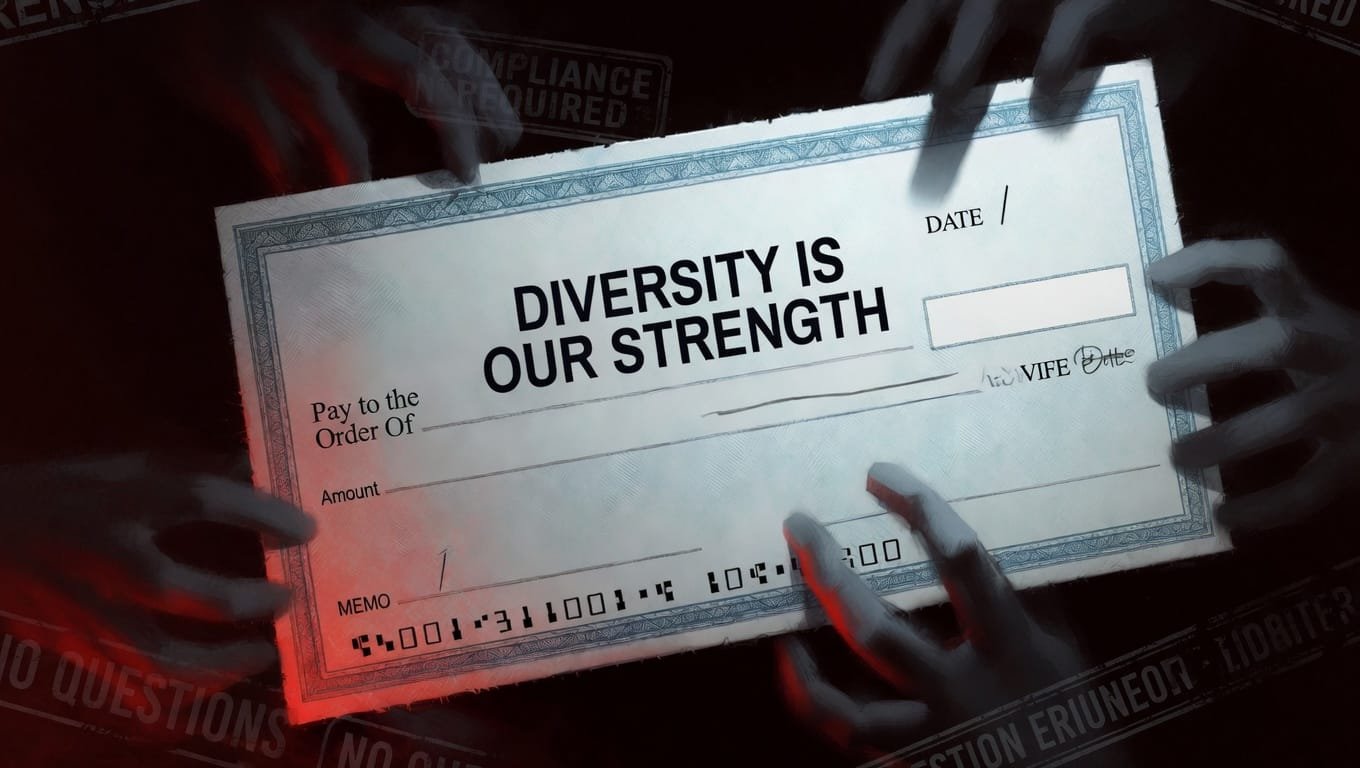
“Diversity is our strength.”
The sentence looks like a claim. It has the shape of one. What it lacks is content. The word “diversity” names a category of difference without specifying which differences—genetic, cognitive, linguistic, ideological, experiential—matter or why. “Strength” implies a purpose, a condition, an alternative against which to measure—none of which the slogan provides. Strip away the emotional freight and what remains is: [unspecified differences] produce [unspecified advantages].
That is not a proposition. It is a noise with good grammar.
This matters—not because the slogan is wrong, but because you cannot be wrong about nothing. Something that cannot be true or false cannot be argued with, tested, or refined. It exists outside the space where reason operates. Calling it a value, as its proponents do, is a category error. Real values have implications you can trace and consequences you can evaluate. Justice, liberty, individual rights—these generate specific claims about how to treat people, and those claims can be contested. “Diversity is our strength” generates nothing. It simply sits there, impervious, demanding assent.
The impervious part is not accidental.
A specific claim invites examination. “Teams with varied domain expertise solve novel problems faster” can be tested, qualified, accepted in some contexts and rejected in others. Nobody gets accused of moral failure for questioning it. The specificity defuses the weapon. The slogan works precisely because it cannot be made specific—pin it down and it dies. Leave it vague and it is unkillable. Every attempt to examine it becomes an attack on it, and every attack on it becomes an attack on diversity itself.
This is also a trap. Agree and you have signed a blank check redeemable for whatever the enforcers decide it covers next. Push back and you have placed yourself against diversity—against tolerance, against inclusion, against human dignity. The statement generates its own prosecution. Every exit is blocked.
Consider what that blank check has already purchased. “Diversity is our strength” began as an appeal for tolerance and inclusion—who could oppose that? It has since justified demographic quotas in hiring, ideological litmus tests in university admissions, mandatory training in which participants confess to prejudices they do not hold, and the suppression of research findings that contradict preferred conclusions. The original statement covered none of this. It covered nothing. That was precisely the point.
The vacuousness is not a design flaw. It is the design.
But the trap only fully reveals itself when you see what the slogan is actually doing. It is not communicating. It is testing.
Watch where the slogan appears: corporate mission statements, university orientation sessions, legislative testimony, award acceptance speeches. In none of these settings is it deployed as a hypothesis awaiting evidence. Nobody says it and then pauses for examination. It is said the way liturgy is said—as performance, as signal, as proof of membership. What it communicates is not a belief about diversity. It communicates that the speaker has been processed. They know the codes. They are safe.
You do not even have to believe it. Belief was never the point. What the slogan extracts is compliance—the public performance of assent to something indefensible, witnessed, recorded, career-consequential. The test is not whether you agree. The test is whether your social survival instinct overrides your epistemic standards when asked to say a thing you cannot defend. Those who comply without hesitation are compliant. Those who pause are problematic. The sorting is the function.
We have seen this machine before.
Mao’s struggle sessions did not require true believers. They required public submission to claims the speaker knew were false—before witnesses, under social pressure, with professional and physical survival on the line. The ideology was almost incidental. What the sessions produced was not agreement but demonstrated subordination: proof that private judgment had been successfully overridden by collective enforcement. The person who confessed to crimes they did not commit, who praised policies they knew were catastrophic, who denounced colleagues they respected—that person had shown they would say the false thing when required to say it. That was the point.
DEI compliance culture runs identical machinery at lower stakes. The land acknowledgments. The pronoun declarations in email signatures. The mission statement genuflections. The diversity statements required for academic employment. None of these are designed to produce genuine conviction—their architects are not naive enough to expect that. They produce performance: the public, witnessed, institutionally recorded act of saying the thing. The difference between the struggle session and the sensitivity training is the consequence for non-compliance, not the structure of the demand.
This is not hyperbole. It is a precise analytical observation. The comparison is not to the gulags, the famine, the mass death—those are the consequences of a fully realized totalitarian state, and no serious person claims we are there. The comparison is to the mechanism by which ideological capture operates: the extraction of compliance with indefensible assertions as a precondition for institutional participation. That mechanism does not require violence to function. It requires only that the cost of non-compliance—the lost job, the destroyed reputation, the social exile—exceed the cost of self-betrayal.
The tell has always been the same. When an assertion cannot be questioned without punishment, it is not functioning as a belief. It is functioning as a test. And a society that systematically tests its members’ willingness to subordinate private judgment to public ritual is not a free society—regardless of what the ritual is ostensibly about, regardless of how benevolent the stated intentions of those administering it.
The content of the slogan is almost beside the point.
“The party is our mother.” “Struggle is our progress.” “Diversity is our strength.” Swap the nouns. The mechanism is identical. What marks the unfree society is not which indefensible things it requires you to affirm. It is that it requires you to affirm indefensible things—and obscures the requirement by presenting it as a value.
Free societies argue about true things. They contest propositions with evidence and reasoning, and the argument itself is the system’s health. Unfree ones demand agreement on propositions that were never true or false to begin with—and punish the honest person’s first and most natural response, which is simply to ask what the words mean.
“Diversity is our strength.”
Four words. No content. Total compliance required.
That is not a value. That is a machine. And the first obligation of a free mind is to call it by its name.