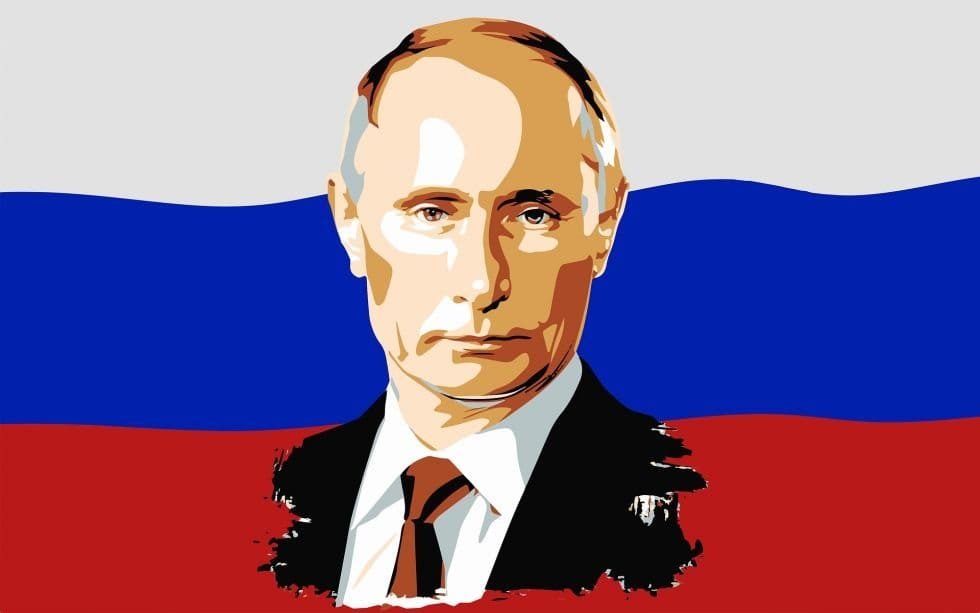
In April 2004, I attended a Cato Institute conference in Moscow, Russia. The highlight of the event was when prominent members of the Cato staff, including the Institute’s president, Ed Crane, held a four-and-a-half-hour-long meeting with Valdimir Putin, president of the Russian Federation, at his residence outside of Moscow.
When they returned to the hotel venue of the conference, almost all of them were aglow with excitement and optimism. Russia was about to enter a free-market and (classical) liberal golden age. A Russian economic advisor had persuaded Putin to introduce a pro-growth flat income tax. Putin expressed interest in a “privatized” pension system like the one established in Chile. He spoke of a non-inflationary monetary policy to be pursued by the Russian central bank. Putin even seemed open to the ideas of freedom of the press and speech and an impartial rule of law when argued for by Cato participants during the meeting.
However, while creating the impression of being open to all free-market options, Putin did not suggest any intention of introducing such reforms any time soon or all at once. One of the participants in the meeting told some of us later that near the end, Putin said, “We all want to go to heaven, but none of us is in a hurry to get there.”
One interpretation at the time was that moving too quickly or completely all at once would be “politically impossible,” threatening a social backlash that would lead to the demise of ever getting such a free-market society in Russia. But there were already signs and doubts about Putin really having any such interest in an open, liberal society.
Putin a KGB agent and power-luster
Born in 1952, Putin spent 16 years as an intelligence officer in the KGB, the Soviet secret police, and was stationed in Dresden part of the time working with the East German secret police, the Stasi, until 1990. He embedded himself in the new post-Soviet political system, first in St. Petersburg and then in Moscow, especially with the up-and-coming oligarchs, many of whom were former KGB members and personal cronies. Joining Russian Federation President Boris Yeltsin’s government in 1996, he moved up rapidly to become head of the new KGB, the Federal Security Service (FSB) and then Russian prime minister in 1999 before replacing Yeltsin as president in 2000.
Putin demonstrated a knack for concentrating power and using privilege and wealth to ensure loyalty and obedience. He also demonstrated a ruthlessness against real and potential opponents, including the use of assassination at home and abroad, arrest and imprisonment on trumped-up charges against those who challenged him, and use of police suppression of all public demonstrations opposing his power and control. He also manipulated and faked election results to keep himself in control of the government. To do all these things he built up a powerful post-Soviet military and secret police system that makes Russia very much a national-security state. He has demonstrated, time and again, that he is willing to use the national-security state to pursue his purposes domestically and in foreign affairs.
The role of ideology in collectivist regimes
In April 2005, just a year after the Cato conference in Moscow, Putin said in his annual presidential address that the end to the Soviet Union in 1991 had been “the greatest geopolitical catastrophe of the 20th century.” Rarely do authoritarian rulers maintain their power simply through naked and brute force. Rulers thirst for political legitimacy from those over whom they rule. This diminishes the likelihood and the cost of ensuring that the ruled do not revolt against their government masters.
At the same time, the authoritarian often has his own vision and rationale for his rule. It is easy to put this down as just the ruler’s rhetorical subterfuge to try to justify his reason for insisting that his rule is necessary and as an excuse for the extreme methods he may resort to in the face of any opposition and resistance to his rule. Even if he knows it serves as camouflage for his own desire for political power, the authoritarian often and even sincerely believes that his rule is indispensable, an historical necessity, even a “calling” from a higher authority — God or “destiny” — to lead his country and people for some greater purpose.
The reason why totalitarian dictators are so dangerous is that they really believe in what they say and do. Hitler was, well, a Nazi, and Stalin was a communist, and they both believed in what they were doing. Even though in 1944 and 1945 it was clear that Germany was losing the war, the trains and personnel were allocated to transport as many Jews from across Europe as possible to the death camps. Killing Jews was more important than sending as many supplies and soldiers to the front as possible to hold back the Western allies and the Soviet armies.
For Stalin, imposing a government-created famine in the early 1930s, especially in Ukraine, that killed millions or forcing peasants off their private lands and into collective farms were the necessary price to have more grain to export in exchange for Western capital equipment to accelerate Soviet industrialization in the name of “building socialism.” When a British visitor to Moscow asked Stalin in 1933 how long the mass killing would continue, he calmly replied, as long as needed to ensure socialist victory.
It is often argued that what separates totalitarian regimes from authoritarian ones is that the former are ideologically committed to controlling every aspect of society and to remaking every citizen into a “new man,” reflecting a vision of a big and beautiful future for all of humanity, or some selected portion of it. Authoritarians may have stated political dogmas that rationalize their regimes, but they are far less concerned with a total remolding of the citizenry and more concerned in ensuring little or no opposition to the dictator and his policies. Keep your head down and your mouth shut, and you can likely get by.
Putin’s collectivist ideology of “Russia”
Putin may have grown up in a system of Marxist-Leninist education and indoctrination, and he may have served in the KGB as a loyal subject of the Soviet state, but by the time he went to school in the 1960s and 1970s, very few really believed in communist ideology anymore. It was something to memorize and repeat like a parrot in both public and private occasions, but to naively believe in and work for it required being totally blind to the reality of socialism-in-practice. Soviet power structures were the avenues to make a career, to live more comfortably by being a member of the Communist Party, or having some position of authority in the bureaucratic hierarchy that ran every aspect of economic and social life. That was Putin, a loyal servant of the Soviet state, looking out for himself.
Putin is not a stupid or ignorant man. He is fairly well-read and knowledgeable about the history of Russia and its leaders before and during the Soviet period, and he is a strong believer in “Russia” as an idea and as a special nation in the family of nations. Anyone who watched Tucker Carlson’s interview with Putin in February 2024 would have been impressed by his detailed explanation of Russian history over the centuries and his use of it to rationalize that, in reality, there really is not a separate Ukrainian people and nation but merely a subgroup of the Great Russian people. And not a single notebook or cheat sheet in sight.
He claims to have become religious in the form of the Russian Orthodox faith. We can only speculate about how real his belief in God and its special Church on Earth is. But he sometimes speaks as if he wears his religion on his sleeve. How much of this is personal fact and how much is political fiction, well, only a “higher authority” can know. While Putin may hope to go to Heaven, he clearly uses his power to ensure that he does not get there too soon.
Whether it is a totalitarian or an authoritarian system, the leader and his regime, as I said, offers some type of ideology to explain, justify, and arouse support and enthusiasm among the ruled. Underlying all of them ends up being some form of philosophical, political, social, and economic collectivism. There must be some rationale, some appeal to something outside of and greater than the individual, for which the individual is expected and called to serve and sacrifice.
The individual must see himself as small and the group as large; his own individual life has to be seen as transitory, and “the nation” or “the people” or “the class” to which he has been assigned membership to have a purpose, significance, and existence beyond his own place and time. The individual has no meaning, no existence separate from the collective, so he must selflessly sacrifice for it. And to ensure this, the state will mold him, confine him, and make him conform to this “greater good.”
This is no less true in Putin’s Russia. In his mind, if his words are to be taken as a reflection of what he believes and how he sees the country he controls, the history of Russia is a story of a people marked by destiny to be unified “not merely [as] the result of political and diplomatic decisions. It was underlain by the common faith, shared cultural traditions and — I would like to emphasize it once again — language similarity,” as Putin has said. However, the role of conquest of areas that are now southern Russia or the vast territory of Siberia were all victories of the sword. At an economic forum in St. Petersburg in June 2025, Putin highlighted this by saying, “Wherever the foot of a Russian soldier steps, that is ours.” Hardly a peaceful philosophy of freedom and self-determination.
Russia’s living dream-idea for the 21st century
Unlike either Lenin or Stalin, Putin has not written essays or books on his ideological views. However, there are various voices of those around or in ways connected to him that offer reflections of the vision of Russia that is part of his collectivist ideology. A recent one is by a prominent Russian political scientist, Sergey Karaganov (b. 1952), who, according to the independent Russian news source Meduza, is a founding member of the Valdai Discussion Club, which Putin has regularly attended for over 20 years. He has also been a close policy advisor to Putin and a member of the international advisory board of the American Council on Foreign Relations (CFR).
In July 2025, the Russian Higher School of Economics and the Council of Foreign and Defense Policy published a report by Karaganov titled, Russia’s Living Dream-Idea: The Russian Citizen’s Code for the 21st Century. Often appearing on Russian news programs, he has suggested dropping nuclear bombs on Poland due to that country’s support for Ukraine. Putin has publicly endorsed the council’s research, and Russian foreign minister Sergey Lavrov frequently participates in the council’s events.
Karaganov declares in the report, which is 42 pages long, that Russia is a unique and special “state-civilization, even a civilization of civilizations.” The Russians “are all bearers of a common civilizational consciousness, united by a single spirit and responsibility to people, the country and the Almighty for the future of our land and all of humanity. This invisible responsibility is absorbed with mother’s milk and is present in everyone…. This consciousness must be protected and developed.”
As a consequence, he continues, “A leading ideology is needed, supported by the state, and taking root through education and upbringing, but not by direct orders, but offered and imposed through textbooks, discussions, images, literature and art. If it is not there, the people and the country inevitably fade away and then degrade.”
Russia, he says, at “its core has always remained unchanged: Russia is a unique civilizational entity with its own mission before God and humanity.” Only through such an educationally and culturally imposed ideological platform can there be successful “state building,” with a commitment to this ideology as “the most important criteria for selecting citizens for the country’s governing elite.” Such an “ideological platform must be implemented from childhood.”
Western liberalism as the enemy of Russian civilization
He also makes it clear what is the greatest threat and enemy of this Russian civilization: the West and liberalism. Russia is in another great war in Ukraine, no different than the war against Napoleon in the early 19th century or the war with Germany in the 1940s. The goal of its opponents is to destroy and then control and exploit Russia and its people for the benefit of a global “neoliberal” elite that wishes to continue its domination of the world.
The problem is that leading up to and then following the fall of the Soviet Union in the early 1990s, too many Russians were lured into believing they wanted to be like those living in Western Europe and America. The economic failures of the Soviet Union opened the door to “the penetration of the ideology of liberalism, individualism, economism, and the cult of consumerism.”
Liberalism leads to a skepticism about religion and a faith outside of and above rationalism and material wealth. “Modern capitalism,” the author says, “with its cult of endless consumption turns man into a thoughtless consumer. In general, there has been a tendency for man to return into an animal state, to his degradation.” It cultivates an individualism that makes people think that their lives, purposes, and goals are above and more important than the state civilization. It makes people believe that they should not identify with and want to sacrifice for something bigger than their selfish interests. It threatens the collectivist higher good.
Western influences also promulgate a false belief in democracy. Of course, there must be feedback from the people to those in political power, especially at local levels. But the right kind of feedback “can only be ensured by a fair amount of authoritarianism, which keeps the oligarchies that inevitably develop under capitalism within strict limits.” Large countries like Russia can only be held together by strong, centralized governments: “The natural path for us is a leader-democracy with strong elements.” While political leadership must periodically be changed, in Russia there is no need for such change to come every four or six or seven years. Karaganov does not specify how long a person might be in the highest political office, but clearly the 25 years, the quarter of a century, of Putin in power is not too much in his view.
The Russian Empire on a mission for the world
Nor is Karaganov hesitant or embarrassed to call Russia an empire. “There is no need to be ashamed of the fact that Russia is an empire, and also a state-civilization,” he declares. Unlike other Western empires, Russia has been generous and respectful and kind to its subject peoples, he insists. Furthermore, Russia did not go overseas to build its empire, it just expanded it outwards from its earlier, much smaller size centuries ago. “We are a type of Asian empire, Chinese, Indian,” he says.
Only an empire like Russia’s, a state-civilization, can give the world the leadership to fight social injustice, climate change, sexual deviance, and the Satanism of enlightenment skepticism that attempts to eliminate the God-based foundation of Russia’s unique importance and role in the world. Says Karaganov:
We must not forget that we are a people with a mission…. The preservation of humanity in man is our national idea. And we must not only defend ourselves, but also actively attack, promoting this credo….
We must understand that modern Western civilization, which has penetrated us quite deeply, is based on an unnatural prominence of individualism. Man is a social being. But all social beings for which there is something no less, and sometimes more essential and important, than their own satiety and even life. Therefore, man could not and cannot develop outside of family, society, nature, country. And without serving them…. Let us remember that Christ sacrificed himself for the salvation of all mankind….
A full-fledged citizen of our country must serve society, family, country, state. If he seeks to serve only himself, he cannot and should not count on respect and public recognition…. But this is not Western multilateralism, but community, coherence, solidarity, close to the genetic type of most Asian civilizations….
Justice in the Russian understanding of the word is that everyone works not for himself alone, but so that what one or a few have done can become public property … by consciously moving toward an economic model of national social capitalism…. All that remains is for the state and society to promote the dissemination of this and similar models. And, of course to subject to moral, if not administrative and legal, condemnation conspicuous consumption, especially it if occurs abroad with money earned in Russia.”
In Karaganov’s view, this also requires Russia to follow this mission globally to rid the world of Western neoliberalism, including through force: “Perhaps, this is the new world historical mission of Russia, its idea and dream, a continuation of another of its missions — the ridding the world of all pretenders to world domination, which can be achieved only through global violence,” he states.
We are not a peaceful people, but a warlike people, historically defending ourselves and others, a warrior people…. We are armed peacekeepers, a warrior nation. Pacifists ready, if necessary, to go with bayonets. This is our destiny, calling, burden, but also a comparative advantage in an increasingly dangerous world. The development of this trait should become an important component of the state ideology, Russia’s dream idea…. We are a warrior nation, but a warrior for peace, not conquest and enslavement.
Karaganov then concludes this part of the report:
Russia is now fulfilling a special mission, liberating the world, as it previously freed it from Napoleons and Hitlers, from the Western yoke, undermining the basis of its domination — military superiority and providing the world with an alternative — a multinational, multicultural community based on the incorrectly called ‘conservative,’ but in reality — simply truly human values…. For us the God-bearing nature of Russia is obvious. Are we ready for such a mission now?
To ensure Russia’s centralized cohesion and ability to fulfill its domestic and foreign missions, private enterprise must be subservient to the needs and goals of the state as part of the wider collectivist ideal. “We are for collectivism,” Karaganov declares: “A person can be fulfilled and be free only in service to a common cause.” He continues:
We are not money-grubbers, but we strive for well-deserved personal and family wellbeing. Excessive, conspicuous consumption is immoral and unpatriotic…. Economically, we are building a people’s capitalism, where property is inviolable, but conspicuous consumption is shameful, where the goal of business is to serve the wellbeing of all, to increase the power of the state, the new Russian ideology with its emphasis on the development of Man in his service to the Motherland.
These are the values and beliefs to be “promoted from infancy.” To ensure this, Karaganov ends the report with a proposal for “the establishment of a Department of Ideological Policy under the leadership of a trusted assistant to the President…. The ideological agendas should become the core of state policy. It is necessary to create an Institute of Man — a Russian man, preserving and promoting the best in Man.”
Slavaphilism as the basis of Putin’s Russia
This collectivist and strongly anti-individualist ideology, one that places the nation and the state above the person, that harks back to the “soul of Russia” and its claimed unique religious and spiritual nature, that sees the state as a parent to educate and guide and mold the citizen-child, that sees a higher mission for Russia in cleansing the world of corruption and evil, is nothing new.
In Russian history, they are known as the Slavophiles, who developed this outlook in the middle decades of the 19th century as a reaction against Westernization, that is, the introduction and implementation of ideas and institutions from Western Europe and then from America. The ideas of the West were considered anathema to the special and distinct civilization of the Russian people, a virus that would be the death of God’s chosen people as reflected in the teachings of the Russian Orthodox Church.
While Western churches and philosophies had focused on the individual and his freedom of choice, along with scientific rationalism as the basis of its view of the world, the Russian Church and culture had taught the organic communalism of the Russian people. That is, the individual only had identity, meaning, and place in the world within the group, the sense and appreciation of which could only be fully understood through a higher force outside of and beyond the visible and the measurable. Hence, the Slavophiles always have had a strong element of mysticism and irrationalism at their core. This is part of the history and heritage behind Putin’s Russia.
In Russian literature, one of the leading 19th-century Slavophiles was Fyodor Dostoyevsky (1821–1881), and in more modern times, it includes Aleksandr Solzhenitsyn (1918–2008). For all of Solzhenitsyn’s hatred for the Soviet system as reflected in his novels and in Gulag Archipelago (1973–1978), a central aspect of which was communist Godlessness, he detested just as much what he considered the decadence and spiritual corruption of the West, as reflected in his famous Harvard Commencement Address (1978).
Productive America and plundering Russia
At the end of volume 1 of Democracy in America (1835), the French social philosopher Alexis de Tocqueville (1805–1859) made a comparison between the American and the Russian people:
Today there are two great peoples on earth who, starting from different points, seem to advance toward the same goal: these are the Russians and the Anglo-Americans…. The American struggles against the obstacles that nature opposes to him, the Russian is grappling with men. The one combats the wilderness and barbarism, the other, civilization, clothed in all its arms. Consequently, the conquests of the American are made with the farmer’s plow, those of the Russian with the soldier’s sword.
To reach his goal the first relies on personal interest, and, without directing them, allows the strength and reason of individuals to operate. The second in a way concentrates all power of society in one man. The one has as principle means of action liberty; the other, servitude.
Their point of departure is different, their paths are varied; nonetheless, each one of them seems called by a secret design of Providence to hold in its hands one day the destines of the world.
Writing in the 1830s, Tocqueville’s America was very much a new and developing land. There was a spirit of individual energy, enterprise, and innovation that was cooperatively shared with others through the institutions of trade and commerce based on free markets. Government attempted to provide security for each person’s right to his life, liberty, and honestly acquired property, with little of the political paternalism and plunder that plagued most other parts of the world.
Where and when such paternalism and plunder did exist in that earlier America, it was viewed as an exception to the philosophy of a free America, an embarrassment to be opposed and not tolerated. Slavery, of course, was the greatest of these blisters on the body of the country. The fact that it so dominated political discourse and fiery debate leading up to the Civil War showed how anathema it was to the principles upon which the country had been founded.
America has become more like Russia
Through much of the remainder of the 19th century and an early part of the 20th century, the idea of liberty that de Tocqueville highlighted remained central to the American experience. But today, America in practice has become more guided by a set of ideas closer to those of the Russians than to our own ancestors. Ours may seem like a kinder and gentler political paternalism and system of plunder than in Russia, but our own variation on the collectivist theme has come to dominate America as well.
The government determines and dictates a great deal of how we live and what our life opportunities may be. What else is it when government imposes mandatory Social Security, Medicare, and Medicaid, sets prices and wages, and uses domestic regulations, and protectionist trade barriers to influence what we produce, how we produce it, and for what purposes? When government gives privileges to some and imposes taxes and other burdens on others to pay for them? Is it not molding the young to think and believe a certain way by demanding they attend government-mandated and supplied education? Even if different groups and ideologies are in competition in deciding what the school curriculum should be, the premise is that a role of government is to make the young think a certain way and to make them the right kind of citizens in the future to conform to and follow what government expects of them.
Furthermore, America has become very much the imperial power that Russians are not only not embarrassed about but hail as a hallmark of their national greatness. America’s military presence covers the world, with bases and personnel on every continent of the planet. The surveillance state watches and knows virtually everything that is done, by almost anyone, anywhere around the globe. The U.S. government, regardless of the presidential administration or the political party in power in Congress, considers itself at liberty to assassinate anyone, bomb anywhere, and influence, if not dictate, the domestic policies of multitudes of countries. The U.S. government feels itself affronted by any government that challenges its imperial presence and attempted determination of world affairs. Why? Because America is on a “mission” to ensure a “better world,” one cleansed of “evil,” just as much as the Russians consider themselves responsible to do so.
What continues to be lost in America is the idea and ideal of political practices that made the country that de Tocqueville saw as so starkly different from the Russia of the 19th century. Only the Russian people finally can decide what kind of country they want and the ideas behind it. Americans, in turn, must ask themselves what kind of country they want. At least we have a national legacy and tradition of liberty to harken back to and offer as an improved and more consistent form as an alternative to either collectivist Russia or our own imperial and paternalistic America. That is the task of friends of liberty for a future of freedom.
This article was originally published in the October 2025 issue of Future of Freedom.