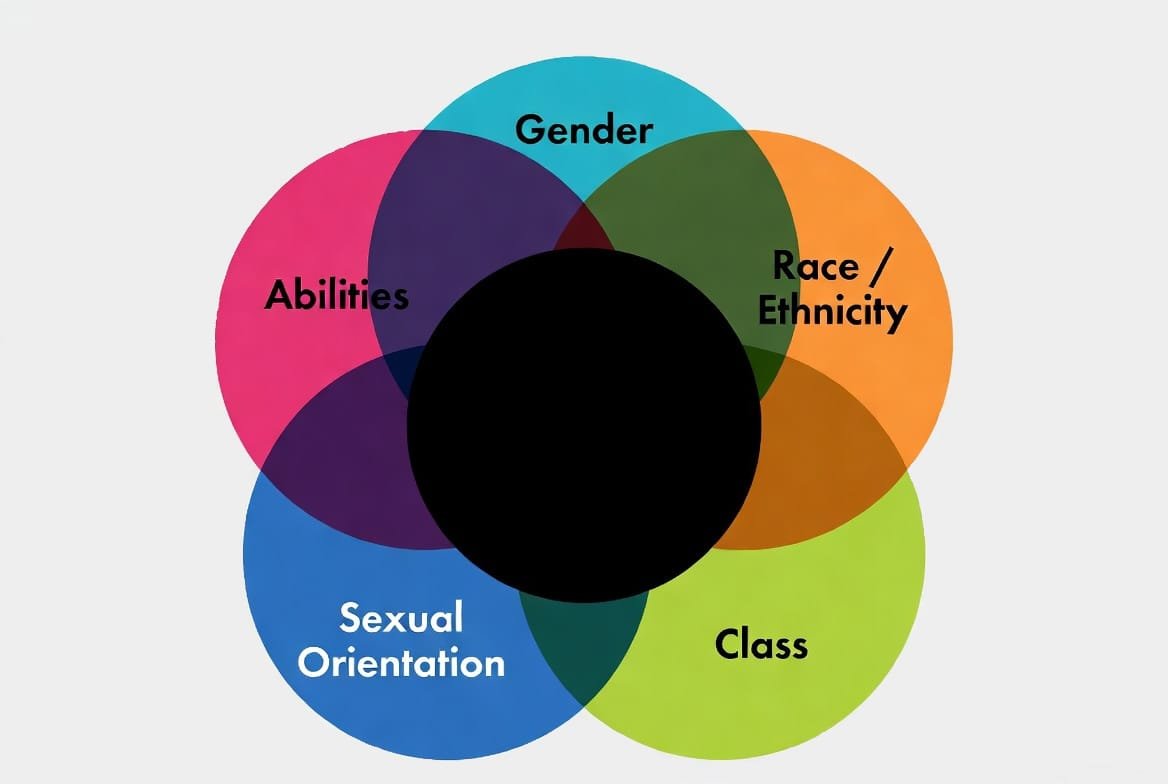
What Intersectionality Is
Intersectionality is a current claim about oppression in America. It asserts that non-whites, women, immigrants, homosexuals, and so forth are discriminated against—and that if an individual falls into several of these categories, then his (or her) victimization will be compounded. For example, a woman who is a black, Congolese, lesbian immigrant will face significantly more prejudice than would a native born black American heterosexual male.
In their book, Intersectionality, Patricia Hill Collins and Sirma Bilge offer a recondite definition of “intersectionality” but then go on to explain it: “This working definition describes intersectionality’s core insight: namely, that in a given society at a given time, power relations of race, class, and gender…are not discrete and mutually exclusive entities but rather build on each other and work together; and that, while often invisible, these intersecting power relations affect all aspects of the social world.”[1]
Scholar Kimberle Crenshaw, who coined the concept, described it like this: “Intersectionality is a lens through which you can see where power comes and collides, where it interlocks and intersects. It’s not simply that there’s a race problem here, a gender problem here, and a class or LBGTQ problem there. Many times that framework erases what happens to people who are subject to all of these things…. If someone is trying to think about how to explain to the courts why they should not dismiss a case made by black women, just because the employer did hire blacks who were men and women who were white, well, that’s what the tool was designed to do.”[2]
As a principle, intersectionality is one aspect of a constellation of racial beliefs that falls under the rubric of Critical Race Theory. In essence, the theory states that: 1. White people are racist 2. The United States is still dominated by white supremacy 3. The nation’s oppressed people—non-whites, women, gays, immigrants, and so forth—should stand together in solidarity against the white male oppressor.
Theorists of this school state these claims unequivocally. For example, Robin DiAngelo, an academic who instigated the field of “Critical Whiteness Studies,” wrote: “…a positive white identity is an impossible goal. White identity is inherently racist; white people do not exist outside the system of white supremacy.”[3] Similarly, Barbara Applebaum, a philosophy professor, stated: “…all whites, by virtue of systemic white privilege that is inseparable from white ways of being, are implicated in the production and reproduction of systemic racial injustice.”[4] A further example of many that might be provided was a 2002 Harvard Magazine essay with the jaw-dropping title “Abolish the White Race.” It said, in part: “The goal of abolishing the white race [conceived as a pernicious ‘social construct’] is on its face so desirable that some may find it hard to believe that it could incur any opposition other than from committed white supremacists.”[5] Finally, Applebaum makes clear that she endorses the viewpoint of critical race theorists Stephanie Wildman and Adrienne Davis who “contend that white supremacy is a system of oppression and privilege that all white people benefit from.”[6]
In essence, intersectionality and Critical Race Theory more broadly are anti-white racism combined with Marxism. White supremacists have long directed scorn at non-whites, and especially blacks who they accuse of both low intelligence and low morals. The intersectionalists may be thought of as the “new racists”, who openly and shamelessly spew forth relentless racist hatred of whites. Whites, they often claim, are uniquely (or at least primarily) responsible for slavery, imperialism, and genocide.[7] As seen, the intersectionalists also proclaim that whites are inherently racist, or, at the very least, benefit from a philosophy of white supremacism that is hard-wired into the American psyche and culture. After all, the Marxist element of such diverse “oppressed” groups as non-whites, women, gays, and immigrants uniting in opposition to the white male oppressor obviously relies upon the claim that white males are oppressive. The intersectionalist principle has diverse strands to it but the one it returns to over and again is that whites are intrinsically racist, especially toward blacks. This is its cardinal teaching.
But is it true?
White Racism in America’s Past
American history is undoubtedly permeated with egregious injustices by whites against blacks. More than 200 years of black slavery from Jamestown in the 17th century to the 13th Amendment in 1865 is one example. Roughly a century of persecution from the 1860s to the 1960s under Jim Crow and other similar policies, largely but not limited to, the South was a second. Regarding the latter, widespread lynchings were a salient and especially horrific phenomena. For example, Booker T. Washington’s staff at Tuskegee Institute began keeping records of publicly known lynchings. Between the 1880s and 1944, “when lynchings first began to decline strongly, Tuskegee recorded 3,417 lynchings of blacks…”[8] The brutal murder of Sam Hose in Georgia in 1899 is a representative example. Hose was accused of murdering his white employer and raping the man’s wife. He was not tried in a court of law in an attempt to establish his guilt; instead, he was savagely tortured and murdered by a blood-crazed mob who cut off his body parts, sold them for souvenirs, doused him with oil, and set him aflame, burning him to “a heap of ashes.”[9] This was not an isolated incident; there were numerous similar horror stories, as the Tuskegee archives attest.
Then there were the white race riots that burned down entire black neighborhoods, killing many innocents and displacing more. Perhaps the most egregious example was the Tulsa race riot of 1921. There, following a relatively innocuous incident in which a black youth allegedly touched a white girl, a riot ensued in which an enraged white mob burned down the Greenwood section of town, a bustling, prosperous black business district home to many professional people. “The Red Cross estimates that more than 300 people were killed and approximately 1,200 homes were destroyed.”[10] No damages were ever paid by the perpetrators to the victims. The racist horror stories can be endlessly recounted from the past. But what about the present?
White Racism in America Today
Virulent white racism continues to exist in contemporary America. Violent white supremacists still murder innocent blacks and Latinos in the U.S. For example, Dylann Roof attacked a black church in Charleston, South Carolina in 2015, murdering nine innocents. In 2019, Patrick Wood Crusius murdered twenty-three mostly Latinos in a mass shooting in El Paso, Texas. Payton Gendron in 2022 murdered ten blacks in an unprovoked assault in a store in upstate New York. And the savage beat goes on.
These attacks are atrocities perpetrated by the killers and tragedies for the innocent victims. But what is the long-term trend line regarding white racism in America? Has the nation made progress regarding this intractable issue? The truthful answer is that over the last 60-70 years since the Civil Rights Movement of the 1950s and 1960s, the United States has made enormous progress regarding anti-black racism among its majority white population. The evidence supporting this claim is overwhelming.
Great Progress in the United States
One major step forward was the de-segregation of the public school system in the Jim Crow South during the 1950s. In the early days of this process, the SCOTUS issued its landmark Brown vs. the Board of Education decision, ruling that segregated schools were unconstitutional. In 1957, President Eisenhower sent federal troops to Little Rock, Arkansas to protect black students who put this ruling into practice against fierce opposition from the segregationist governor and his many supporters. Similarly, in 1962, President Kennedy sent first federal marshals and then U.S. Army units to assist James Meredith in his successful attempt to integrate the University of Mississippi against violent racist opposition. In 1965, President Johnson sent U.S. soldiers to line the route from Selma to Montgomery, Alabama protecting the Freedom Marchers seeking to ensure their right as American citizens to vote. The Civil Rights and Voting Acts of the mid-sixties were enacted largely to protect the rights of black American citizens. The burgeoning popularity of the relatively new television technology played a role, beaming into the homes of millions the hideous violence unleashed by the practitioners of Jim Crow against black American citizens seeking to protect their voting and other basic rights as U.S. citizens. And gradually, over time, Jim Crow began to die.
Further, the decline of violently racist organizations has been dramatic. For example, it is estimated that 100 years ago, in the 1920s, the white American population was roughly 95 million and the Ku Klux Klan totaled some 3-5 million members.[11] Today, a century later, the white American population is approximately 234 million people but the Klan’s membership is likely less than 5-10 thousand.[12] That is 5-10 thousand too many but it represents a tiny fraction of the white American population, and is certainly progress. Similarly, the American Nazis were never popular and less so today than ever. In 2011 the New York Times claimed that the American Nazi Party was the most widespread Nazi group in the country but then claimed they had but 400 members.[13] In truth, the biggest Nazi group in the country is probably the Aryan Brotherhood, largely a prison gang and crime syndicate totaling roughly 15,000 to 20,000 members.[14] These white nationalist organizations number in the thousands among the many millions of white Americans—and, despite the relentless anti-white hatred spewed by intersectionalists and their allies on the political left, do not appear to be growing. Indeed, these white racists are so marginalized that their leading spokesmen—men like Richard Spencer and Jared Taylor—are unknown to the overwhelming majority of Americans of any race. Finally, at the 2017 Charlottesville riot instigated by white supremacists, CNN footage shows maybe a few dozen Nazis and Klansmen and hundreds of counter-protestors.[15] At the commemorative rally held a year later in Washington D.C., forty or fifty white supremacists showed up and hundreds, perhaps thousands of counter-demonstrators.[16] As Thomas Sowell said: “If [white] racism in America is not dead, then it is certainly on ‘life support.’”[17]
Finally, there is a boatload of evidence at the individual level, not involving organizations or governmental policy that may be adduced to support the claim of substantially declining white racism. In no particular order: A 2021 Gallup poll shows that 93% of white Americans support racially mixed marriages.[18] The United States gets substantially more black immigration from the Caribbean and Africa than it experiences black emigration. Today, there are roughly 5.6 million black immigrants in the United States compared to some 655,000 black American expatriates.[19] Black politicians elected to high office routinely gather millions of white votes, whether it’s Barack Obama, Byron Donald, Tim Scott (elected twice to the Senate from South Carolina, cradle of the Confederacy), or others.[20] In 2025, Winsome Earle-Sears, a black Republican woman, won 61% of the white male vote and 35% of the white female vote in a losing effort against a white Democrat woman in the Virginia gubernatorial election. (In 2021, Sears won the Lieutenant Governor election in Virginia with 61% of the white vote against a bi-racial Democrat woman.)[21] If black Americans formed a separate nation, it would be the 15th wealthiest nation in the world.[22] According to a 2018 Nielsen report, black Americans possess a huge $1.2 trillion dollars in purchasing power.[23] Black Americans have shown immense upward mobility out of poverty and into the middle or wealthy classes.[24] Nigerian immigrants have the highest educational levels in the country.[25] Indian immigrants have the highest economic levels in the country and it’s not even close.[26] Thomas Sowell showed as far back as 1981 that second-generation black Caribbean immigrants had higher levels of income than white Americans.[27] Any number of Asian immigrant groups have higher levels of affluence than white Americans.[28] Caravans of wannabe non-white immigrants trudge toward the United States, not away from it. And so on.
What factor(s) have enabled the United States to reduce anti-black racism so dramatically?
Explaining the U.S. Ability to Combat Racism
The question can be raised in a different form. The Civil Rights Movement in the United States has made substantial progress in protecting the rights of black Americans. By contrast, how has the so-called Human Rights Movement done in many countries around the world? For example, North Korea is a brutal Communist dictatorship in which fully ten percent of its population is at heavy slave labor…and the state murders slaves for the slightest infraction.[29] Has any international Human Rights organization succeeded in improving the lives of North Korean slaves? No. How about in Sudan? In this zealously Islamic country tens of thousands of blacks, many of them Christians, are pitilessly enslaved, mostly by Baggara Arabs.[30] Has a Human Rights organization brought relief to any of these cruelly oppressed people? No, none has been able to. What moral principle has enabled such progress in the United States—and prevented it in the most brutally repressed hellholes around the world?[31]
Prefatory to an answer, “let’s start with a movie example: the 2016 film, The Promise, the story of a fictional love triangle set during the real-life Armenian genocide in 1915 (in which Turkish Muslims slaughtered roughly 1.5 million innocent Armenian Christian civilians.) In one memorable scene in the story, Talaat (the chief architect of the Genocide, the real-life Hitler of this massive crime) says to Henry Morgenthau, the U.S. Ambassador to the Ottoman Empire: “You’re a Jew. What do you care what happens to these Armenian Christians?” In other words, it’s not your tribe being annihilated. Why should you care? On this way of “thinking”, a human being is first, foremost, and always a member of a tribe, fundamentally distinct from all other tribes, and a person’s allegiance should be, properly, to his own ethnic/racial group. And the others, fundamentally different from us, are potentially and often the enemy…or, at best, of no concern.
“But there is another, vastly more benign way of understanding racial differences between and among us. The great Roman dramatist Terence phrased it perfectly: “I am human. I consider nothing human alien to me.” That is: Each person is an individual member of the human race. Every individual is unique and unrepeatable. We are not interchangeable parts of a tribal whole. An individual human life—regardless of race or tribal membership—is sacred, it has great worth in and of itself. An injustice perpetrated against an innocent individual of a differing ethnic group is of great concern to me; for, as a human, nothing human is alien to me.
“Individualism is the theory of human nature that states: Individuality is real, it is important, and each individual has an inalienable right to life, to liberty, to earn and to own property, and to pursue personal happiness. On such a theory, we recognize that racial differences are real—but we also recognize that they are trivial differences between us, akin to the differences in hair and eye color between and among many white people.”[32]
Of central importance: We recognize that individuals possess free will[33]; they make choices, including moral choices. Accordingly, we judge them on their moral choices, not on their racial or tribal membership; on what is in their volitional control, not on what lies outside of it. Consequently, colorblind individualism (or CBI as I conceive it) means neither to deny nor ignore race or racial differences: These are real. It means to recognize that race is trivial, as trivial as is hair color, that moral choices are all-important, and to judge each human individual on the moral choices they make. The truth is simple: Character is important all the time—competence is important regarding our work—race is never important. Recognition of this constellation of truths is the way forward regarding our efforts to expunge the timeless horror of racism from human life.
And it is a timeless horror. To discern an answer to our question regarding American efficacy to combat racism, let’s look at history around the world. But first a clarification: When I talk about racism, I refer to bigotry more broadly, whether its judging people by their race—black, white, Asian, and so forth; or their tribe—Hutu or Tutsi, for example; or their religion—Judaism, for example, or the Islamic persecution of Hindus.
Let’s take merely a few salient, brutal examples. During the aforementioned Armenian Genocide in 1915, for example, Turkish Muslims butchered virtually the entire Armenian Christian population of the Ottoman Empire, often in the most savagely primitive form with axes and hatchets.[34] In the horrific Rape of Nanking in 1937, Japanese soldiers savagely gang raped and murdered hundreds of thousands of Chinese civilians, mostly women, in part because the soldiers had been taught in school that the Chinese were animals no better than pigs and that the Japanese were a superior race.[35] In the Bengali Genocide of 1971, Pakistani Muslims slaughtered a minimum of 1.5 million Indian Hindus and similarly perpetrated mass rape of the women.[36] In the Rwandan Genocide of 1994, members of the Hutu tribe butchered more than 900,000 Tutsis, largely in the most primitive way—hacking their victims to pieces with machetes.[37] And, of course, the Holocaust of World War Two, in which the National Socialists (Nazis) slaughtered some five to six million Jews is well documented.[38] There are numerous other instances of racially-based mass murder that can be adduced; not to mention the class war, rather than race war mass murders, across multiple continents, numbering 100 million slaughtered victims of the Communists.
Notice there are degrees of evil. Violently assaulting a victim, robbing him and leaving him bloodily crumpled in the street is worse than picking his pocket. Murdering him is morally worse than assaulting him—and so forth. Americans have been guilty of serious crimes, as discussed above, but on relatively small scales. There have been no genocidal slaughters of hundreds of thousands or millions of perceived enemies. For example, if the Nazis held power in America and regarded blacks as racial enemies, they would have herded them to concentration camps and gassed all of them. But the Americans under Jim Crow at its worst did not do this. Even under the horrors of Jim Crow legislation, Booker T. Washington, one of America’s greatest educators, was free to help found and run Tuskegee Institute, an outstanding college for blacks in Alabama; and more, he was sufficiently free to raise millions of dollars from such northern businessmen as Julius Rosenwald, president of Sears, Roebuck and Company to help build thousands of schools for black American children across the South, an educational process that, in time, helped develop such future black leaders as Martin Luther King and many others.[39] (And a genius like George Washington Carver was likewise free at Tuskegee Institute to make significant advances in agricultural science that greatly benefited southern farmers both black and white.)
America at her best has been an extraordinary haven of freedom and creativity in every field from agriculture to zoology, the most beloved country of history, judging by people “voting with their feet,” that is, choosing the nation to which they desire to emigrate. America at her worst has not approximated the race war mass murders of the Nazis or other racists mentioned above —or the class war slaughters of the Communists.
Why is this? Because the United States was founded on a philosophy of individualism and inalienable individual rights that is distinctive to it. It imported the brutal policy of human slavery from the Old World–a horrific practice that existed all over the world and for all time dating back into the mists of pre-history, and one that still exists in many parts of the world. America was and remains morally mixed, governed partly by the principle of inalienable individual rights distinctive to it, the powerful conviction that your life belongs to you—and partly by Old World tribalism, the belief that your life belongs not to you but to the tribe, the group, the collective, the nation, the state. It’s not that the Americans did not perpetrate crimes against blacks, American Indians, and others; they did. It’s that the principle of individual rights, distinctive to America and deeply embedded in her culture, severely restricted the willingness of Americans to perpetrate massive atrocities.
Let us remember that the world-wide, ages-old practice of human slavery faced no concerted opposition until 18th century Great Britain. During the late-17th and 18th centuries Enlightenment period, seminal thinkers like John Locke and others—including Locke’s leading students across the pond in Britain’s North American colonies—cultivated the principle of individual rights. Not surprising, history’s first abolitionist movement developed in Britain and at this time. The logic is clear: It is wrong to enslave an innocent human being because his life belongs to him, not to the slave drivers. Observe that abolitionism and republicanism are sibling moral principles. Why is it wrong for a monarch or hereditary aristocrats to dictate taxation or public policy to innocent men? Because their lives belong to them, not to the king. It is no accident that John Adams, Benjamin Franklin, Alexander Hamilton, and Thomas Paine were all fervent abolitionists, or that even the Virginians—Washington, Jefferson, Madison—slave owners all, held that slavery in the new republic must be gradually phased out. The principle animating the American Revolution led directly to the 13th Amendment in 1865.
As for the claim that white Americans perpetrated genocide against the American Indian tribes, it has been known for a long time that the overwhelming majority of American Indians died not in battle against whites but from smallpox and other European diseases to which they had no natural immunity.[40] Even when in the 1830s President Andrew Jackson seized Indian lands in the Southeast and forced the tribes to march long miles on the appropriately named “Trail of Tears” to Oklahoma, causing the deaths of thousands, the goal was a land grab, not a genocidal slaughter.[41] Finally, by the late-19th century, the Western tribes were subdued. Many were mighty warriors but they were outgunned, outmanned, defeated, exhausted, and consigned to reservations. Why didn’t the U.S. military simply wipe them out? There was nobody to stop them. And why were the Indian reservations, unlike Communist countries, not sealed to emigration? Why did many Indians, true to their warrior heritage, leave the reservations, join the U.S military, and fight courageously for the United States in World Wars One and Two and other wars? Why, in 1924 did the U.S. Congress grant American citizenship to the Indians born in the country? These events add up to many things but genocide is not one of them.
Why were the Turks, the Pakistanis, the Japanese, the Hutus, and the Germans, among others, willing to perpetrate the genocidal atrocities described briefly above? Because their culture lacks any awareness of or commitment to the principle of inalienable individual rights. Similarly, what moral principle animated Russian, Chinese, Cambodian, and other Communists to butcher 100 million innocent civilians? The Khmer Rouge, the Cambodian Communists, answered this question unequivocally. They told their victims: “Losing you is no loss. Keeping you is no specific gain.”[42] In other words, you, as an individual member of the human race, have no value in yourself. The only value you have is to sacrifice for and serve the state. The individual is nothing in and of himself (or herself). Your life belongs to the state and the state can dispose of it as it sees fit.
This leads back to our original question: Why has the Civil Rights Movement in the U.S. made substantial progress in reducing anti-black racism in the country? Because the Americans have an individualistic heritage; at their best, they realize that an individual makes moral choices; and that these, not the trivial characteristic of skin color or racial membership, are what is important about him. Thousands of years ago, the great Chinese philosopher Confucius said that the beginning of wisdom is to call things by their right names. The right name for the Civil Rights Movement is the Individual Rights Movement for black Americans—and long overdue.
And why, to complete the reasoning, have international Human Rights organizations had no success in succoring North Korean or Sudanese slaves? Because North Korea is a Communist dictatorship: There are no distinct individuals, only appendages of the people as a whole, which the all-powerful state can dispose of at will. In Sudan or anywhere under Islam, there are no individuals, there are only two groups, Muslims and infidels. Muslims cannot enslave their co-religionists, but infidels are fair game.
America the World Leader
“American industrial might and military forces played a central role in defeating the Axis powers in World War Two. Likewise, American opposition to Communism was necessary to overcome the Soviets in the Cold War. Twice in the past eighty years, Americans have been the driving force protecting freedom and defeating totalitarianism. America has triumphed over both National Socialism and Communism.
“Today it must once again marshal its strength and stand up to another menace. This is a battle in which its most powerful weapon is not its army, its navy, or its nuclear arsenal. In this battle, its most powerful weapon is its founding principle. The greatest nation of history is called upon to take the lead in fighting racism—the worst scourge of history. There is no one else to do it.”[43]
The Bitter Truth About Intersectionality
The above facts and the logical conclusions to which they lead—what do they tell us about intersectionality? They tell us a great deal:
- White racism and commitment to white supremacy in America is still alive but barely. It is mercifully dying and its strength today is severely attenuated.
- What enabled this progress is America’s heritage of individualism and individual rights.
- The way forward on this intractable issue first in America and then around the world is a full, consistent, and unconflicted embracing of colorblind individualism (CBI.)
- Intersectionality claims that white people are always or generally racist, that white supremacy is hard-wired into American culture, and that colorblind individualism is not a viable strategy for combating racism or for advancing the well-being of persecuted minorities. All three claims are egregiously false.
A critical point in this discussion is that intersectionality’s advocates fully reject CBI as a panacea for racism. As just one example, Kimberle Crenshaw and her supporters wrote a book titled Seeing Race Again: Countering Colorblindness Across the Disciplines. As the title indicates, the book’s content is a 300-plus page screed against the only logical cure for racism in any and all of its iterations. The book’s authors say things like: “Color-blindness is a one-way street….It holds that whites are all individuals who can never be held accountable for the enrichments they enjoy as a group.” Or: “Its [the philosophy of colorblindness] invocations of the egalitarian aims of the freedom movement of the mid-1960s hide an enduring allegiance to the evasions of accountability and practices of denial and disavowal at the heart of white supremacy.”[44]
If we embrace CBI, then we judge people on their moral choices, we hire them based on competence, we embrace the merit system, we reject affirmative action programs and Diversity Equity Inclusion (DEI) considerations, and we know then that people hold their positions based on merit. But if we reject CBI, then we are “seeing race again,” that is, we judge people based on race not on their moral choices, we accept people into schools or jobs based not on merit but on race, and we are not certain if an individual holds a position based on competence or because of racial preferences. On the basis of CBI, race is never an important consideration. With the repudiation of CBI, race is not merely an important consideration, it is a decisive one.
The brilliant brain surgeon, Dr. Ben Carson, tells us a relevant true story in his autobiography, Gifted Hands: The Ben Carson Story. Decades ago, he was a young intern in neurosurgery at the Johns Hopkins Hospital in Baltimore. Dr. Carson wrote: “It was inevitable that a few white patients didn’t want a black doctor, and they protested to Dr. Long [Dr. Donlin Long, chief of neuro-surgery at Hopkins.] One woman said, ‘I’m sorry, but I do not want a black physician on my case.’
“Dr. Long had a standard answer, given in a calm but firm voice. “”There’s the door. You’re welcome to walk through it. But if you stay here, Dr. Carson will handle your case.”[45]
To the white patient, race was important; to Dr. Long, race was not important. To the patient, race not competence was the decisive factor. To Dr. Long, competence not race was the deciding issue. When competence (and character) are decisive factors in judging a person, and race is not, then we can finally rid ourselves of the hideous scourge of racism. But when race—not competence or character—is a deciding consideration, then we embrace and perpetuate racism.
Let’s say, for example, that Dr. Carson was not superbly competent in his work but that he was akin to a contemporary DEI hire, chosen over more proficient Asian or white candidates because of skin color. In a new form, such a policy enshrines racism and does so to the detriment of the surgeon’s patients and their families. Notice that in either version of racism, the patient always loses when race is more important than proficiency. In the first case, the white patient condemns herself to inferior medical care by virtue of her racist prejudices. In the second case, the racist system consigns patients to lesser care by foisting a less competent surgeon on them.
Racism in any form always victimizes innocent people.
Who, if anyone, does the new racism benefit? Do the preferential race policies of the intersectionalists aid black Americans? The first point to make is the injustice of the system. Years ago, it was unjust to more qualified black candidates to disqualify them in favor of less qualified white candidates on the basis of race. Today, it is similarly unjust to more qualified white or Asian candidates to be rejected in favor of less qualified black candidates. Nor is the injustice diminished by a supposed attempt to compensate blacks for the terrible injustices of the past; for the current white and Asian candidates were most likely not even born when those injustices occurred, much less responsible for them. A person is a unique and unrepeatable individual, to be treated as such, not a stand-in for his race to be held accountable for the virtues or vices of his ancestors. And as a practical consideration: It is true that a candidate inferior to others might still be qualified for the position in question; but as soon as some consideration other than merit becomes the decisive factor, it opens the possibility that unqualified people will be chosen and guarantees that, in many cases, less qualified people will be. And if some are then caught in a position for which they are unqualified, they are set up for failure. Dr. Carson’s many patients may thank God that merit, not race, was the deciding factor in his advance.
Obviously in logic CBI is the only way to terminate racism. The termination of racism will benefit everybody, first and foremost members of a historically persecuted racial minority. In this case, to advance, those individuals will only need to maintain strong character and develop skills in their chosen fields; they need not depend on racists to alter their irrational ideas and relinquish their prejudices. Their fate is thereby in their own hands, not reliant on others, above all, not reliant on irrational, bigoted others.
But intersectionalists reject it. Let’s pause on this. They scream endlessly against white racism. They whimper and moan about the poor victims of the evil white man. And yet, they utterly reject the only panacea for racism. Why?
The answer, perhaps shocking to some innocent people, is that they do not want to terminate racism. That is not their goal. What they seek to do instead is to perpetuate, even enshrine racism albeit in a new form.
The incessant wailing of Robin DiAngelo and her ilk, in the face of overwhelming contrary evidence, is designed to inculcate massive quantities of undeserved guilt in the character of white Americans. To what end? The race hustler and author Ibram X. Kendi provides an answer. He proposes a massive (and coercive) re-distribution of income, so that there is no inequity of wealth between and among racial groups. This involves governmental seizing and re-distributing the wealth of many non-whites, especially Indians, but Kendi’s main target is the huge white middle and wealthy classes in this country. Worse, he wants the government to squelch voices dissenting to his Marxist money grab.[46] Presumably, if whites are made to feel sufficiently guilty regarding their “privileged status”, they will be more tractable about complying with governmental theft of their wealth and suppression of their speech.
The Race Grievance Industry (RGI) institutionalized by the intersectionalists thereby grants to government the power to coercively redistribute immense amounts of wealth in a racist twist on classic Marxist methods; to seize from the middle class and wealthy races, and confer on to the poorer race(s). Observe the different forms this takes. Kendi’s scheme, which, incredibly, he calls “anti-racism,” is but one variant. Then there is the slavery reparations grift, which seeks so-called “racial justice” by stealing money from people who neither owned slaves nor supported slavery to give to people who neither suffered slavery nor knew anyone who did. Then, in general, there is the American welfare state which steals from the productive to give to the unproductive, the largest number of whom by percentage, although not by total numbers in America are black.[47] The Race Grievance Industry provides not only a racket via which much wealth can be stolen, but also, an opportunity for power lusters to work for or control the governmental agencies that enforce the coercive redistribution. It is clear why the critic James Lindsay describes intersectionality and CRT as “Race Marxism.”
The power lust of the RGI minions also applies more broadly than to government. In corporations, in universities, in schools, and in other institutions, the intersectionalists ooze out of colleges and into numerous organizations, where they control training programs in “racial sensitivity”, which in many instances are merely anti-white indoctrination sessions, as in the infamous Coca-Cola “training regimen” of 2021 designed to harangue employees to be “less white.”[48]
Finally, the intersectionalist power lusters carve out for themselves their own fiefdoms in the universities; they create “black studies” programs and/or “woman’s studies” programs, new so-called “disciplines” of little content and less rigor. For the most part, they don’t study or teach Philosophy or History or Classics of Western Civilization or some similar real discipline; they study and teach subjects of weak content, shallow thinking, low standards, and tribal hatreds. Because most university Humanities departments have been long captured by leftists sympathetic to the new racism of the intersectionalists, these superficial thinkers have great power in the academy and often use it to cancel dissenters, i.e., get them fired or ensure they are not hired in the first place.
Such fraudulent programs may benefit a small cadre of corrupt so-called “intellectuals” who seek unearned wealth, power, and academic prestige—but this massive grift certainly does not help some 40 million black Americans, most of them honest, hard-working, morally upright citizens.
What Will Help Black Americans
The biggest problem facing black Americans used to be white racism. But as we’ve seen, that’s not the case anymore. The biggest problem for black Americans is what is killing so many young black Americans.
The crime statistics from the Department of Justice (DOJ) show that, year after year, thousands of black teens or young men die by homicide. Every year some 90 percent of those victims are murdered by black thugs.[49] Not by whites or Asians or Latinos or the police…but by black thugs. Blacks constitute roughly 13 percent of the U.S. population but make up close to 50 percent of homicide victims and 52 percent of homicide perpetrators.[50] Over the past fifty years, hundreds of thousands of young black males have been murdered by black criminals. This is literally a Holocaust of black American murder victims.
The best thing we can do to help black Americans is to end the Holocaust. First we must identify its cause(s). The War on Drugs, just like the 1920s War on Alcohol (Prohibition) makes it profitable for criminal gangs to traffic in illegal substances. Today, many street gangs in black urban neighborhoods do so. Street gangs battle for control of lucrative sales areas; they battle violently, and the body counts add up. This is one major cause of the current Black Holocaust.
But there is another more insidious cause. In the 1960s and since, many black Americans were rising gradually out of poverty. However, black Americans were still disproportionately poor and they were and are targeted by the welfare state. Aid to Families with Dependent Children (AFDC) gave money to mothers for child support if and only if the woman was not married.[51] In the 1930s, black Americans had an illegitimacy rate lower than white Americans. But today, the black illegitimacy rate is a staggering 72 percent. As Thomas Sowell pointed out: “If you pay people to not get married, fewer people will get married.”[52] Although an unmarried man may still be a firm, loving father to his children, this welfare policy ensures that many will not be. For if a man is not married to the mother of his child(ren), and if she gets money from the government for every child she has out of wedlock, there are fewer legal problems for him if he chooses to have little or no relationship with his kids. Today thousands and untold thousands of black children are raised with no father in their lives. This is terrible for the girls—but it is a catastrophe for the boys. A woman might be a loving, hard-working single mother but it is impossible for her to role model for her son what it means to be a man—what it means to be an honest, hard-working productive man who contributes to the support of his family, who is respectful to his wife, and who is a firm, loving, constant presence in the life of his children.
Read the true crime literature. Some fatherless boys join gangs at eleven or twelve years old.[53] The gang is akin to a family; the older boys of seventeen or eighteen years of age are like father figures; the gang will literally fight to the death to protect the child. Perhaps even more than the drug money, the family structure is the gang’s greatest appeal.
The other major problem that contributes to the hideous violence is the repudiation of education by many young black males in favor of a physicalistic culture of sports, drugs, alcohol, sex, and violence. Reading and education are often rejected as unmanly. Education, it is too often believed, is for whites or Asians—but the black man is gangsta.
These are difficult problems to resolve. But as the great Antarctic explorer, Ernest Shackleton, pointed out: “Problems are just things to be overcome.” How do we overcome these?
- The War on Drugs must be fought in a different form. Drugs must be de-criminalized, even legalized. Drugs can then be imported by honest businessmen and sold over the counter in non-pharmaceutical drug stores, in the way that alcohol is sold in liquor stores. A practical benefit is that this will disenfranchise drug gangs, leading to declining profits, dwindling membership, and reduced violence over drug money. Morally, such a policy respects the right of each individual human being to choose for himself—drug use or sobriety. Nor does this mean that society’s most responsible individuals cannot war against the use of toxic drugs. Every honest individual and every institution—moms, dads, extended family members, schools, TV and radio stations, Hollywood, celebrities, social media influencers, and more—should beam out a steady, concerted, and positive message: Clean living makes possible a fulfilled all-around life of education, career success, earned money, comfortable living, good friends, romantic love, children, exercise, travel, and entertainment—while toxic drugs will kill you! Skeptics may scoff that such a moral/educational policy has no chance to succeed. But it could not possibly fail as egregiously as has the legal war on drugs with its legacy of massive drug use, violent gangs, and an endless body count.
- The welfare state must be phased out. Governments must announce publicly that in two years, benefits will start to be reduced, within five years they will be eliminated entirely. Begin to upgrade your skills, start to look for work, contact fathers to begin paying child support; if you still need help, arrange to receive it from family, friends, churches, and/or other private charity organizations. Mothers, fathers, and extended families—not the government—should take care of children emotionally, financially, and in every other way. Not surprisingly, in our day and for many years past, the poverty rate among married black American couples is below ten percent. The middle class income is certainly important but having a father is even more so.[54]
- Teach the kids to read. The public school system is abysmally bad and has been for a long time. It often rejects phonics—by far the best method to teach reading—in favor of failed methods. Reading is the fundamental cognitive skill; once a child is a strong reader, the entire world of learning is open to him. It is a simple matter to teach a child to read. First, motivate him (or her). At one or two years old, let the child pick out a book at the library or a bookstore; whatever it is, as long as it interests him. Then read it to him. The child discovers that books are fun, that they have all kinds of interesting things in them. The child then wants to learn to read and not depend on mom or dad to read to him. By age four or so, most children can learn to read. Second, parents must teach him systematic phonics—the sounds made by all letters in the alphabet and the sounds of the letters in combination. Third, read many hero stories—stories of black heroes, of white ones, of Asian ones, and so forth; child heroes, adult heroes; heroes and heroines—all heroes all the time. Why? One: It shows the child that human beings can be good and strong, and that we can aspire to be those things ourselves. Two: heroes pursue noble goals and are opposed by powerful villains or antagonists. They struggle and the conflict builds to a climax which is resolved. The child will want to learn how the struggle turns out, he is in suspense, and will keep turning the page. He learns that reading is exciting! All parents should do this for their children. If all black parents do this, for their sons as well as their daughters, it will go a long way toward short-circuiting the physicalistic, anti-intellectual, violent culture that permeates too many black urban neighborhoods.
- Celebrate the critical role of fathers. I’ve written about this previously. “Tough policing is necessary [in high crime areas.] But as the late great economist Walter Williams argued: Police aren’t enough. More fathers are needed….Fathers Matter. This is the movement we need: Fathers Matter. We need thousands, eventually millions of fathers who march peacefully in the streets, as did Martin Luther King and his supporters, raising public awareness of how important fathers are in the rearing of children. Imagine a Million Father’s March through high crime areas, publicly proclaiming that real men—married or not—work honestly and productively, help support their biological children, have loving relationships with their children, treat the mother of their children (and all women) respectfully, and so forth—and repeat the march on a regular basis. Imagine members of Fathers Matter speaking regularly in elementary schools, middle schools, and high schools across the nation regarding the importance of fatherhood. Imagine them speaking at churches, at political rallies, at numerous public events. Imagine signs and billboards everywhere proclaiming “Fathers Matter,” and depicting a father reading a book with his sons and daughters. Imagine bi-partisan support for Fathers Matter, both major political parties championing the cause, doing everything they can to encourage fathers to play an active role in the lives of their children. Imagine major corporations taking up the cause, donating hundreds of millions of dollars to Fathers Matter, seeking to educate boys and young men regarding the importance of their role in child rearing…and the joy and pride of it. Imagine the I-Net and social media brimming with messages of loving support for loving fathers. Imagine all of this and more…and the benign outcomes.”[55]
These are the kinds of policies and activities that will greatly benefit black Americans.
Conclusion
The intersectionalists and their allies in the Race Grievance Industry—critical race theorists, Black Lives Matter members, and others—are frauds. The horrifying truth, judging by both what they do and they do not do, by what they say and they do not say, is that they do not care about black lives. They care about spewing racist hatred of white people, inculcating undeserved guilt in millions of whites, and keeping the gravy train of undeserved wealth, power, and prestige flowing. Harming whites is not the same as helping blacks.
[1] Patricia Hill Collins and Sirma Bilge, Intersectionality (Cambridge, Mass.: Polity Press, 2020), 2.
[2] “Kimberle Crenshaw on Intersectionality More than Two Decades Later,” Columbia Law School, June 8, 2017; https://www.law.columbia.edu/news/archive/kimberle-crenshaw-intersectionality-more-two-decades-later (accessed June 1, 2026.)
[3] Robin DiAngelo, White Fragility: Why It’s So Hard For White People To Talk About Racism (Boston, Mass.: Beacon Press Books, 2018), 149.
[4] Barbara Applebaum,, Being White, Being Good: White Complicity, White Moral Responsibility, and Social Justice Pedagogy (Lanham, Md.: Lexington Books, 2010), 179.
[5] “Abolish the White Race,” Harvard Magazine, September-October 2002, https://www.harvardmagazine.com/sites/default/files/pdf/2002/09-pdfs/0902-30.pdf (accessed June 2, 2026).
[6] Applebaum, Being White, Being Good, 15.
[7] I answered these claims forthrightly in my essay, “The Case For Western Civilization”, The Objective Standard, Vol. 19, No. 3, Fall 2024, 11-38. Reprinted in Aristotle Versus Religion and Other Essays (Seneca, S.C.: Loco-Foco Press, 2025), 403-450.
[8] Philip Dray, At The Hands Of Persons Unknown: The Lynching Of Black America (New York: The Modern Library, 2002), viii.
[9] Dray, At The Hands Of Persons Unknown, 3-15.
[10] Tulsa Race Riot Of 1921; https://www.tulsalibrary.org/tulsa-race-riot-1921 (accessed June 4, 2026).
[11] Joshua Rothman, “When Bigotry Paraded Through the Streets,” The Atlantic, December 4, 2016, https://www.theatlantic.com/politics/archive/2016/12/second-klan/509468/ (accessed June 12, 2026.)
[12]“Tattered Robes: The State of the Ku Klux Klan in the United States,” Anti-Defamation League, May 11, 2016, https://www.adl.org/resources/report/tattered-robes-state-ku-klux-klan-united-states.
[13] Jesse McKinley, “Jeff Hall, a Neo-Nazi, Is Killed and His Young Son Is Charged,” New York Times, May 10, 2011, https://www.nytimes.com/2011/05//11/us/11nazi.html. ,
[14] “Aryan Brotherhood,” Southern Poverty Law Center, https://www.splcenter.org/resources/extremist-files/aryan-brotherhood/. “Aryan Brotherhood,” https://en.wikipedia.org/wiki/Aryan_Brotherhood.
[15] Ralph Ellis, “The KKK Rally in Charlottesville Was Outnumbered By Counter Protestors,” CNN, July 10, 2017, https://www.cnn.com/2017/07/08/us/kkk-rally-charlottesville-statues.
[16] Joe Heim, et. al., “White Supremacist Rally Near White House Dwarfed By Thousands of Anti-Hate Protestors,” Washington Post, August 12, 2018, https://www.washingtonpost.com/local/washington-readies-for-todays-planned-white-supremacist-rally-near-white-house/2018/08/12/551720c4-9c28-11e8-8d5e-c6c594024954_story.html.
[17] Quoted in Douglas Murray, The War on the West: How to Prevail in the Age of Unreason (New York: HarperCollins, 2022), 21.
[18] Justin McCarthy, “US Approval of Inter-Racial Marriage at New High of 94%,” September 10, 2021, https://news.gallup.com/poll/354638/approval-interracial-marriage-new-high.aspx.
[19] Gabriel Pina, Alexandra Cahn, Carolyne Im, “Key Findings About Black Immigrants in the U.S. Version A,” April 13, 2024, https://www.pewresearch.org/short-reads/2026/03/20/key-findings-about-black-immigrants-in-the-us/version/a; Sonari Glinton, “They Didn’t Wait For America To Change—They Left,” Forbes, April 10, 2025, https://www.forbes.com/sites/sonariglinton/2025/04/10/they-didnt-wait-for-america-to-change-they-left/
[20] An AI search reveals, “Yes, all three figures have secured substantial support from white voters during their respective political careers…” (Accessed June 13, 2026.)
[21] An AI search reveals: “Polling data from major Virginia elections shows that Winsome Earle-Sears consistently commands strong support among white voters.”
[22] This point is made in the excellent film, Uncle Tom (2020), which chronicles the history of the black conservative movement in the United States. Its executive producer is Larry Elder. Its director is Justin Malone.
[23] “Black Impact: Consumer Categories Where African Americans Move Markets,” https://www.nielsen.com/insights/2018/black-impact-consumer-categories-where-african-americans-move-markets/.
[24] Stefan Thernstrom and Abigail Thernstrom, America In Black and White: One Nation, Indivisible (New York: Touchstone Books, 1999), 18, 183.
[25] “Why Nigerian Immigrants Are One of The Most Successful Immigrant Groups in the U.S., July 2, 2018, ” https://medium.com/@joecarleton/why-nigerian-immigrants-are-the-most-successful-ethnic-group-in-the-u-s-23a7ea5a0832. This claim is in dispute. But Nigerian immigrants consistently rank near the top of U.S. educational levels.
[26] Kyung Ju Lee and Jeanne Batalova, “Indian Immigrants in the United States,” April 15, 2026, https://www.migrationpolicy.org/article/indian-immigrants-united-states)
[27] Thomas Sowell, Ethnic America (New York: Basic Books, 1981), 220.
[28] Jens Manuel Krogstad, Carolyne Im, “Key facts about Asians in the U.S.,” May 1, 2025, https://www.pewresearch.org/short-reads/2025/05/01/key-facts-about-asians-in-the-us/
[29] Pierre Rigoulot, “Crimes, Terror, and Secrecy in North Korea,” in Stephane Courtois, et.al., The Black Book of Communism: Crimes, Terror, Repression (Cambridge, Mass.: Harvard University Press, 1999), 547-564; “Modern Slavery in North Korea: Global Slavery Index 2023 Country Snapshot,” https://cdn.walkfree.org/content/uploads/2023/09/27164815/GSI-Snapshot-North-Korea.pdf
[30] Ronald Segal, Islam’s Black Slaves: The Other Black Diaspora ((New York: Farrar, Strauss and Giroux, 2001), 220; “Modern Slavery in Sudan: Global Slavery Index Country Snapshot,” https://cdn.walkfree.org/content/uploads/2023/09/28090032/GSI-Snapshot-Sudan.pdf
[31] I have written on this topic previously, although in a booklet that has drawn scant attention. I am happy to reprise my argument here, hopefully for a broader audience. American Racism: Its Decline, Its Baleful Resurgence, and Our Looming Race War (Independently Published, 2023.)
[32] Andrew Bernstein, American Racism: Its Decline, Its Baleful Resurgence, and Our Looming Race War, 25.
[33] On this timeless philosophic issue, read my recent booklet, A Challenge To Determinism: The Rational Case for Human Free Will (Seneca, S.C.: Loco-Foco Press, 2026). It provides a devastating critique of determinism in any of its iterations, of determinism as such—and shows the overwhelming evidence in support of free will.
[34] Vahakn Dadrian, The History of the Armenian Genocide (New York: Berghahn Books, 1995), passim. See also, Andrew Bernstein, “Lessons of the Armenian Genocide,” The Objective Standard, vol. 10, no. 2, Summer 2015, 48-57.
[35] Iris Chang, The Rape of Nanking: The Forgotten Holocaust of World War Two (New York: Basic Books, 1997), passim; Matthew White, Atrocities: The 100 Deadliest Episodes in Human History (New York: W.W. Norton & Co., 2012), 377.
[36] Matthew White, Atrocities, 481-483; “1971 Bengali Hindu Genocide: Remembering the Lost—Celebrating Survival,” https://www.hinduamerican.org/1971-bangladesh-genocide/
[37] Matthew White, Atrocities, 519-522.
[38] Raul Hilberg, The Destruction of the European Jews ((new York: Holmes and Meier, 1985), passim.
[39] “Rosenwald Schools,” https://savingplaces.org/places/rosenwald-schools
[40] Clark Wissler, Indians of the United States (New York, Anchor Books, 1940), 106.
[41] “President Andrew Jackson’s Message to Congress on ‘Indian Removal’ (1830), https://www.archives.gov/milestone-documents/jacksons-message-to-congress-on-indian-removal
[42] Jean-Louis Margolin, “Cambodia: The Country of Disconcerting Crimes,” in The Black Book of Communism, 597.
[43] Andrew Bernstein, American Racism: Its Decline, Its Baleful Resurgence, and Our Looming Race War, 28-29.
[44] George Lipsitz, “The Sounds of Silence: How Race Neutrality Preserves White Supremacy,” in Kimberle Crenshaw, et. al., Seeing Race Again: Countering Colorblindness Across the Disciplines (Berkeley, Cal.: University of California Press, 2019), 24, 25.
[45] Ben Carson, Gifted Hands: The Ben Carson Story (Grand Rapids, Michigan: Zondervan Books, trade paperback, 1991), 121.
[46] Ibram X. Kendi, “Pass an Anti-Racist Constitutional Amendment,”Politico, https://www.politico.com/interactives/2019/how-to-fix-politics-in-america/inequality/pass-an-anti-racist-constitutional-amendment/
[47] Robert Moffitt and Peter Gottschalk, “Ethnic and Racial Difference in Welfare Receipt in the United States,” https://www.nationalacademies.org/read/9719/chapter/8
[48] “Coca-Cola staff told in online training seminar ‘try to be less white,’ https://www.fox32chicago.com/news/coca-cola-staff-told-in-online-training-seminar-try-to-be-less-white
[49] James A. Fox and Marianne Zawitz, “Homicide trends in the United States,” https://bjs.ojp.gov/content/pub/pdf/htius.pdf
[50] Fox and Zawitz, “Homicide Trends in the United States.”
[51] Charles Murray, Losing Ground: American Social Policy, 1950-!980 (New York: Basic Books, 1984), 157-162.
[52] Thomas Sowell, “On the Myths of Economic Inequality,” https://www.youtube.com/results?search_query=thomas+sowell%2C+on+the+myths+of+economic+inequality+
[53] One good example is Jonathan Green, Sex, Money, Murder: A Story of Crack, Blood, and Betrayal (New York: W.W. Norton & Company, 2018).
[54] Jason Riley, “Black Americans Failed by Good Intentions: An Interview with Jason Riley,” Reason TV, YouTube, September 3, 2014.
[55] Andrew Bernstein, American Racism: Its Decline, Its Baleful Resurgence, and Our Looming Race War, 55-56.