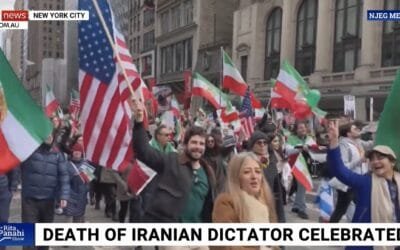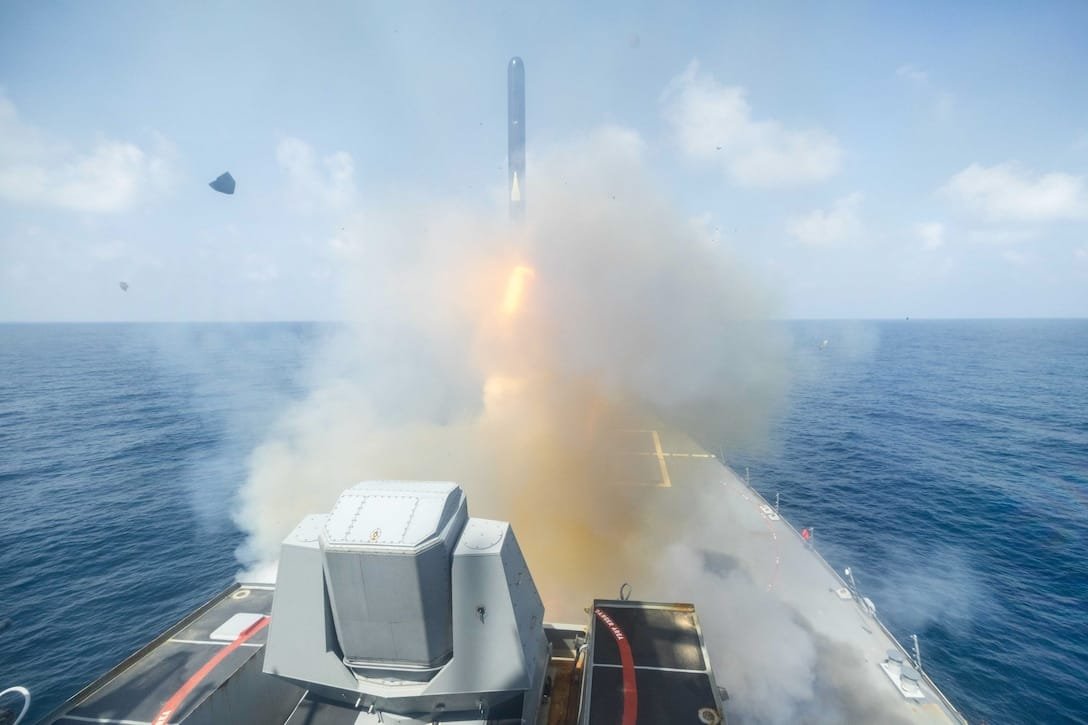
America ended appeasement of Iran last week. For this reason alone, the February 28 military strike against the religionist state is an unequivocal good.
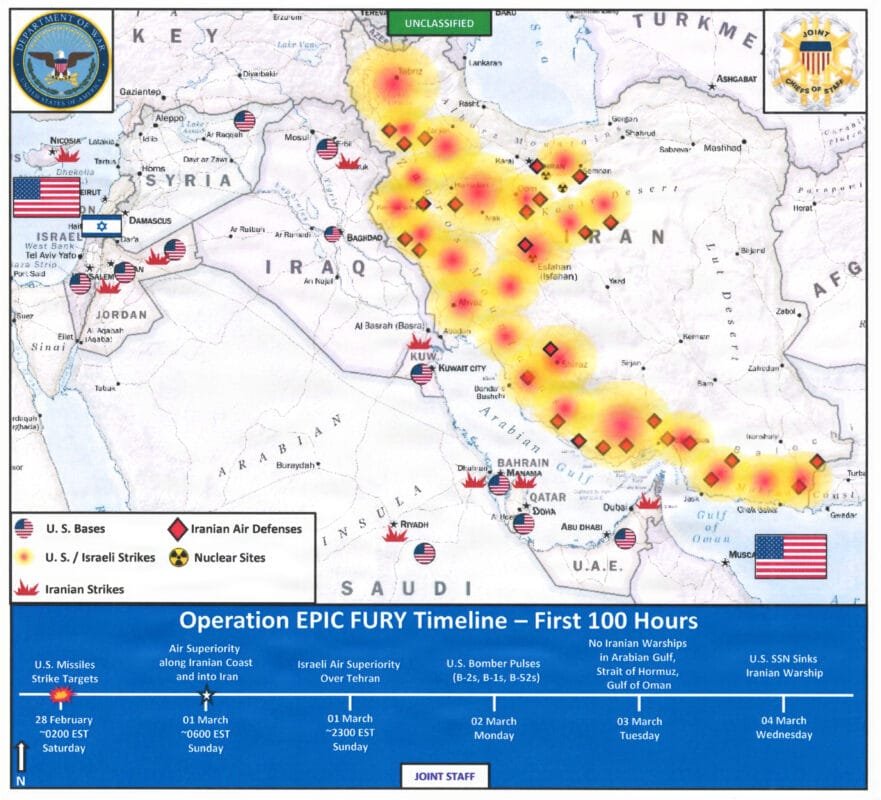
Map detailing the first 100 hours of Operation Epic Fury. (Courtesy Photo U.S. Dept. War)
While it’s tempting to belittle the U.S. action, conducted with our ally, Israel, the low caliber of today’s discourse lends itself to overestimating the retaliation, too. President Trump, America’s 45th and 47th president, targeted for assassination by the Islamic dictatorship, deserves credit, particularly philosophical and moral credit, for defending America against Iran.
Operation Epic Fury ends 47 years of American appeasement of the Iranian terrorist regime
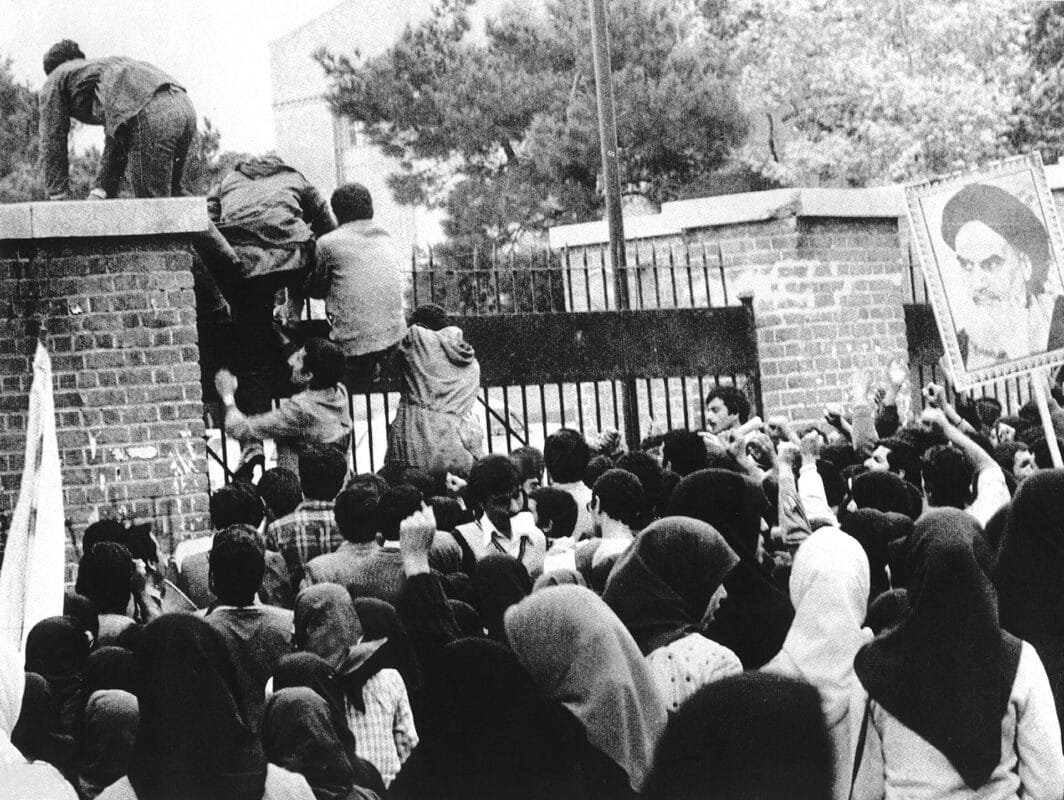
American appeasement began in earnest on November 4, 1979, the day Iran declared war on America, when Ayatollah Khomeini’s thugs stormed the U.S. embassy in Teheran, Iran, seizing Americans and holding 52 Americans as prisoners for 444 days. Despite a previous attack, the embassy’s U.S. Marines were given orders not to shoot.
Americans were blindfolded, beaten and held in dank prison cells, according to the Washington Post. During one interrogation, an Air Force officer had several teeth knocked out. Jihadists told another prisoner, who lived in Virginia, the number of his child’s school bus. It was the beginning of Iran’s systematic military siege against the West. Describing his reaction to the September 11, 2001, attack, one former prisoner, Bill Daugherty, asked: “What took them so long?”
Iranian-sponsored acts of war against America include truck-bombing 241 Marines in Lebanon, the worst single attack on Marines since World War 2, kidnappings, executions and airline hijackings. Iran was linked to the bombing of the U.S.S. Cole in Yemen in 2000. According to the so-called 9/11 Commission, Iran sponsored and/or coordinated the September 11, 2001 attack Leonard Peikoff described as Black Tuesday.
Iran attacked within America long before 2001, sending its “soldiers of God” to Maryland in 1980 to assassinate a former diplomat critical of Islamic fundamentalism, who was gunned down at his Bethesda home. Another target was the U.S. Navy commander whose ship, the U.S.S. Vincennes, had been attacked by Iranian guns in the Persian Gulf. During the American ship’s defense, the Vincennes shot down an Iranian airliner. In 1988, his minivan exploded in San Diego while his wife was driving.
Iran ordered the assassination of writer Salman Rushdie, threatening attacks on his U.S. publisher and U.S. bookstores, while President George Bush—the first Bush president—refused to defend the Americans or retaliate. “Death to America!” chants continued unabated, moving from Teheran streets to Iran’s parliament.
America’s government evaded Iran’s threat to annihilate the U.S. Terms of appeasement were set in 1979, when Iran first declared war and America refused to respond with military action. President Carter, who’d rejected a plan to assassinate Ayatollah Khomeini, an expatriate who had been coddled by France in the suburbs of Paris, instead negotiated with Iran, releasing blocked funds.
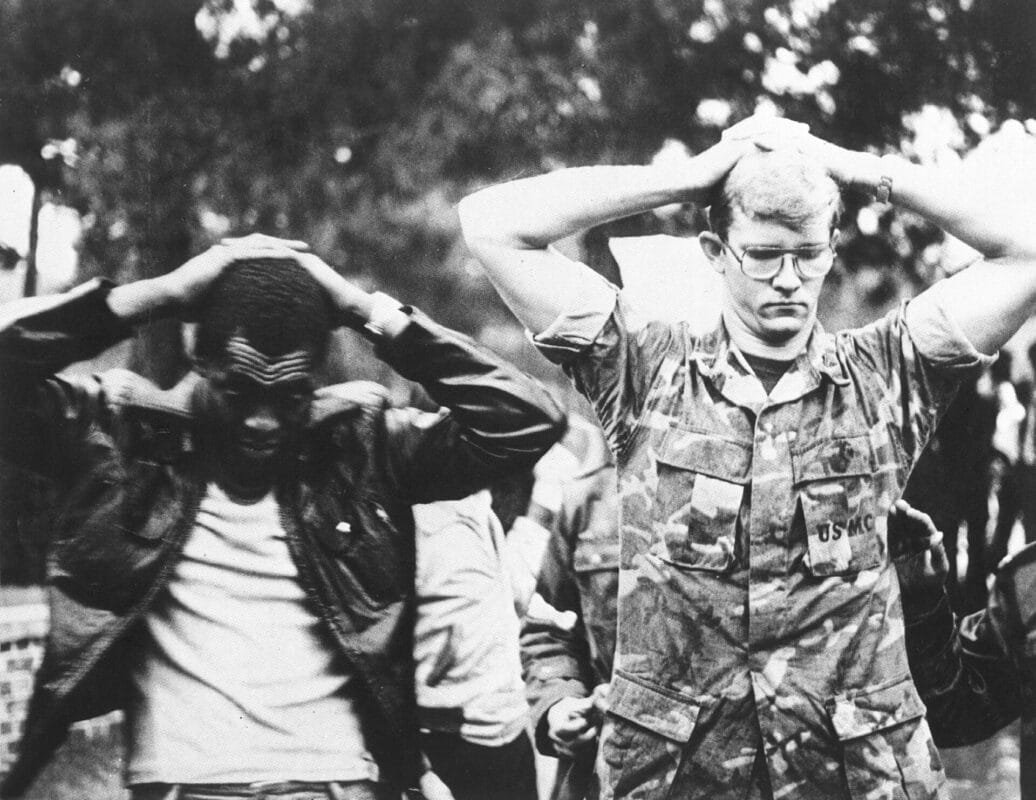
Only then did Iran return America’s prisoners of war in what was wrongly heralded as a victory for America’s new president, Ronald Reagan. Contrary to his reputation as a good leader, Reagan’s presidency began and ended with appeasement of Iran. Jimmy Carter, who defined Iran’s act of war as a crisis set the pre-conditions. Carter referred to prisoners of war with similar language—calling the prisoners hostages, which became the default term to describe Americans who are tortured and beheaded. Evangelical Christian Carter performed rituals—lighting candles and tying ribbons around trees—instead of defending Americans. Carter proved that, when Americans are attacked, America will shrink, cower and reflect—not rise, resolve and respond.
Carter’s appeasement dominated U.S. policy toward Iran. Following Black Tuesday, one of the Teheran prisoners, Moorehead Kennedy, wrote: “When we came back, the State Department didn’t even want to debrief us. They didn’t want to know the names of our captors. The war was over. We had won. Reagan was president. And it would never happen again. And ladies and gentlemen, it’s happened again, and it’s going to happen more.”
Iran besieged the U.S. and our allies over and over. While Iran sponsored Islamic terrorists and manufactured nuclear weapons, President Bush—the second Bush president—like those before him, claimed to defend America while doing the opposite. Bush named Iran as part of an “axis of evil” yet did nothing to defend and retaliate against Iran.
This is the pattern. This is the history. This is the reason America was at higher risk than ever that Iran would wage a diabolical war of mass death of Americans. When Iran attacked America’s embassy—an attack on U.S. soil—Carter negotiated. When Iran attacked America’s Marines, Reagan negotiated. As Iran declared their intention to attack the U.S. with nuclear weapons, Bush, who’d also negotiated with Iran, yielded to Europe and the United Nations. Whatever one can honestly say about President Trump, he ended this appeasement and he did so on principle, calling Iran an “evil” dictatorship and explicitly acting in America’s defense for the sake of America and Americans.
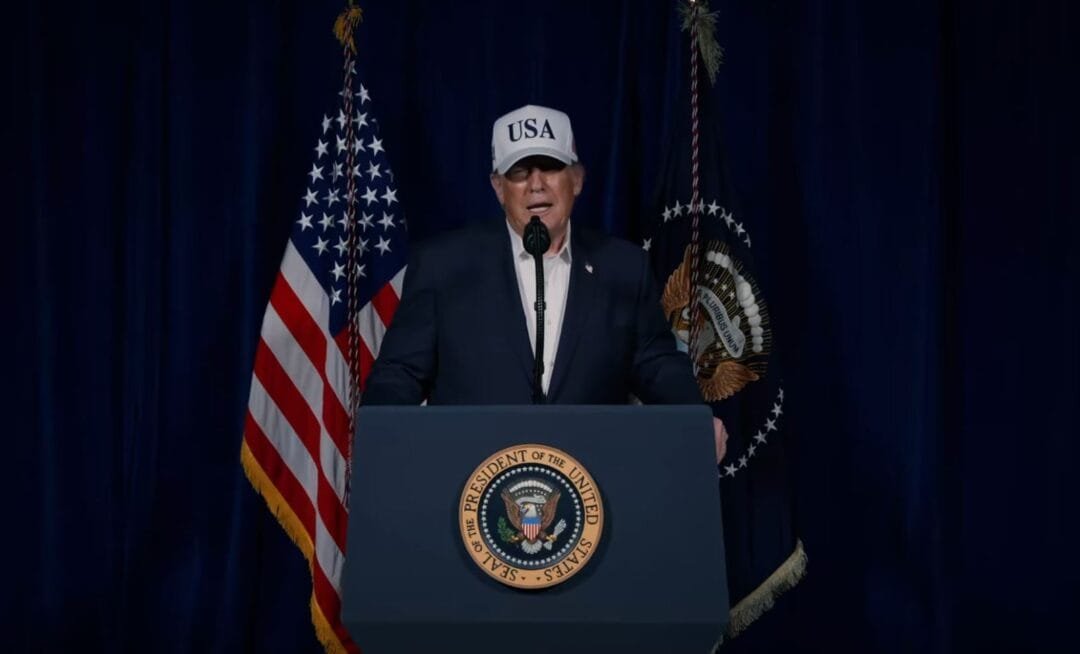
For nearly five decades, America refused to defend itself. Instead, the United States of America acted in altruism and collectivism in foreign and military political affairs. Today’s military campaign, Operation Epic Fury, may be flawed, overdue and too narrow in scope. But America’s first major defense against Iran is an absolutely rational act and a historic exemplar of the virtue of selfishness.
At the request of the author the article title was changed from “Operation Epic Fury ends 47 years of American appeasement of the Iranian terrorist regime” to “Iran Gets Just Deserts” as the phrase, just deserts, was a favorite of Leonard Peikoff‘s during his talk radio program and podcast years.