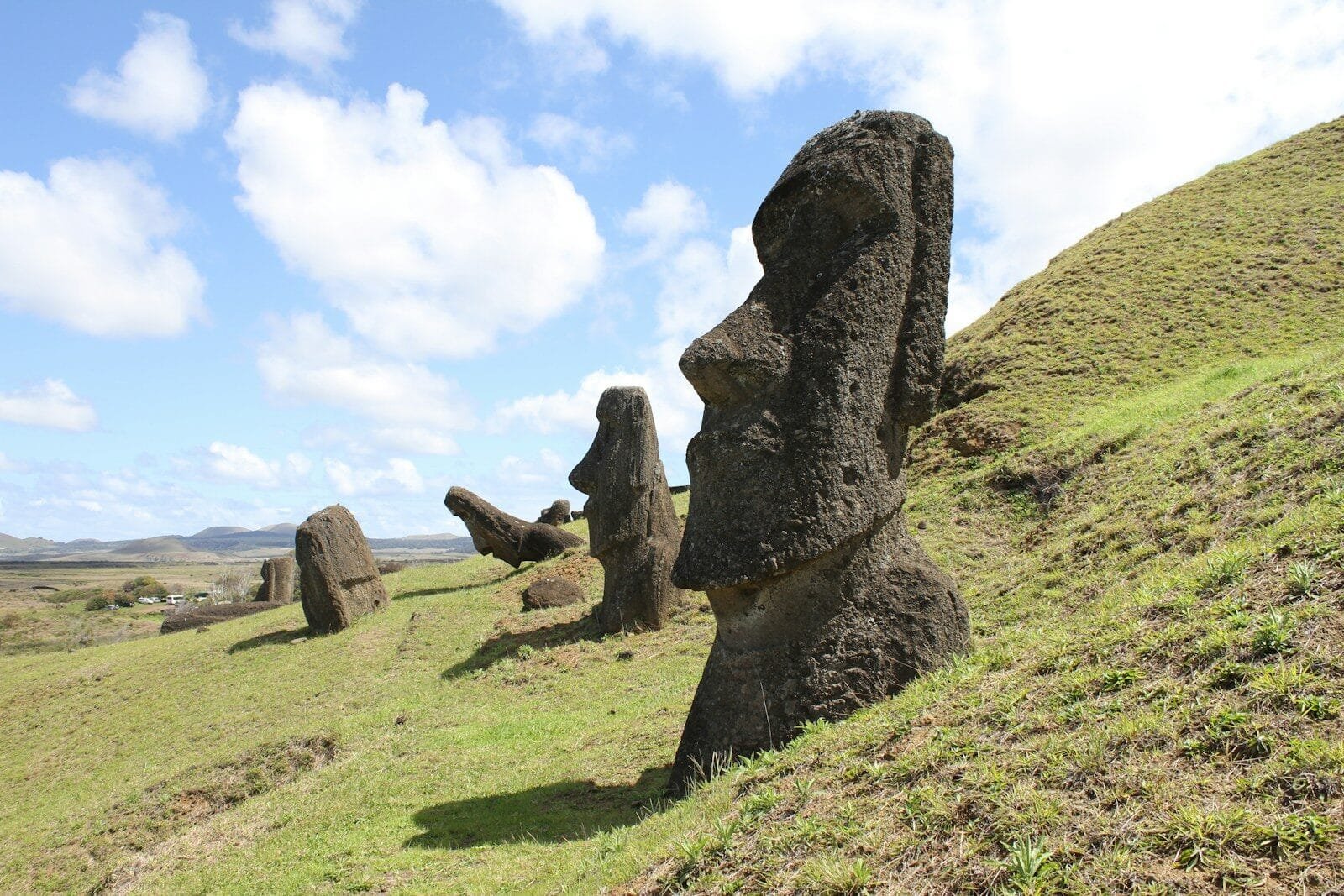
Two islands, both isolated, both harsh—one collapsed into cannibalism and extinction while the other built one of the world’s oldest democracies and survived catastrophes for a millennium. The difference between Easter Island and Iceland can’t be explained by geography alone, and the answer to why one thrived and one died determines whether we see human beings as prisoners of their environment or as problem-solvers who transform any landscape into a foundation for flourishing. The explanation we accept shapes the policies we pursue, the innovations we attempt, and the future we believe is possible.
The Geographic Explanation
Jared Diamond’s Guns, Germs, and Steel won a Pulitzer for answering a question posed by a New Guinean politician named Yali: “Why is it that you white people developed so much cargo and brought it to New Guinea, but we black people had little cargo of our own?” Diamond’s answer demolished racist explanations by demonstrating that geography, not genetics, determined which societies flourished. The east-west axis of Eurasia allowed crops and domesticated animals to spread easily across similar climates, while Africa and the Americas, with north-south axes, faced climatic barriers that slowed diffusion. Eurasia’s advantages compounded: domesticable plants like wheat, barley, and rice produced food surpluses; domesticable animals like horses, cattle, and pigs enabled transport, plowing, and protein; dense populations near livestock bred deadly germs that conferred immunity to Eurasians but devastated isolated populations during conquest.
The result was that Eurasians developed guns, steel weapons, and innovations that allowed them to dominate societies without those geographic advantages. Diamond’s framework replaces vague cultural explanations with concrete environmental factors, showing how contingencies of geography—availability of wheat versus cassava, horses versus llamas—shaped historical trajectories, explaining why the conquistadors sailed east across the Atlantic instead of Inca fleets sailing west to conquer Spain, and why smallpox killed millions of Native Americans while European diseases barely dented Eurasian populations. Environment shapes possibility, and of course societies with better starting conditions succeeded.
But geography doesn’t explain everything.
Easter Island
Easter Island’s story has become the archetype for environmental catastrophe. Polynesian settlers arrived around 1200 AD to find a lush subtropical island where forests dominated and palm trees soared 80 feet high. The population grew, and then it all fell apart. By the time Europeans arrived in 1722, the island was barren, the forests were gone, and the population had crashed from an estimated peak of 15,000 to perhaps 2,000. Archaeological evidence suggests warfare, possible cannibalism, and societal collapse, while the famous moai statues—massive stone figures erected across the island—had been toppled, many deliberately destroyed.
The standard explanation blames resource depletion: the islanders cut trees faster than they regrew, using logs to transport the moai, to build canoes, to fuel fires. Deforestation caused soil erosion, crop yields declined, and without trees for canoes, they couldn’t fish effectively. Famine set in, the population crashed, and violence erupted. Diamond uses Easter Island as a warning that isolation plus finite resources equals inevitable collapse—the island became a closed system, and when resources ran out, the people starved. Geography trapped them; the Pacific Ocean prevented escape or resupply, making them passengers on a doomed vessel.
The lesson is fatalistic: human ingenuity can’t overcome environmental limits, and if you exceed your carrying capacity, you die.
Iceland
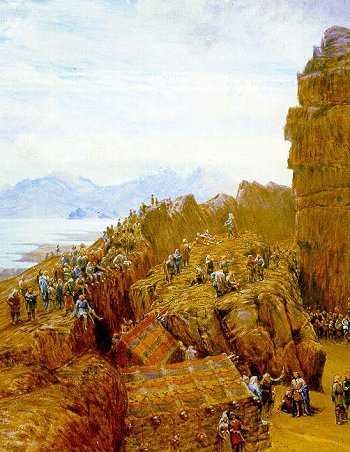 Norse settlers arrived around 870 AD to a volcanic wasteland where Iceland’s climate was harsher than Easter Island’s—subarctic winds, minimal sunlight in winter, volcanic eruptions, frequent earthquakes. The soil was thin, trees were sparse and within decades of settlement nearly all were cut for fuel and construction, and traditional European crops couldn’t grow—wheat failed and barley barely survived. If geography determines outcomes, Iceland should have collapsed faster than Easter Island.
It didn’t.
Instead, Icelanders built the Althing in 930 AD—one of the world’s oldest parliaments—and developed a literate culture that produced the Sagas, epic prose narratives that preserved Norse mythology and history. They maintained trade networks despite isolation, exporting wool and fish to Norway in exchange for grain and goods, and they survived volcanic eruptions, famines, plagues, and political subjugation. The Althing wasn’t just symbolic; it functioned as a legal assembly where disputes were adjudicated, laws were debated, and alliances were forged, with chieftains gathering annually at Thingvellir and bringing their disputes before a council of judges.
The system prevented blood feuds from spiraling into societal collapse.
The Sagas served a parallel function, not as mere entertainment but as encoded repositories of legal precedents, genealogies, property claims, and cultural values. Literacy wasn’t reserved for an elite priesthood—Icelanders cultivated widespread literacy among freemen, enabling knowledge transfer across generations so that when catastrophe struck, the cultural memory survived because it was written down and distributed.
In 1402, plague arrived—likely pneumonic plague, which kills virtually everyone infected—with mortality estimates ranging from 30% to 60% of the population. Farms were abandoned and entire communities vanished, as the Bishop’s Annals record the horror: “Many farms were devastated, and on most farms only three or two survived, sometimes children, usually two or mostly three, and some of them yearlings, and some sucking their dead mothers.”
A second plague struck in 1494, killing 30-50% of the population, and then came the Laki eruption in 1783—one of the most catastrophic volcanic events in recorded history. For eight months, the Laki fissure spewed lava and gases across southern Iceland while hydrofluoric acid and sulfur dioxide poisoned the soil, causing crops to fail and killing 50% of cattle and 80% of sheep. Famine killed 20% of the human population, yet Iceland’s challenges exceeded Easter Island’s with a harsher climate, fewer resources, and repeated catastrophes on a scale Easter Island never faced.
Iceland should have been the textbook collapse.
But it recovered. Every time.
After the plagues, Iceland rebuilt; after Laki, despite losing one-fifth of its population and most of its livestock, the society stabilized within a decade. By 1801, births exceeded deaths and population growth resumed, and Iceland didn’t just survive—it preserved its culture, maintained its institutions, and became one of the most prosperous nations per capita in the world.
What did Iceland have that Easter Island lacked?
The Limits of the Geographic Lens
Diamond’s framework explains why Iceland faced harsher conditions than Easter Island, why both societies struggled with resource constraints, and the proximate causes like deforestation on Easter Island, volcanic eruptions in Iceland, and plague mortality in both. But it doesn’t explain divergence—why did one collapse and the other endure when geography can’t answer that question because the environmental variables don’t favor Iceland? Easter Island had better climate, more arable land, and fewer catastrophic disruptions, so if determinism held, Easter Island should have thrived while Iceland collapsed.
The opposite happened.
Diamond’s framework emphasizes the importance of domesticable animals, noting that Eurasia had horses, cattle, pigs, and sheep while the Americas had llamas and alpacas in the Andes, and he argues that llamas were inferior to horses—smaller, less useful for transport, unable to pull plows. But this raises a question: why didn’t South American civilizations fully exploit llamas the way Eurasians exploited horses when the animals were there and the potential existed? Horses started as wild, small, skittish animals that humans bred, trained, and developed harnesses and saddles and techniques for using in agriculture and warfare through a process that took ingenuity, not just proximity to the right species.
Llamas could have been bred for size, strength, and temperament; they could have been used more extensively for transport and agriculture since the resources existed, but the knowledge didn’t spread. Diamond’s answer points back to geography—the north-south axis of the Americas slowed diffusion and climatic barriers prevented innovation spread—but that doesn’t explain why some societies innovate within constraints and others stagnate.
Easter Island and Iceland shatter the deterministic model since both were isolated, both faced resource limits, and both endured catastrophes, yet one died and one thrived. Geography can’t explain the difference.
The Variable That Matters
The difference wasn’t the environment—it was culture. Iceland maintained trade despite isolation, and when plague killed half the population, survivors reorganized rather than fragmenting. When Laki destroyed crops and livestock, Icelanders relied on coastal fishing communities, rationed grain, and accepted aid from Denmark—grudgingly and inefficiently, but enough to prevent collapse. The adaptation was concrete: after Laki, Icelanders shifted to fishing along the coast where the eruption’s effects were minimal, traded wool for grain despite livestock losses, reorganized land holdings to concentrate remaining resources, and maintained the Althing even when starvation loomed, using legal mechanisms to distribute aid and settle disputes over scarce resources. The institutions bent but didn’t break, and this wasn’t accidental—the culture prized survival and adaptability.
The Sagas are filled with heroes who survive through cleverness, not just strength, with Egil Skallagrimsson earning fame for composing poetry that saves his life, for navigating political intrigues, for adapting to changing circumstances. The cultural heroes embodied the values the society needed to survive: flexibility, intelligence, willingness to change strategies when conditions shifted.
Easter Island didn’t adapt—when the forests disappeared, the islanders kept cutting; when crop yields declined, they didn’t shift strategies; and when population exceeded sustainable limits, they built more moai instead of conserving resources. Statue-building competitions between clans intensified as resources became scarce—exactly the opposite of rational adaptation—because the moai weren’t religious monuments alone but representations of clan prestige. Each clan competed to erect larger, more elaborate statues than their rivals, creating a status arms race where transporting a 14-ton statue required hundreds of workers, miles of rope, and trees to roll the moai across the island. As forests thinned, the clans didn’t stop—they escalated with larger moai, longer transport routes, and more trees cut while more labor was diverted from farming and fishing.
The last trees were cut when everyone could see the catastrophe coming, but no clan could afford to stop building while rivals continued since the prestige system locked them into collective suicide.
The individual who cut the last tree wasn’t stupid—he was trapped in a cultural framework where status mattered more than survival.
The difference wasn’t resources but willingness to change behavior in response to evidence. Iceland had a culture that valued literacy, trade, legal institutions, and adaptive problem-solving, with the Sagas celebrating cleverness and resilience rather than just martial prowess, while the Althing provided a forum for dispute resolution that prevented clan warfare from destroying society and literacy enabled knowledge transfer across generations. Trade networks meant Iceland wasn’t truly isolated, so when famine struck, Norwegian merchants brought grain; when plague decimated the population, survivors inherited land and consolidated holdings rather than fragmenting into warring factions; and the legal system provided mechanisms for property transfer, debt settlement, and dispute resolution that maintained social cohesion through catastrophe.
Compare this to Easter Island, where no trade networks existed and Pacific isolation was absolute, no legal institutions mediated disputes between clans, and prestige came from monument-building rather than from problem-solving or resource management. When resources became scarce, the culture had no mechanism to shift course since the only status available came from the same activities that were destroying the island. Easter Island had a culture built on prestige competition through monument-building where clans demonstrated status by erecting larger moai, which required more trees, more labor, more resources, and the competition became existential—cutting the last tree wasn’t irrational in that cultural framework because it was necessary to maintain status. The society locked into a system that couldn’t adapt.
Geography provided the constraints, but culture determined whether societies solved the problems those constraints created.
The Mechanisms of Cultural Survival
The difference between Iceland and Easter Island reveals itself in specific mechanisms, not vague cultural superiority. Iceland had institutional redundancy—when farming failed, fishing sustained the population; when trade with Norway stalled, local production compensated; when plague killed half the population, legal mechanisms for property consolidation prevented fragmentation. Multiple systems provided multiple paths to survival, whereas Easter Island had a single-point failure: the moai culture required trees, and when the forests disappeared, the entire status system collapsed with no alternative source of prestige existing and no institutional mechanisms channeling competition into productive rather than destructive activities. The culture was fragile because it depended on a resource that could be exhausted.
Iceland had external connections where trade meant access to grain when local crops failed, Norwegian merchants brought news and technology and innovations, and the Althing’s structure was influenced by Norse legal traditions imported from Scandinavia. External knowledge supplemented local adaptation, while Easter Island had none—isolation meant no external ideas, no trade, no rescue. The Polynesians who settled the island arrived with sophisticated navigation and seafaring traditions, but after settlement, those traditions atrophied so that by the time Europeans arrived, the islanders had forgotten how to build ocean-going canoes. The knowledge was lost because nothing reinforced its use.
Iceland had literacy, where written records preserved knowledge across generations—legal precedents, farming techniques, genealogies, stories—all survived catastrophes because they were recorded so each generation didn’t have to rediscover what previous generations learned. Easter Island had oral tradition where knowledge survived only as long as the people who held it, meaning that when plague or famine killed the elders, the knowledge died with them. The rongorongo script—Easter Island’s writing system—remains undeciphered because the people who could read it were dead before anyone recorded how it worked, making knowledge fragile.
These aren’t accidents of geography but choices—societies chose to maintain trade or isolate, to build institutions that channeled competition productively or destructively, to preserve knowledge through writing or rely on memory, to create redundancy or concentrate all status in a single exhaustible resource. Geography shaped the difficulty of those choices, but it didn’t determine the outcomes.
The Question We Avoid
If geography determines outcomes, then human beings are passengers—victims or beneficiaries of environmental luck—and policies focus on redistribution, on compensating those born in unfavorable locations for accidents of geography, while innovation becomes secondary to managing finite resources and progress becomes zero-sum. But if ideas determine outcomes, then human beings are agents, policies focus on creating conditions where innovation thrives and knowledge spreads and adaptive cultures outcompete static ones, resources become problems to solve rather than limits to accept, and progress becomes infinite. The choice between these frameworks shapes how we respond to every challenge from climate change to economic inequality.
Diamond’s geographic determinism offers absolution—societies failed because they drew a bad hand, no one is responsible, and outcomes were inevitable. But that erases the most important variable: human agency. It ignores the Icelanders who chose to trade rather than isolate, to fish when farming failed, to rebuild after plagues that would have destroyed less resilient cultures, and it ignores the Easter Islanders who chose prestige competition over survival and cut the last tree despite knowing it doomed them.
Those choices mattered. Culture mattered. Ideas mattered.
Geography shaped the stage, but ideas wrote the script.
What Comes Next
Diamond’s framework is seductive because it explains so much—the east-west axis, the domesticable species, the germs—and denying their importance would be absurd. But treating them as determinism is equally absurd since geography alone can’t explain why some isolated, resource-poor societies like Iceland thrived while others like Easter Island collapsed.
The missing variable is ideas: the ability to generate new knowledge, to adapt to changing conditions, to build institutions that preserve and transmit solutions across generations, and the willingness to abandon failing strategies and embrace innovation. In the next part of this series, we’ll examine the thinker who identifies this missing variable and restores human agency to history—a physicist and philosopher who argues that the story of human progress isn’t about maps and animals and germs but about explanations, and the societies that figure out how to create better ones.
The difference between Easter Island and Iceland wasn’t geography but whether they could solve problems faster than new problems emerged—one couldn’t, one could. That’s the difference between static versus dynamic cultures.