Throughout modern history, the story of gold has unfolded in cycles — crises, recoveries, and rediscoveries. But what’s happening now is not just another rally driven by inflation fears or a nostalgic nod to the 1970s. It’s the beginning of a structural reset — one that reveals as much about the world’s financial system as it does about gold itself.
The Debt Trap and the Age of Inflation
Western economies, led by the United States, are now prisoners of their own debt. Mandatory spending on programs like Social Security and Medicare, ballooning military costs, and rising interest payments have made trillion-dollar deficits a permanent feature of government budgets.
The political system cannot default on these promises without risking upheaval. That leaves only one option: a policy of continuous monetary inflation — quietly eroding the value of the dollar to shrink the real burden of debt. Inflation is no longer a threat to the system; it’s the system itself.
For savers and investors, that means one thing: protecting dollar-based wealth now requires moving part of it outside the dollar system — into assets that cannot be printed. Gold and silver, the oldest forms of money, are again becoming the most rational hedge.
A Surge Like No Other
As of October 2025, gold has approached $4,000 per ounce, while silver nears $50. Year-to-date, gold is up roughly 45%, the strongest move since 1979 — the year before gold’s infamous spike to $850.
That comparison invites an obvious question: Is this 1979 all over again?
The answer, as we’ll see, is no. What’s happening today is not a blow-off top. It’s a revaluation of money itself.
The Quiet Buyers Behind the Boom
The first and most important driver of this bull market isn’t retail speculation. It’s central banks.
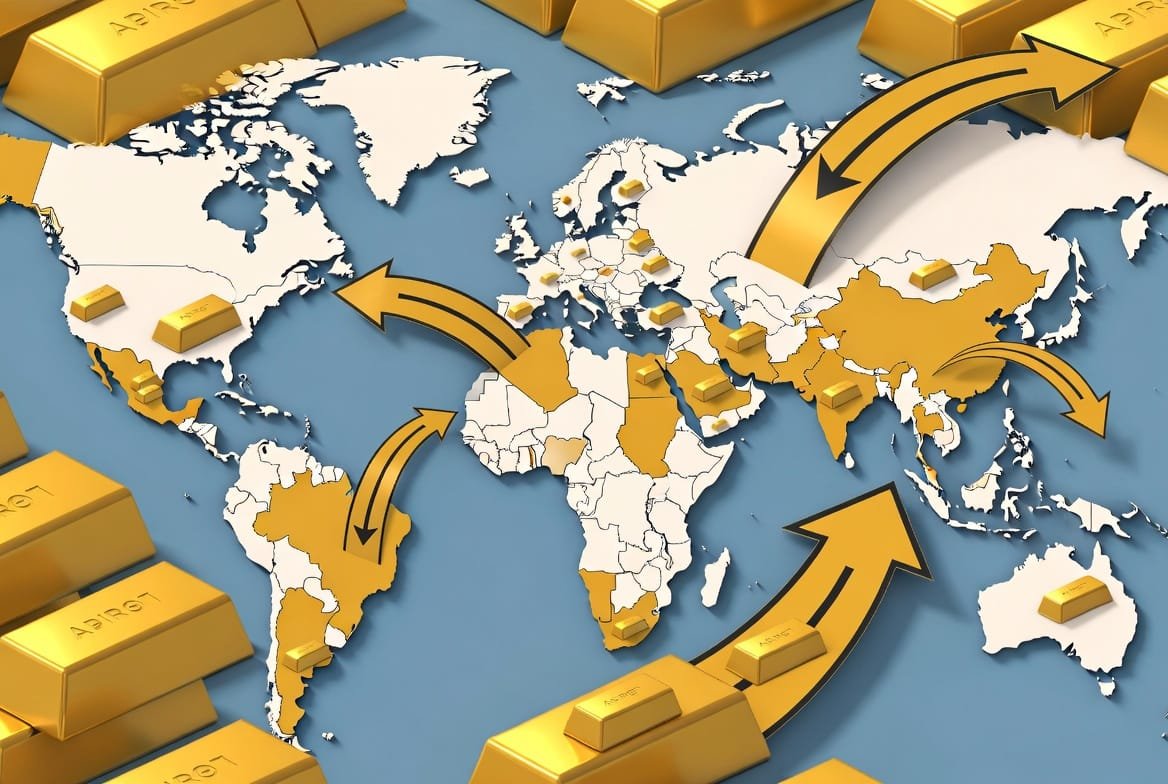
Across Asia, central banks and sovereign wealth funds have been diversifying away from U.S. Treasuries — the traditional “safe asset” — and replacing them with gold. Bloomberg now reports that the dollar value of gold held by central banks has surpassed their Treasury holdings.
This marks a monumental shift: gold has quietly reclaimed its role as the preferred reserve asset of the world’s monetary authorities.
China leads this transformation. Through the Shanghai Gold Exchange (a subsidiary of the People’s Bank of China), Beijing is building the infrastructure of a new global settlement system centered on gold. It’s establishing new vaults in Hong Kong and Saudi Arabia, encouraging oil exporters to accept yuan and convert it to gold — effectively creating an oil-for-gold loop.
By inviting other central banks to store bullion in Shanghai, China is replicating what the United States did after World War II — positioning itself as custodian of the world’s reserves. But this time, the collateral is not dollars. It’s gold.
Why Gold, and Why Now
For emerging nations, gold’s appeal is simple: it’s neutral money. It can’t be frozen, sanctioned, or inflated away.
When the U.S. seized Russia’s dollar reserves in 2022, every finance minister in the developing world took note. If dollar reserves can be weaponized, they are no longer “risk-free.” The global South began quietly migrating its wealth into a medium beyond political control.
Gold’s role as “the neutral reserve asset” has thus been reborn — and China is accelerating that process with every new vault it opens.
How High Could Gold Go?
History suggests that when gold revalues, it does so in multiples, not percentages.
Since the U.S. left the gold standard in 1971, there have been three major bull markets. Each saw gold rise between 5.6 and 8.2 times from trough to peak. Using the 2015 low of $1,015 as a base, a comparable move would imply prices between $6,000 and $8,000 per ounce.
Analysts at major institutions are already racing to catch up:
- J.P. Morgan: $4,200 by year-end, $6,000 by 2029.
- Goldman Sachs: $5,000 near-term.
- Jefferies: $6,600 to match gold’s 1980 share of disposable income.
- GoldFix and Capital Wars analysts: between $10,000 and $12,000 based on global liquidity and M2 growth.
- Even at $4,000 today, gold represents less than 20% of the value of foreign-held U.S. Treasuries — far below the 100% ratio reached at the 1980 peak. To equal that “collateral parity,” gold would need to exceed $30,000 per ounce.
These aren’t forecasts — they’re reference points showing how far we still are from a bubble.
Silver: The Overlooked Partner
Silver’s rally has been even more explosive. Analysts like Michael Oliver call it a “new price reality,” with potential to reach $52 and even $140 per ounce.
Meanwhile, the U.S. is considering declaring silver a strategic metal due to its military and industrial importance. A government stockpiling program would, in effect, create a price floor — meaning the downside for silver could soon be limited by policy itself.
Why This Isn’t 1979
Superficially, the 1979 gold price chart looks similar to today: stubborn inflation, gold surging, investor excitement. But the underlying dynamics could not be more different.
In 1980, the Federal Reserve under Paul Volcker slammed interest rates to 20%, crushing inflation and making bonds more attractive than gold. At that time, U.S. debt was only 30% of GDP — high rates were painful but sustainable.
Today, debt exceeds 100% of GDP. Raising rates high enough to curb inflation would bankrupt the Treasury. Inflation, far from being an aberration, is the lubricant that keeps the system running.
Back then, central banks were dumping gold. The IMF sold hundreds of tons. The U.S., U.K., and Europe followed suit, culminating in “Brown’s Bottom” in 1999.
Now, the same institutions are buying hand over fist — including China, Russia, India, and even Western treasuries seeking to rebuild reserves. The supply–demand equation has reversed.
The Long Monetary Reset
This is not a speculative bubble; it’s a process — a gradual rebalancing of the world’s financial system. The dollar’s role as the uncontested global reserve is being diluted, and gold is being reintroduced as neutral collateral in trade and credit markets.
As the essayist Bob Farrell once wrote, “By the time secular trends are acknowledged by the majority, they are already mature.” The secular shift toward hard assets has begun, even as most Western investors remain oblivious.
They are like the young fish in the old parable who don’t know what water is. For decades, investors have swum in the water of cheap credit and rising asset prices. That current has now turned — and they still expect it to carry them forward.
How Much Gold Should You Own?
For the average investor, a 10–15% allocation to precious metals is prudent. Ray Dalio and Jeffrey Gundlach suggest even higher.
I personally maintain about 20% of my portfolio in gold, silver, and mining shares — a level that reflects both conviction and experience. For most, a smaller share is appropriate, but having none is a mistake.
If you’re new to this, start with physical gold — a few coins or bars — and forget about them. Store them safely. Don’t trade them. Their purpose is not speculation; it’s preservation.
The Human Element
Gold investing isn’t only about economics. It’s about psychology — learning to detach your sense of security from paper promises.
In the near term, expect volatility. As one analyst put it, this bull market will be a “marathon of sprints” — sharp rallies followed by equally sharp corrections. But the long-term direction remains clear.
This is not a temporary rush. It’s the repricing of faith itself — from trust in governments to trust in tangible value.
Closing Thoughts
We are witnessing the slow construction of a new monetary architecture — one that quietly re-centers the global system around neutral, real assets. Gold’s ascent is not a symptom of chaos, but of recalibration.
For decades, Western investors dismissed gold as a relic. Now, the rest of the world is buying it — not out of nostalgia, but necessity.
Whether you participate or not, the Great Gold Reset is already underway.
And as always, amid the noise of markets and media, keep your promises to yourself — financial and otherwise. In my case, that promise is to never miss another Jackson Hole autumn. A commitment to something real.
Like this piece, tell your friends, but above all, buy some gold!