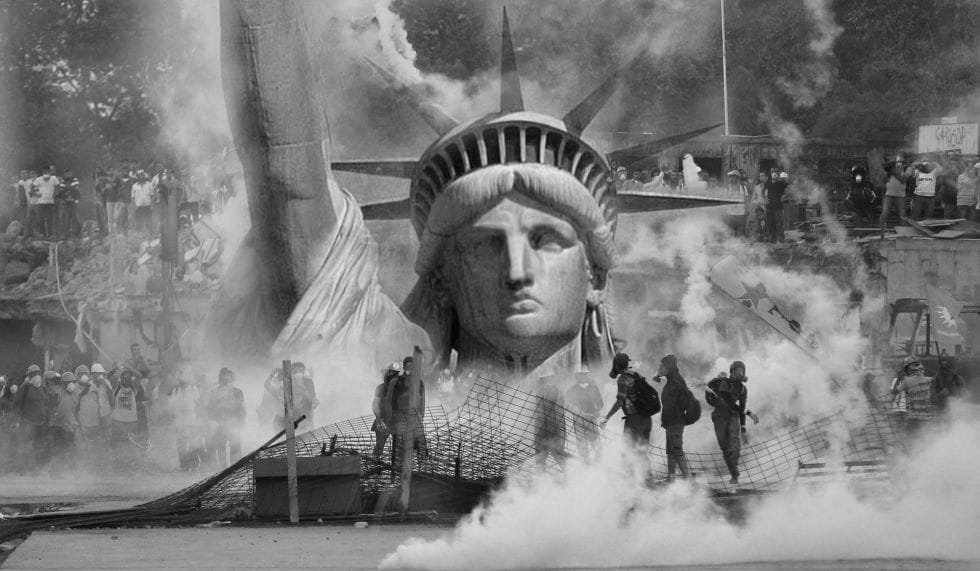
The immigration debate has two poles and no center.
On the left: open borders, moral universalism, the claim that national membership is an arbitrary construct that free people should ignore. On the right: restriction as identity, the nativist instinct dressed in civilizational language, walls as tribal markers rather than rational policy. Both positions generate heat. Neither produces a framework capable of surviving contact with reality.
There’s a third position. It doesn’t get much air because it requires actual thinking.
A rational immigration system starts with a question neither side will ask: what does this country owe the people already in it? Not what it owes the world. Not what sentiment demands. What do Americans—the people who built this country, who sustain it, who pass it to their children—owe themselves?
The answer determines everything.
The Foundation
In a previous article for Capitalism Magazine—Ayaan Hirsi Ali, ICE, and Illegal Immigration—I examined Ali’s analysis of what mass unvetted immigration actually produces. Drawing from her Somali background and decades observing immigrant communities in the West, Ali described how concentrated populations import pre-modern social structures incompatible with liberal democracy. The clan system she documents operates as a complete alternative to Western civic order: children learn bloodline loyalty before anything else, welfare fraud becomes normalized because public benefits are viewed as communal resources to exploit, and internal clan loyalty supersedes external law. Islam, in its Islamist political form, amplifies these dynamics—turning ethnic enclaves into unified voting blocs advancing values hostile to individual rights and secular governance.
The piece examined the enablers who praised Ali’s warnings while recoiling from the enforcement those warnings demand. It made the case that ICE agents enforcing existing law aren’t the threat to American values. The accumulated mass of people who broke the law to enter, refuse to assimilate, and exploit systems meant for citizens—that’s the threat.
This article asks the natural next question: if the current system fails, what does a rational one look like?
Whose Country Is This?
Start with what’s actually at stake.
America isn’t an abstraction worth preserving for institutional reasons. It’s a country belonging to the people already here—their property, their civic inheritance, the framework their labor and sacrifice built and sustains. Immigration policy isn’t about the health of government structures. It’s about whether Americans have the right to determine who joins them, on terms that serve their interests rather than eroding them.
They do. And that right doesn’t require elaborate justification.
Rights are inherent in human nature—discoverable by reason, not granted by governments. A government doesn’t create rights; it either recognizes and protects them, or it violates them. The man on a desert island has rights. He just has no recourse if they’re violated. What political frameworks provide isn’t the rights themselves but the conditions under which those rights can be expressed and defended.
This matters for immigration because it reframes the entire question. The issue isn’t preserving institutions. It’s protecting the people whose rights those institutions exist to serve. Americans have a rational self-interest in admitting people who will strengthen that protection and excluding people who will undermine it. That’s not jingoism. It’s the same logic that justifies any property right: you can exclude people from your home not because you hate them, but because the alternative makes ownership meaningless.
A nation that cannot control its membership cannot protect its people. That’s the beginning and end of the sovereignty argument.
The Standard Is Values, Not Blood
Here’s where the nativism charge collapses.
Cultural origin is not ethnicity. Norway has centuries of civic order, rule of law, low corruption, and individual accountability embedded in its institutions. Somalia collapsed into clan warfare, tribal loyalty, and Islamist supremacism that subordinates civil law to religious authority. Those are facts about cultures—their institutions, their operating assumptions, their track records. They are not facts about bloodlines.
A rational system uses cultural origin as a probability assessment, not a determinant. An applicant from a society with deep Enlightenment roots carries a higher prior probability of compatibility with Western civic values than an applicant from a society built on clan loyalty and religious supremacism. That’s pattern recognition applied to cultural evidence. It means more scrutiny for higher-risk applications—not automatic exclusion, never ethnic exclusion.
The screen is behavioral and values-based at the individual level. Employment history. Civic conduct. Language acquisition. Demonstrated renunciation of loyalty structures incompatible with liberal democracy—clan primacy, sharia supremacy over civil law, ethnic solidarity that treats public institutions as resources to exploit rather than frameworks to inhabit. These are observable behaviors. They apply regardless of origin.
Ayaan Hirsi Ali walked through the door this system would build. She’s Somali. She fled Islamic oppression, genital mutilation, forced marriage, and clan warfare. She arrived in the West, learned the language, assimilated completely, and spent decades defending Enlightenment values against the pathologies she escaped. Under a rational system, she gets in. She’s exactly who you want.
The Islamist operative who learned to speak her language also gets scrutiny. That scrutiny is the point.
The Dissident Problem
Dissidents from authoritarian systems are frequently the best immigrants a country can receive. They self-selected out of systems built on tribal loyalty, religious submission, or political terror. They took real risks to reject those systems. They understand, from lived experience, what the alternative to Western liberalism actually produces. Ali is the archetype. So are the Cubans who fled Castro, the Iranians who fled the revolution, the Eastern Europeans who survived communism and arrived understanding exactly what they’d escaped.
They often make better Americans than people born here—because they chose it, deliberately, at cost.
But defecting from an authoritarian system takes either extraordinary courage and values, or extraordinary cunning and opportunism. The same journey produces both. The genuine political refugee and the Brotherhood operative who learned to perform liberal commitments took the same flight. A rational system has to tell them apart.
This is why the dissident category demands more scrutiny, not less—and more sophisticated scrutiny. Surface signals aren’t enough. You’re looking for demonstrated behavior over time, not performed values under interview conditions. Employment record. Community integration. What organizations they joined. What they said when they thought no one important was listening. The genuine dissident leaves a trail of actual assimilation. The opportunist leaves a trail of strategic accommodation.
These are hard calls. They require judgment, resources, and institutional competence. A rational system invests in that competence rather than pretending the problem doesn’t exist or that blanket exclusion solves it.
What This System Actually Does
It selects for demonstrated compatibility with Western civic values. Cultural origin sets the scrutiny level. Individual behavior and values determine the outcome.
This isn’t restriction. It’s selection. The distinction matters: restriction is about keeping people out; selection is about determining who strengthens what you’re trying to preserve. America built itself on selection—immigrants who came to become American, who assimilated, who saw opportunity rather than extraction, who adopted civic values rather than importing the systems that destroyed their countries of origin.
That standard isn’t nostalgia. It’s the operating principle that made the intake of millions work. The current system abandoned it. The results are exactly what abandoning it produces.
Both Sides Fail
The open-borders position isn’t owned by the left. Libertarians make the same argument with different branding. Both invoke freedom. Both arrive at the same destination: unrestricted entry, assimilation optional, cultural incompatibility a bigoted fiction. As I documented in the Ali piece, the result is parallel societies that maintain clan loyalty, exploit welfare systems, form political blocs to expand state dependency, and import pre-modern frameworks hostile to individualism.
The economic reality is straightforward. Productive immigrants cover their own costs and often generate surplus—they build businesses, employ people, pay taxes, contribute to the society they joined. Unproductive immigrants do the opposite: they consume resources others produce, increase costs across public systems, and lower living standards for the citizens funding them. The distinction isn’t origin. It’s output. A rational system selects for the former and excludes the latter.
The libertarian answer—simply deny immigrants access to welfare and the problem solves itself—doesn’t survive scrutiny. Cutting benefits doesn’t compel productivity. It doesn’t transform someone habituated to clan dependency into a self-supporting individual. It doesn’t dissolve the loyalty structures that treat public institutions as resources to exploit. People from cultures built on collective extraction don’t become producers because you’ve closed one avenue of extraction. They find others—or they don’t, and the costs shift from direct welfare to emergency services, law enforcement, courts, and prisons. The bill doesn’t disappear. It just moves.
Which brings the second cost that open-borders advocates consistently ignore: crime.
This isn’t a generalization about individuals. It’s a pattern recognition about cultures. Societies that collapse into clan warfare, where law is an obstacle rather than a framework, where violence is the primary mechanism of dispute resolution—those societies export people habituated to lawlessness. Not every person. But enough to matter, at scale, concentrated in communities that reinforce rather than correct those habits. The data from communities with high concentrations of unvetted immigrants from high-crime cultures is not ambiguous. Rape, assault, robbery, gang activity—these rise. American citizens, particularly in working-class communities that absorb these populations, pay the cost in safety, property values, and quality of life. Their government imposed that cost on them without their consent.
In a welfare state—which is what we have, whatever we wish we had—unrestricted entry doesn’t produce voluntary charity. It produces forced wealth transfer from citizens to non-contributors, mandated by the government.
This isn’t compassion. It’s conscription.
Every dollar of welfare consumed by someone who entered illegally and rejects assimilation is extracted from Americans by government force. Every hospital bed occupied, every classroom resource diverted, every public service consumed by people who crossed illegally and maintain contempt for the country funding them—that’s compelled sacrifice. Not voluntary generosity. Not private charity. Government-mandated transfer from citizens to people who broke the law to be here and intend to remain hostile to the values that built what they’re extracting.
The open-borders advocate who invokes individual rights to justify this arrangement isn’t making a liberty argument. He’s making the altruist argument with libertarian branding. He’s using the language of rights to mandate the one thing a rights-based government exists to prevent: the sacrifice of its people to others’ benefit by force.
And when a government deliberately admits people inimical to its citizens’ values—people who reject assimilation, who maintain parallel loyalties, who increase crime, who vote to expand the apparatus extracting from the citizens funding them—that government has inverted its entire purpose. It no longer protects its people. It conscripts them in service of their displacement. That isn’t policy failure. It isn’t misguided compassion. It is a moral atrocity: a government turned against the people it exists to defend.
You cannot invoke rights to mandate sacrifice. You cannot claim to defend liberty while engineering its systematic extraction. The contradiction doesn’t bend under pressure. It breaks.
The nativist right fails differently. When restriction becomes ethnic identity rather than values screening, it abandons the principled ground that makes the position defensible. It would exclude Ali. It would have excluded the Cuban refugees who became the most reliably pro-liberty voting bloc in Florida. It treats origin as destiny and collapses the distinction between culture and blood that makes rational selection possible. Tribalism dressed in civilizational language is still tribalism. It’s also an argument that can’t survive contact with a single counterexample—and history provides thousands.
A rational system satisfies neither side. It gives Americans what they’re actually owed: a framework that serves their interests, on their terms, without apology.
The Principle
This is our country. The people here built it, sustain it, and have every right to determine who joins them. The standard for joining is values—demonstrated through behavior, informed by cultural probability, indifferent to ethnicity. Higher scrutiny where cultural distance from Western norms is greater. Active welcome for those who fled the pathologies we’re screening against, once they’ve proven the flight was genuine.
Rigorous. Non-arbitrary. Completely defensible.
Everything else—open borders, ethnic restriction, the performative compassion that sacrifices citizens to abstractions—is sentiment dressed as policy.
Americans deserve better than sentiment. It’s their country.