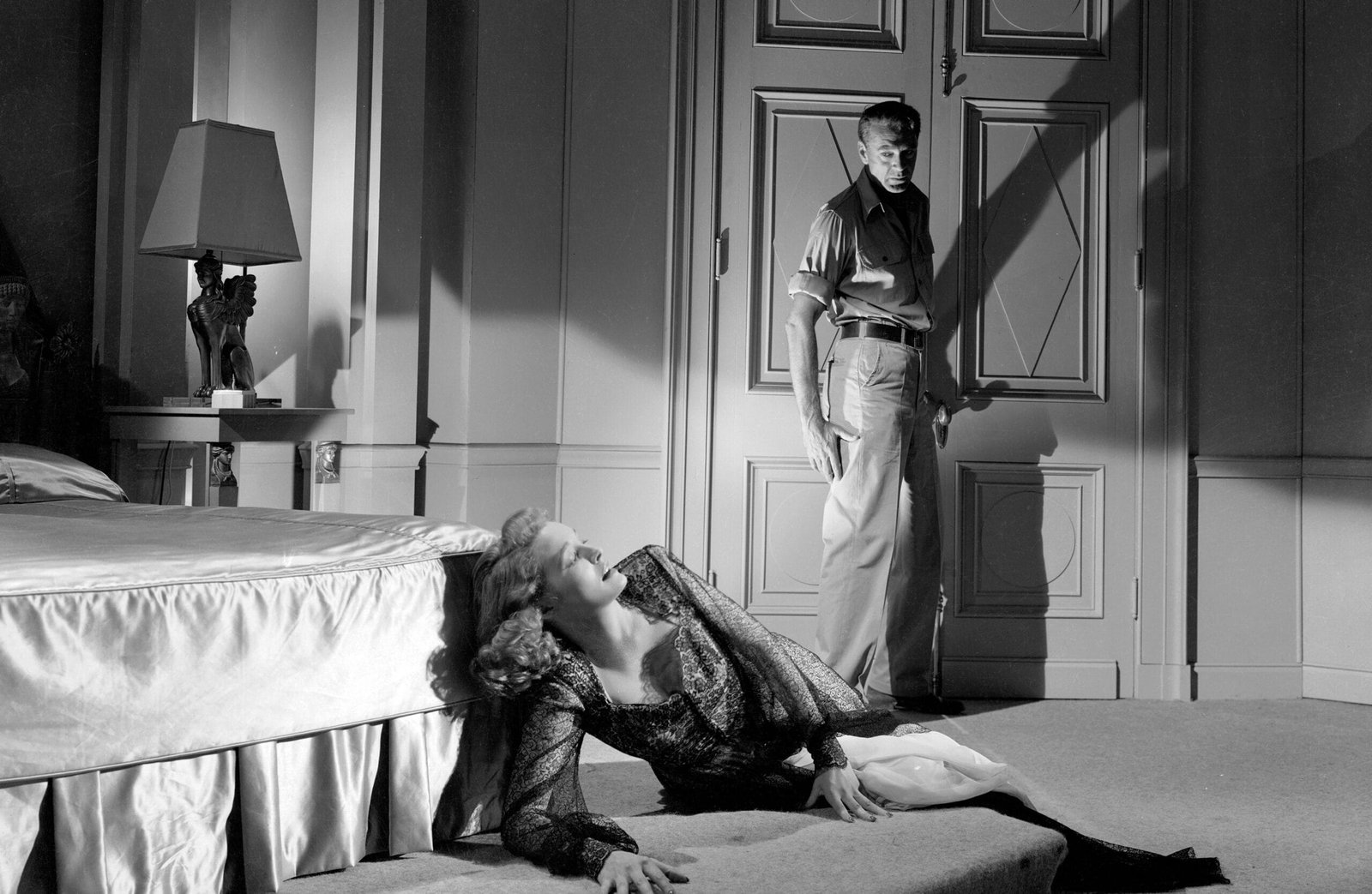
There is a moment near the middle of The Fountainhead when Peter Keating stands in his apartment after receiving the commission that should define his career—the crowning proof that his choices were correct, that the sacrifices were worth it, that he has arrived. Rand describes what he feels with surgical precision: nothing. Not satisfaction, not pride, not even the flat relief of a goal accomplished. Just a boredom so complete it seems to eat the air in the room.
Most readers register this as Keating’s condemnation. He made the wrong choices; emptiness is his punishment.
That reading is too easy. And it misses what Rand is actually doing.
His boredom isn’t punishment. It’s a revelation. Keating has been chasing the experience of achievement his entire life, and in this moment he discovers something he can never unknow: the experience was never available to him. Not because he failed, but because of how he succeeded. The self that would have felt pride had been quietly evacuated, decision by decision, accommodation by accommodation, until the person standing in that apartment was a finely tuned instrument for detecting what others wanted—and nothing else.
He hadn’t been broken. He had been completed. And completion felt like nothing at all.
Rand built five main characters in The Fountainhead who function as psychological archetypes, but her real achievement was more precise than that. She mapped five distinct textures of subjective experience that emerge from a single upstream choice: where does the self live? In one’s own judgment, confronting reality directly? Or in the consciousness of others, sustained by their approval, their envy, their need?
She called these first-handedness and second-handedness. The terms sound like moral labels, and readers often receive them that way. But Rand meant something more clinical. She was describing the location of a person’s center of gravity. First-handers aren’t virtuous because they’re independent. They’re independent because that’s where they actually live—inside their own perception, inside the problem in front of them, inside the work. Second-handers aren’t weak because they seek approval. They seek approval because without it, there is genuinely nothing there. The self has been outsourced. These states are morally unchosen, in other words: the product of psychological development that makes a person’s innermost identity that seems immutable.
A person doesn’t choose to be a first-hander or second-hander any more than they choose other highly stable dispositional personality traits such as core temperament dimensions, cognitive architecture, and sexual orientation.
What makes the novel devastating rather than merely didactic is that Rand doesn’t just show us the consequences of these two orientations. She makes us inhabit them. She lets us feel, from inside, what it is to be each of these five people moving through the same world.
That world matters more than most readers realize. Though it’s from a long time ago and mostly in New York City, It’s recognizable: a world organized around inherited authority, established forms, the social penalty for deviation. A world, in other words, that has existed across most of human history and that Rand was watching reassert itself, in new ideological dress, across the 1930s West. The five psychologies she mapped aren’t literary devices. They’re the five ways a human being can respond to that kind of world.
The Void at the Center
Start with Keating.

Author’s conception of Peter Keating created with Grok.
The common reading: Keating is weak. He wanted the easy path, leveraged his charm and attractiveness, chose prestige over integrity, and got what he deserved. The void is karma.
The accurate reading: Keating is what happens to a person of genuine sensitivity—and he does have sensitivity, Rand makes this clear—when the world he inhabits systematically rewards a particular kind of self-erasure. He didn’t choose the void. He chose, repeatedly, what every signal in his environment told him was rational. His mother’s ambitions, his professors’ approval, the architecture establishment’s hierarchies, the society pages, the clients who wanted familiar grandeur—every system he moved through offered the same deal: subordinate your judgment to ours, and we will give you position, money, admiration. He took the deal. Of course he took it. The deal worked.
What he couldn’t know—couldn’t have known, because no one told him and his culture had no language for it—was that every time he took the deal, he was paying with something that couldn’t be recovered. Not his talent, not his time. His interiority. The capacity to experience things from the inside out rather than the outside in.
There is a detail Rand plants early and never fully develops, but which contains the novel’s most quietly devastating observation: Keating wanted to be a painter. Not an architect. A painter. The desire was real—particular, personal, his. His mother redirected him toward architecture because it was respectable and practical, and Keating, being Keating, allowed the redirection. He was seventeen. He didn’t have the vocabulary to defend a desire against the argument that it was impractical. He barely had the vocabulary to recognize what he was surrendering.
That’s the first trade. Not the worst one—he’ll make far more costly ones later—but the original one, the one that established the template. Desire, real and first-hand, meets social pressure, and the desire retreats. In a world that offered no reward for insisting on it, the retreat was rational. And so a painter became an architect, and an architect became a shell, and the shell became the most celebrated designer in New York.
By the time we meet him at full success, the transaction is nearly complete. Watch how he moves through scenes: he enters a room and immediately begins scanning—not for what interests him, but for what the room requires of him. What face should he wear? What is expected? Who holds the most status and how should he orient toward them? This scanning is not social intelligence. It is the only form of navigation available to someone who has no internal compass. He is perpetually looking for his reflection in other people’s eyes because that is the only place he exists.
His friendship with Roark is the most revealing thing about him. Keating seeks Roark out again and again across the novel, ostensibly for architectural help, but what he’s actually seeking is something Roark provides that no one else can: the experience of being seen by someone who doesn’t need anything from him. Roark has no use for Keating’s performance. He won’t be impressed, won’t be manipulated, won’t offer the validation Keating usually extracts. And this—perversely, painfully—makes Keating feel more real in Roark’s presence than anywhere else. Not because Roark gives him what he wants, but because Roark’s indifference to the performance forces Keating to briefly drop it. In those moments, something almost like a self flickers on.
He can’t sustain it. The world won’t let him, and more to the point, he won’t let himself. The flicker terrifies him because it implies a standard he can no longer meet.
This is the appeal of second-handedness stated plainly: it’s not corruption, it’s adaptation. In a world that prices conformity, prestige, and the smooth management of others’ perceptions, the second-hander is magnificently equipped. He is native to that terrain. The first-hander is the one who doesn’t fit, who fails the auditions, who makes people uncomfortable with his refusal to perform. In the novel’s world—in any world tilting toward enforced consensus—second-handedness isn’t just rewarded. It’s the only game in town.
The resentment comes later. It comes when the second-hander encounters someone who didn’t take the deal. But that encounter, and the resentment it generates, belongs to another character. Keating’s tragedy is quieter: he never quite understands what happened to him. He just knows that arrival keeps feeling like nothing, and he can’t figure out why.
What It Costs to Be Unmoved
Howard Roark is often read as a fantasy—the invulnerable hero who cannot be touched, whose serenity is so total that conflict slides off him. That reading makes him less interesting than he is, and it misreads what Rand is actually describing.
Roark is not invulnerable. He is constituted differently. The pain that registers to others as catastrophe—expulsion, professional destruction, the dynamiting of his own building—registers to him as external fact. It doesn’t wound him because it doesn’t reach the part of him that can be wounded. That part is located somewhere opponents can’t access: inside the work itself, inside the experience of solving a problem that no one else has solved, inside the private transaction between his mind and the materials he shapes.
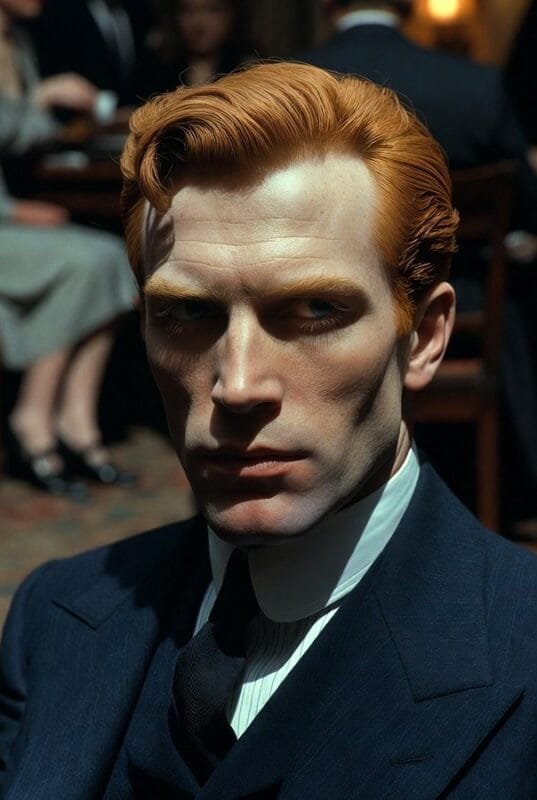
Author’s conception of Howard Roark created with Grok.
When he is expelled from architecture school, he doesn’t lean into stoicism. He isn’t suppressing anguish. He sits with the dean and the conversation is puzzling to him—the dean’s system of values is so foreign that the condemnation barely translates. He leaves and begins making practical decisions about what to do next. The expulsion is a fact to be responded to, not a wound to be nursed.
This is the texture of first-handedness at its purest: reality is the primary referent. Others’ judgments of that reality are secondary data—sometimes useful, mostly noise.
What Rand is careful to show, though, is what this costs in a world organized against it. The quarry scenes are not about Roark discovering himself. He already knows himself. They are about what happens to a first-hander when the static forces of his world have closed every door: he adapts without self-betrayal. He cuts granite because he needs to eat and because the work is honest. He does not experience this as humiliation, and that absence of humiliation is precisely what makes it bearable—and precisely what makes his eventual return possible. He hasn’t spent the quarry months consuming himself in bitterness or compromise. He’s just been waiting, intact.
But here is what the heroic reading tends to skip: the specific cruelty of what a static world demands of its first-handers. It is not content to merely reject them. It demands their conversion. The architecture establishment doesn’t want Roark to fail quietly—it wants him to submit. Every offer extended to him carries the same hidden clause: agree that the standard is theirs, not yours. Acknowledge that your judgment is subordinate to tradition, to committee, to client whim. Produce what we recognize as architecture and we will reward you. Refuse, and we will not just withhold the reward—we will make an example.
This is the specific torture the static world inflicts on the first-hander: not destruction, but the demand for self-betrayal as the price of survival. Accept our terms and be materially successful but spiritually dead. Refuse our terms and be spiritually alive but professionally destroyed. The first-hander who survives this intact isn’t succeeding despite the world’s opposition. He is surviving a sustained campaign designed to hollow him out.
His serenity is not indifference. It is resistance. Every day he remains himself in that environment is an act of psychological warfare conducted entirely on the interior.
The Logic of Resentment
Readers take Ellsworth Toohey as a straightforward villain—the manipulator, the power-seeker, the destroyer dressed as humanitarian.
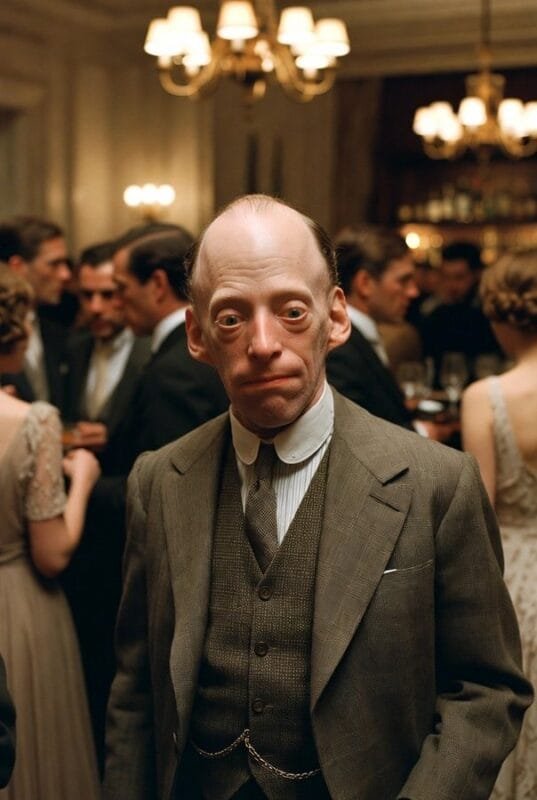
Author’s conception of Ellsworth Toohey created with Grok.
They’re not wrong. They just miss the psychological architecture beneath the villainy.
Begin earlier than the novel does. Begin with a boy who is small, physically unimpressive, constitutionally unsuited to the kinds of achievement that generate genuine self-regard—not stupid, not without perception, but unable to do the thing that would make the self-regard possible. Unable to create. Not in the way that matters: with the kind of originality that exists independent of what others think of it, that would be worth something even if no one ever saw it. He knows this early, the way people know things they wish they didn’t.
The question that defines a person is what they do with that knowledge. Most redirect—find other things to value, discover the gap matters less than they feared. This is Keating’s path: imperfect, tragic, but recognizably human.
Toohey follows a different logic, and it’s worth understanding as logic rather than pathology. If you cannot close the gap by rising, you can close it by ensuring that rising becomes impossible—by discrediting the very concept of individual achievement, by making the only legitimate standard collective, by redefining what Roark experiences in his work as arrogance, selfishness, antisocial pathology. You cannot have the thing. So the thing must be made unspeakable.
This requires altruism as a weapon. Rand understood this with such precision that Toohey nearly states it directly. He doesn’t believe in selflessness—he uses it. The moral framework that says your judgment matters less than others’ needs is, for Toohey, the instrument through which a man without a self can achieve the only power available to him: he can prevent others from having selves either. A world full of Keatings is a world Toohey can navigate. A world where Roarks succeed is a world that convicts him daily.
Was he always this? Or did the static world make him?
Probably both—which is the uncomfortable answer. Most second-handers feel the void and keep seeking. Toohey felt the void, assessed it with cold clarity, and built a career on it. That move required something—a deliberateness, an absence of self-pity, a willingness to treat human beings as material—that feels less like a product of circumstance than a feature of character. The static world didn’t create his coldness. But it handed him every instrument he needed and called them ideals.
His pleasure is real, and it is the novel’s darkest note. When he engineers the corruption of a promising young architect, or watches a creator compromise for the last time, he feels what Keating never gets to feel: satisfaction. Cold, deliberate, complete. Not the joy of making something—the confirmation that the gap he cannot close is the gap he has ensured no one else can cross either.
Static societies don’t just tolerate this psychology. They institutionalize it. The apparatus of enforced conformity—tradition as authority, consensus as truth, altruism as the supreme value—is the Toohey program scaled to civilization. He didn’t build that apparatus. He simply recognized it as the machine it was and learned to operate it.
The Man Who Knew Better
Gail Wynand is not a simple villain. He is not a simple victim. He is something more disturbing: a man who saw the choice clearly, understood exactly what he was doing, and did it anyway—and then discovered that the self he planned to deploy later had not survived the transaction he used to acquire the position.
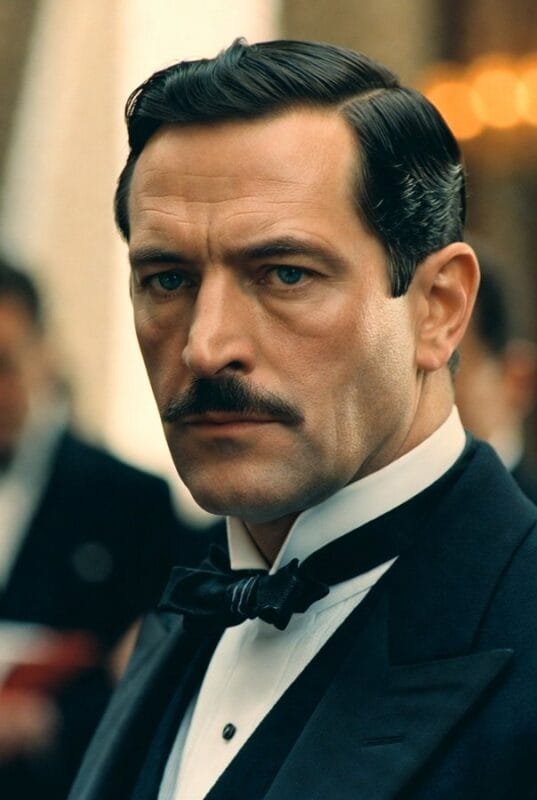
Author’s conception of Gail Wynand created with Grok.
Wynand began close to Roark. Not identical—he lacks Roark’s constitutive serenity, the unshakeable anchorage in work that makes the first-hander essentially siege-proof. But the original Wynand, the boy from Hell’s Kitchen, had genuine perception, real strength, and the capacity to evaluate the world on his own terms. He saw the mechanisms of power and popularity clearly. He understood that public taste was manufactured, that the press shaped rather than reflected, that consensus was always someone’s instrument.
His error was tactical, and it has a specific name: the exception clause. The internal argument goes like this—I’ll compromise here, but I’m not really compromising. I’m strategic. I’ll appear to serve their values while preserving my own. The performance is not the reality. I know the difference. He would give the world its vulgarity for now. He would build the empire first. Then, from a position of real power, he would exercise his actual judgment.
The exception clause is seductive because it contains a partial truth: in the short run, the person making it often really does know the difference. The performance and the reality are genuinely distinct. What the clause cannot account for is time. Feed the performance long enough and it becomes the self. Not through dramatic corruption but through the slow, mundane accumulation of choices that each seem like the last necessary compromise—until the position that was supposed to enable the real self is the real self, and there is nothing underneath it waiting to emerge.
By the time Roark enters his life, Wynand still recognizes greatness—that capacity survived, preserved perhaps by the private collection of art he refuses to sell or publicize, the sealed room that testifies to what he actually values. But recognition without the capacity to act on it is its own torment. When the crisis comes, when Toohey’s forces move against Roark through Wynand’s own newspapers, Wynand alone could turn them back. He cannot. The instrument he spent his life building is the instrument that prevents him from acting. The power he accumulated to protect his values required, at every step, the subordination of those values—and the accumulation is now the thing itself.
He shuts down his newspaper. Too late, at too great a cost, for too little. The gesture has integrity. It changes nothing.
Wynand is Rand’s answer to everyone who has ever said: I’ll get powerful first, then exercise judgment. I’ll compromise strategically. I’ll change the system from inside. Her answer is not that this is always wrong as a tactic. Her answer is that it requires a psychological durability most people cannot maintain—the capacity to spend years performing values you don’t hold without the performance gradually, imperceptibly, becoming the reality. The self is not as durable as we want it to be.
The tragedy of Wynand is sharper than Keating’s precisely because he understood the stakes. Keating never knew what he was trading. Wynand knew. He traded it anyway, lost it anyway, and recognized the loss too late to matter.
The Saddest Case
Dominique Francon is the character Rand’s critics most often misread as evidence of the novel’s pathology—the woman who destroys what she values, whose love contains a violence that makes readers uncomfortable, who seems to confuse suffering with integrity. The surface reading finds masochism or authorial wish-fulfillment.

Author’s conception of Dominique Francon created with Grok.
The accurate reading finds the novel’s most psychologically sophisticated portrait—and its most important warning.
Dominique is a first-hander. Her judgment is as clear as Roark’s—clearer, in some ways, because it extends to social perception he deliberately avoids. She sees Roark and recognizes immediately what he is. She sees the world around him and recognizes, with equal clarity, what it is. And she puts these two recognitions together and arrives at a conclusion that Roark, locked inside his work, never quite lets himself fully face: in this world, people like Roark lose. Not sometimes. Structurally. Inevitably. The same qualities that make him extraordinary make him a target for every Toohey who cannot tolerate the living proof of his own limitations and every Wynand who needs to own and therefore diminish what he can’t be.
She isn’t wrong. She is right about everything except one thing, which turns out to be everything.
She takes her accurate read of this world and mistakes it for a law of all possible worlds. This error—treating an empirical observation about a particular society as a metaphysical fact about existence itself—is the most human error in the novel, because it’s so comprehensible. She has watched carefully. The evidence is overwhelming. The induction feels airtight. What she cannot see, because no one around her has ever falsified it, is that the evidence is local and the conclusion is global.
From that mistake everything follows. If second-handers always win, then to love something in this world is to hand it to its destroyers. The most loving act, by this logic, becomes preemptive destruction—taking what you value on your own terms before they ruin it on theirs. The marble figure that she keeps in her bedroom, she eventually destroys herself. Not in contempt. In grief. In the desperate logic of someone who has confused a contingent social fact with a permanent feature of reality.
She is not indifferent to beauty. She is in agony over it. The contempt is love’s defensive formation—what caring looks like when a person has decided that caring is too costly. Nihilism is not her nature. It is her theory, dressed up as personality.
Dominique doesn’t become braver or softer or more trusting. She changes her metaphysics—updates her theory when the evidence finally falsifies it. When she allows herself to believe that Roark might actually win, that the world might be capable of sustaining what he is, the nihilism dissolves. Not because she has been reassured. Because the premise that generated it has been empirically refuted.
She was always a first-hander. She just had the misfortune of living in a world that kept proving, year after year, that she was right to despair.
Flip the Switch
Here is where the argument stops being literary analysis and becomes something more personally urgent.
The world of The Fountainhead is not a universal condition. It is a specific kind of world—one organized around inherited authority, where criticism of established forms is transgression, where the self-worth of entire classes of people is invested in the perpetuation of received wisdom. In such a world, the anti-rational meme is the master meme: do not question, do not deviate, do not let your own judgment supersede the collective’s. This meme doesn’t merely describe a culture. It reproduces itself across generations by disabling the very faculty—criticism, independent perception—that could challenge it. It is, in the precise sense, self-protective against the only thing that could undo it.
Such worlds are not rare. They are the historical norm. Societies genuinely organized around open inquiry, error-correction, the principle that no authority is beyond challenge—these are the exception, fragile and recent. When they exist, something fundamental shifts for all five of these psychologies.
For Roark, the friction disappears. Not the difficulty—genuine creation is always difficult, the problem always hard. But the specific cruelty of the static world, the demand for self-betrayal as the price of admission, evaporates. His work can be seen, evaluated, and rewarded on its actual merits. The quarry becomes unnecessary. The untouched core that survived the siege can now simply operate. This is what a dynamic culture does for first-handedness: it doesn’t create it. It stops punishing it.
For Keating, the shift is both brutal and—here is the thing the heroic reading misses—potentially redemptive. The dynamic world strips the social scaffolding that has been holding him up. Prestige hierarchies, unexamined deference, the systems that reward smooth conformity over actual achievement—remove these and the void becomes visible, which is painful. But there’s the other side: the seventeen-year-old who wanted to paint never has to make the original trade. In a world where original vision is a competitive advantage rather than a social liability, his mother’s argument loses its force. Architecture is respectable; painting is a dream—this lands differently in a culture that rewards the dream. The deal is different. The deal might not even be offered. Which means the painter who became an architect to please a world that punished first-hand desire might have just become a painter. Might have found, in that pursuit, the self that the architecture world slowly consumed. Might have felt, arriving at success, something.
This is the sharpest indictment static culture earns: it doesn’t only crush Roarks. It converts Keatings—takes people who had something real, genuine, first-hand, and systematically replaces it with the performance of other people’s values. The dynamic world doesn’t guarantee Keating a self. But it doesn’t rob him of the one he started with.
For Toohey, the change is defanging. His apparatus depends on a world where authority flows from position rather than merit, where the collective verdict can be manufactured by whoever controls the right institutional levers. Strip those conditions away and Toohey is an angry man with opinions, his manipulations visible to the same culture of open inquiry he despises. The resentment is constitutional—it would survive any regime, rooted as it is in the gap between what he is and what he cannot do. But in a dynamic world he loses his force multiplier. He remains; he just doesn’t matter in the same way.
For Wynand, the dynamic world removes the trap, if not the temptation. The hunger for power that drove him to make the original bargain probably survives any cultural context. But a society genuinely organized around merit offers different paths to power—ones that don’t require the systematic betrayal of judgment as the operating mechanism. He might have built something real and remained himself in the building. The exception clause fails in static conditions partly because the culture validates it—prestige flows from subordination, so subordinating looks like winning. In a dynamic world, the feedback is different. The compromises show. The performance becomes legible as performance. Wynand might have discovered, earlier and at lower cost, that the self he was planning to deploy was the one he was spending.
And Dominique? The falsification she needs is structural, not personal. She doesn’t need reassurance. She needs to live in a world where her empirical observation—he will be destroyed—simply stops being confirmed by events. Where her induction from the particular to the universal cannot sustain itself against the evidence. In that world, her pessimism dissolves not because she has been changed but because she is, at bottom, a person who follows evidence. She always was. What changes is what there is to follow.
She becomes, finally, what she always was: a first-hander with somewhere to express it.
The Experiment
Rand wrote The Fountainhead in the 1930s through early 40s, setting it mostly in the 1930s deliberately. She was not writing historical fiction. She was writing a diagnosis of her contemporary era.
She had come from Soviet Russia, where the static apparatus had been made total and explicit—the state owned aesthetic judgment, individual vision was counter-revolutionary, architects built what the collective decided was correct. But the lesson she drew was not that collectivism was a foreign disease. It was that collectivism was a direction, one that any society could move in, and that the 1930s West was moving in with ideological enthusiasm that its participants experienced as moral progress.
The decade was a festival of anti-individualism across the full political spectrum. Socialist realism in the Soviet Union reduced art to collective instruction. National Socialist aesthetics in Germany subordinated creative vision to racial mythology. And in America—the country Rand had chosen as the most radical historical experiment in individualist culture ever attempted—intellectuals who should have known better were writing admiringly about planning, about the organized social good, about the need to supersede the messy results of individuals pursuing their own visions. The New Deal’s romance with expertise and collective management was, whatever its economic merits, a cultural meme: your judgment alone is insufficient. Trust the plan. The group sees further than the person.
Rand recognized this not as economics and not primarily as politics but as psychology operating at a civilizational scale. The ideology of collectivism is the Keating dynamic institutionalized: your first-hand perception is arrogance; subordinate it; the collective knows better. This produces, as Keating demonstrates at the personal level, not a better-coordinated society but an emptier one—a culture of scanning, performing, orienting toward approval rather than confronting reality directly. It produces Keatings who think they’re being reasonable. And it produces, at the extreme end of its logic, Tooheys—people who understand the mechanism perfectly and use it without apology.
America mattered to Rand because it was founded on the opposite proposition: that individual judgment is sovereign, that no authority is beyond criticism, that the standard is not tradition or consensus but reason confronting reality. The founding was not the achievement of a dynamic society—it was the most ambitious institutional attempt in history to make one possible. To protect, at the level of law and culture, the conditions under which a first-hander can function without being destroyed. Under which a painter at seventeen doesn’t have to become an architect. Under which Dominique’s pessimism is empirically refuted rather than daily confirmed.
That proposition was under direct ideological siege in the 1930s, from people who were not Tooheys by intent but who were building his conditions by effect—sincerely, which made them more persuasive than cynics would have been. When Keating surrenders his first-hand judgment, he doesn’t experience it as surrender. He experiences it as social responsibility, as maturity, as recognizing that he’s not the center of the universe. The ideological climate of the decade offered that rationalization at a civilizational scale, to millions of people simultaneously, dressed in the language of justice and progress.
Rand set the novel in that precise moment because she wanted to show, from inside five different consciousnesses, what the direction of travel actually does to people. Not to economies. Not to governments. To the interior life of every human being who has to live inside a culture while it decides which way to move.
What Kind of World
Societies don’t tilt static because tyrants seize power. They tilt static when enough ordinary people—not Tooheys, people who harbor no malice, people who just want to get along—make the Keating trade often enough that the culture gradually loses its tolerance for first-hand judgment. Each individual trade is rational in context. The accumulated effect is a world where honest perception has become socially dangerous, where original assessment creates enemies, where the path of least resistance runs through consensus. Once that’s true, the Tooheys don’t need to seize anything.
The culture delivers itself.
This is the mechanism the novel dramatizes across five psychologies and a thousand pages. And it is a mechanism, not a metaphor—it operates through the same process at every scale, from the single conversation where someone decides not to say what they actually think, to the decade where an entire civilization decides that individual judgment is arrogance.
America is fighting this out right now. Not for the first time—the tension is structural, built into the founding proposition, permanent. The dynamic experiment has always required active defense because the forces that erode it don’t experience themselves as erosive. They experience themselves as responsible, as corrective, as preventing the chaos that comes from too many people trusting their own uncoordinated perceptions. This is what makes the fight hard and perpetual rather than a single battle with a clear resolution. The 1930s was one such moment of intensity. This moment is another. What changes across eras is not the nature of the tension but the balance of forces, and the strength of the institutions that protect the conditions under which first-handedness can survive.
The stakes are not primarily political, and this is the thing the novel insists on that political argument consistently misses. The stakes are experiential. They are about what kind of life will be available to the people living in the society that gets built or allowed. Whether there will be room for the quieter version of Roark’s serenity—not the invulnerable siege-proof variety most people can’t sustain, but the more ordinary version available to anyone who is allowed to trust their own perception without systematic punishment. Whether the Keatings of the next generation will be able to keep their painting. Whether the Wynands will find the exception clause exposed before it costs them everything. Whether the Dominiques will have their pessimism falsified before it hardens into a way of life.
Roark’s serenity is not the point. It’s the extreme case, the demonstration that the thing is possible at all. Most people are somewhere between Roark and Keating—capable of first-hand perception, susceptible to the social pressure that erodes it, negotiating daily between what they actually see and what the room will accept. What a dynamic society offers such people is not Roark’s unassailable core. It offers something humbler and more important: the protection of making the honest perception survivable. Of ensuring that the cost of saying what you actually think is not, by default, professional destruction.
The alternative—what Keating’s apartment demonstrates from inside—is not comfort. Not safety. Not the warm belonging of consensus. It’s the existential boredom that arrives when you have successfully become what the world required of you, and you stand in the achievement and feel absolutely nothing, and cannot remember what you might have felt instead.
That’s fundamentally what’s at stake. Not heroism. Not freedom in the abstract.
The texture of being alive.