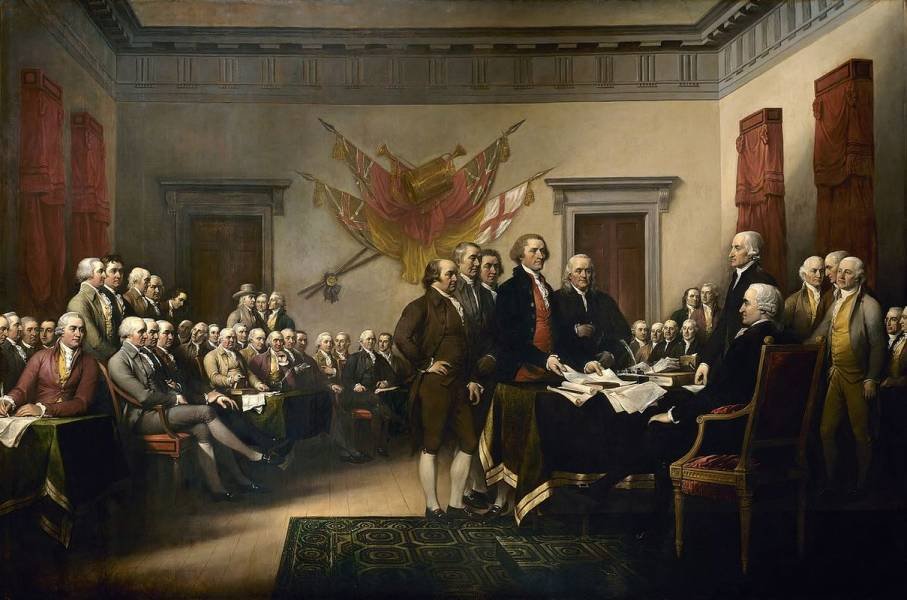
Most people know what the Founding Fathers built. The Declaration. The Constitution. The Bill of Rights. The institutional architecture of a republic that has outlasted nearly every government formed in the same era.
What most people don’t know is what they were terrified of losing before the ink dried.
Not a foreign invasion. Not economic collapse. Their deepest fear was an ignorant citizenry—a public that could be handed liberty and squander it because they lacked the mental tools to defend it. The Founders understood something that gets lost in the monument-and-marble version of history: a republic is not a structure. It’s a practice. And practices die when people forget how to perform them.
So alongside the constitutional project, they ran another one. Less visible, less celebrated, and arguably more ambitious. They set out to teach an entire population how to reason about rights, government, human nature, and political power. Not what to think. How to think.
That project deserves its own examination.
The Problem They Were Solving
The Founders were students of history, and history had not been encouraging. Athens fell to demagoguery. Rome collapsed under the weight of its own corruption. Every republic before theirs had eventually surrendered to the oldest vulnerabilities in human nature—tribalism, short-sightedness, the intoxicating appeal of strongmen promising simple answers to complicated problems.
They had no reason to believe Americans were immune.
Thomas Jefferson put it plainly in his 1779 Bill for the More General Diffusion of Knowledge. Education, he argued, was essential to “illumine, as far as practicable, the minds of the people at large”—specifically so they could “know ambition under all its shapes” and defend their rights against its encroachments. This wasn’t optimistic rhetoric. It was a diagnosis. Uneducated people don’t recognize tyranny until it’s already installed. By then, the constitutional machinery doesn’t matter.
James Madison understood the same problem from a different angle. Democratic republics don’t fail from external assault. They fail from within—from factions, from passion overwhelming reason, from citizens who mistake their grievances for principles and their preferences for rights. The machinery of government could slow that deterioration. It couldn’t stop without something else.
That something else was an educated, reasoning public.
Paine and the Art of Accessible Argument
The first major move in this educational campaign was Thomas Paine’s Common Sense, published in January 1776. It sold over 100,000 copies in months. In a colonial population of roughly 2.5 million, that’s a staggering penetration—the equivalent of a book selling tens of millions of copies today.
But the sales figures miss the real achievement.
Paine did something that had almost never been done before: he translated the abstract philosophy of natural rights into language that a farmer, a tradesman, or a dockworker could not only understand but act on. He stripped monarchy down to its naked absurdity. He showed ordinary readers how to apply first principles—equality, consent, natural law—to political questions they faced in their actual lives.
“In the following pages I offer nothing more than simple facts, plain arguments, and common sense,” he wrote, “and have no other preliminaries to settle with the reader, than that he will divest himself of prejudice and prepossession, and suffer his reason and his feelings to determine for themselves.”
That sentence is a pedagogy. He wasn’t telling readers what to conclude. He was modeling how to arrive at a conclusion—by shedding inherited assumptions and thinking from evidence. The pamphlet was a lesson disguised as a polemic.
Washington understood its effect immediately. He credited Common Sense with doing more to shift colonial opinion toward independence than any military development or political speech. What he recognized was that Paine hadn’t merely persuaded people. He had equipped them.
The American Crisis series extended the work. When Washington ordered the first essay read aloud to his troops at Valley Forge—“These are the times that try men’s souls”—he wasn’t just rallying morale. He was giving desperate men a framework for understanding what they were enduring and why it mattered. Suffering with meaning is endurable. Suffering without a framework of ideas is just suffering.
The Federalist Papers: A Curriculum in Constitutional Reasoning
If Paine taught citizens how to think about liberty, the Federalist Papers taught them how to think about institutions.
Written by Alexander Hamilton, James Madison, and John Jay under the shared pseudonym “Publius” and published between 1787 and 1788, these 85 essays remain the most sophisticated sustained argument for constitutional government ever produced for a popular audience. They were serialized in newspapers. They were read in taverns and debated in town halls. They were, functionally, a university course in political science delivered to anyone who could read.
The genius of the Papers was their method. Hamilton, Madison, and Jay didn’t ask readers to trust the Constitution. They asked readers to evaluate it—to examine the arguments for and against, to weigh the structural logic, to apply their understanding of human nature to questions of institutional design.
Madison’s Federalist No. 10 is the clearest example. He didn’t begin with a conclusion about the Constitution. He began with a problem: factions—groups of citizens united by common passion or interest who inevitably work against the rights of others or the common good. He defined the problem with precision, analyzed its causes in human nature, examined two possible remedies (destroying liberty or enforcing uniformity of opinion), rejected both as worse than the disease, and arrived at the structural solution: an extended republic that dilutes faction by multiplying it.
“The latent causes of faction are thus sown in the nature of man,” he wrote. He wasn’t moralistic about it. He was clinical. Human nature produces faction. Good institutional design accounts for that fact. The reader walks away with not just an argument but a method—how to diagnose a political problem, assess its causes, evaluate solutions, and choose among them.
Federalist No. 51 pushed further. “If men were angels, no government would be necessary,” Madison observed. “If angels were to govern men, neither external nor internal controls on government would be necessary.” The logic was devastating in its simplicity. Government exists because humans are fallible. Government itself is run by fallible humans. Therefore, the structure of government must be designed to make ambition counteract ambition, to use human nature’s predictable tendencies as a check on itself rather than hoping virtue will suffice.
This was not a civics lesson in the thin sense of the phrase. It was epistemological training—teaching readers how to reason about power, corruption, institutional failure, and the structural prerequisites of sustained liberty.
The Institutional Turn
As the republic stabilized, the Founders shifted from pamphlets and newspapers to something more durable. They tried to build civic reasoning into the architecture of American life itself.
Jefferson’s vision was the most systematic. His plan for Virginia’s public schools wasn’t primarily about literacy. It was about producing citizens capable of recognizing and resisting tyranny. Elementary schools would teach reading, writing, arithmetic, and—crucially—history. Not as a collection of dates but as a record of how republics rise and fall, how power accumulates, how rights erode by degrees until they’re gone. Jefferson believed that a citizen who understood history possessed something more valuable than any single political opinion: the ability to recognize a pattern unfolding in real time.
His University of Virginia carried the project further. He designed its curriculum around what he called the “science of government”—the systematic study of political philosophy, law, economics, and history as a unified discipline for producing thoughtful public leaders. He wanted graduates who could reason across domains, connect principles to consequences, and resist the seduction of ideology untethered from evidence.
Benjamin Franklin took a different but complementary approach. His Junto club, founded in Philadelphia in 1727, gathered tradesmen, craftsmen, and merchants for weekly structured debate on ethics, politics, science, and philosophy. The rules were explicit: members were expected to argue from evidence, examine multiple sides of questions, and submit their reasoning to scrutiny. No harangues. No mere assertion. The Junto was an ongoing seminar in epistemic discipline, and it eventually gave Philadelphia its first lending library—democratizing access to the books that made such reasoning possible.
Noah Webster argued for a specifically American education, one that gave citizens a shared intellectual culture rooted in their own history and institutions. “Every child in America should be acquainted with his own country,” he insisted. Washington, who lacked formal education himself, pushed repeatedly for a national university that would train future leaders in the common principles of republican government. His will endowed educational institutions in both Virginia and the new capital.
They were not all in agreement about the specifics. They argued about the role of religion, the tension between classical and practical education, the balance between federal and local control. But on the foundational premise they were unanimous: without an educated, reasoning public, the republic would eventually consume itself.
What They Actually Built
Step back from the individual initiatives and a coherent project comes into focus.
The Founders weren’t just building governmental institutions. They were building an epistemological culture—a set of shared habits and practices for thinking about political reality. They believed that rights were discoverable through reason, not granted by authority. That government was a human construction, improvable and correctable, not a divine or natural given. That human nature was neither angelic nor irredeemably corrupt, but predictably flawed in ways that good institutions could accommodate. That citizens, given access to knowledge and trained in reasoning, could govern themselves.
Every major educational initiative—Paine’s pamphlets, the Federalist Papers, Jefferson’s schools, Franklin’s Junto, Webster’s readers—served this culture. Each one was teaching citizens not a set of conclusions but a mode of inquiry: start from principles, examine evidence, account for human nature, evaluate institutional design, distrust concentrated power, and never mistake tradition for truth.
The revolutionary document was the Declaration of Independence. But the revolutionary act was convincing ordinary people that they were capable of reasoning about their own governance.
That conviction has consequences reaching far beyond the American founding. It echoed through the French Revolution and the Latin American independence movements. It shaped every subsequent democratic constitution. The idea that citizens—not just philosophers or aristocrats—could and must think carefully about political power was not obvious before 1776. The Founders made it seem self-evident. That was the point.
David Deutsch, the Oxford physicist who wrote The Beginning of Infinity, offers the most rigorous external validation of what the Founders achieved. Deutsch’s central argument is that the Enlightenment didn’t succeed because it produced the right answers. It succeeded because it established the right process — one built on open criticism, error-correction, and the rejection of authority as a source of truth. Static societies, he argues, preserve existing knowledge by suppressing dissent. Dynamic societies grow their knowledge by institutionalizing the ability to find and fix mistakes.
The American founding was the most deliberate attempt in history to build a dynamic society from scratch.
Madison’s separation of powers wasn’t just a safeguard against tyranny. In Deutsch’s terms, it was an error-correction mechanism — a system designed on the assumption that any leader, any faction, any majority could be wrong, and that the institutional machinery must make it possible to identify and reverse those errors before they become permanent. The Bill of Rights wasn’t merely a list of protections. It was an acknowledgment that governments would inevitably overreach, and that citizens needed durable tools to push back. The amendment process itself was an admission built into the document’s architecture: we don’t have all the answers, and future generations must be able to correct us.
This is why Deutsch argues that what matters in a political system isn’t its ideology — it’s its capacity for self-correction. By that measure, the Founders built something extraordinary. They designed a republic that could abolish slavery, extend suffrage, overturn its own precedents, and survive catastrophic failures — not because they anticipated every problem, but because they built in the mechanisms to address problems they couldn’t foresee.
The reach of that design, as Deutsch would call it, has proven boundless.
A Question Worth Sitting With
Washington believed that “knowledge is in every country the surest basis of public happiness.” Jefferson believed that an educated public was the only reliable guardian of its own liberty. Madison believed that without the capacity for rational deliberation, a democratic republic was simply mob rule with better paperwork.
They were right about all of it.
They were also fallible men who compromised, rationalized, and in some cases profoundly betrayed the principles they articulated. But the principles survived them. The reasoning framework survived them. The tools they built for thinking about rights, power, and human nature proved durable enough to be turned against the injustices they themselves perpetuated.
That is the real measure of what they built. Not whether they lived up to it. Whether it was true enough, and accessible enough, and rigorous enough, to outlast their failures and do its work across generations.
It was.
The question worth sitting with is not whether the Founders succeeded. It’s whether we still know how to use what they left us.
That’s the invisible teaser. No accusation. No named crisis. Just a question that lands differently depending on what the reader sees when they look at contemporary public life—and that makes them want the follow-up without knowing they’re being set up for it.