
By Stephen Slivinski
Certificate-of-need (CON) laws accomplish exactly what they were created to do. That’s actually a big problem, especially for rural areas.
Under these laws—over 30 states have at least some version of one—new hospital facilities, providers of health services, or even existing hospitals that want to expand first have to prove these things are “needed.” In states with CON laws, the marketplace or patient demand doesn’t decide this. The government does. And many states not only defer to the existing hospitals when making that decision but also give them veto power outright.
You shouldn’t be called a conspiracy theorist to guess that this will probably lead to fewer hospitals, fewer service providers, and fewer choices for consumers—in other words, less overall competition in the health care industry. In fact, that’s the explicit intent of these laws.
The result is a particularly severe scarcity of health care options in the most rural counties (as measured by the US Department of Agriculture’s “Rural-Urban Continuum Codes”) of the most rural states.
The chart below—from a forthcoming Cato study on CON laws—looks at the number of hospitals per capita in counties that are considered both the most rural in the state (scoring an 8 or 9 in the USDA ranking, with 9 being the most rural) and the least wealthy (in the bottom two quintiles of median household income).
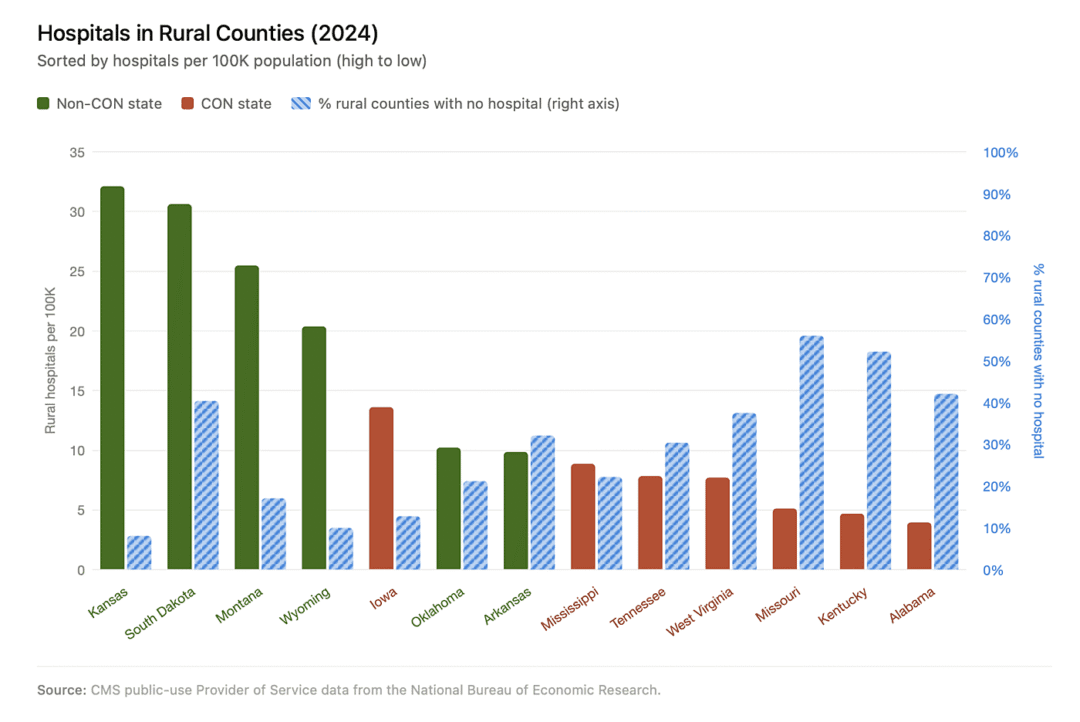
The green bars represent states that do not have CON laws for new short-term hospitals (or similar facilities), and the red bars represent those that do. The pattern is stark: Most rural counties in states without hospital CON laws have substantially more rural county hospitals per capita than most rural counties in states with these types of CON laws (other than Iowa).
The striped bar corresponds to the right axis. It shows the percentage of rural counties in the state that have no hospitals whatsoever. No state with hospital CON laws (again, other than Iowa) has less than 20 percent of its rural counties lacking a single hospital, with most of them actually clocking in at more than a third.
Some states are realizing the need for reform. Bills moving through the legislative process in two of these rural states are gaining steam.
The Tennessee General Assembly is considering a bill that would exempt acute care hospitals from needing a CON to establish new facilities—essentially eliminating the government-permission requirement for hospital construction across the state. In Mississippi, the legislature sent the governor a bill to create a pilot program that specifically exempts some rural hospitals temporarily from CON requirements.
The Tennessee bill also takes on a unique urgency. Not only has Governor Bill Lee stated that CON reform is a key initiative for this session, but the state has a bureaucratic deadline as well: The pending application for federal health care funds makes receipt of that money contingent on active reform of the state’s CON laws.
Hospitals aren’t the only places rural residents can get health services. In fact, the existence of CON laws also correlates with a general lack of access to health care services from all types of providers. Yet, although the Mississippi bill doesn’t go as far as the Tennessee bill—and neither go so far as to eliminate CON laws entirely on a longer-term basis—both are very positive steps to remedying a real problem.