
More than 150 years ago, the noted British political economist and one-time editor-in-chief of The Economist magazine, Walter Bagehot (1826–1877), observed in an essay entitled “The Postulates of English Political Economy”:
The Protectionist creed rises like a weed in every soil…. Every nation wishes prosperity for some conspicuous industry. At what cost to the consumer, by what hardship to less conspicuous industries, that prosperity is obtained, it does not care…. All governments like to interfere; it elevates their position to make out that they can cure the evils of mankind. All the zealots wish they should interfere, for such zealots think they can and may convert the rulers and manipulate state control; it is a distinct object to convert a definite man [in government], and if he will not be convinced there is always a hope for his successor” (reprinted in Economic Studies [1898], pp. 5–6).
We have been seeing the dramatic growth of such protectionist weeds once again with renewed force in recent years. It has been spreading not only in the intellectual landscape but also in the fields of political power both in the United States and around the world. Indeed, it is not an exaggeration to say that a forceful counterrevolution against free trade and global markets has been gaining traction in a way not seen since the interwar years of the 1920s and 1930s.
Not that most of the post–World War II period was an unrestricted age of international freedom of trade. Far from it. Governments on their own or through international organizations restricted, manipulated, and regulated markets both at home and in global intercourse with other nations. But it remains a fact that after the extreme forms of attempted autarky and economic nationalism of the interwar epoch, many of the leading nations of the world stepped back and over the years permitted greater degrees of international commerce, trade, and investment than in that earlier period of the twentieth century.
Tariffs and other trade barriers hampered the free flow of goods and services and investments across political boundary lines around the world after 1945. However, they almost seem mild and “enlightened” compared to the current crop of protectionist weeds and their policy effects, particularly over the past year during Donald Trump’s second presidency.
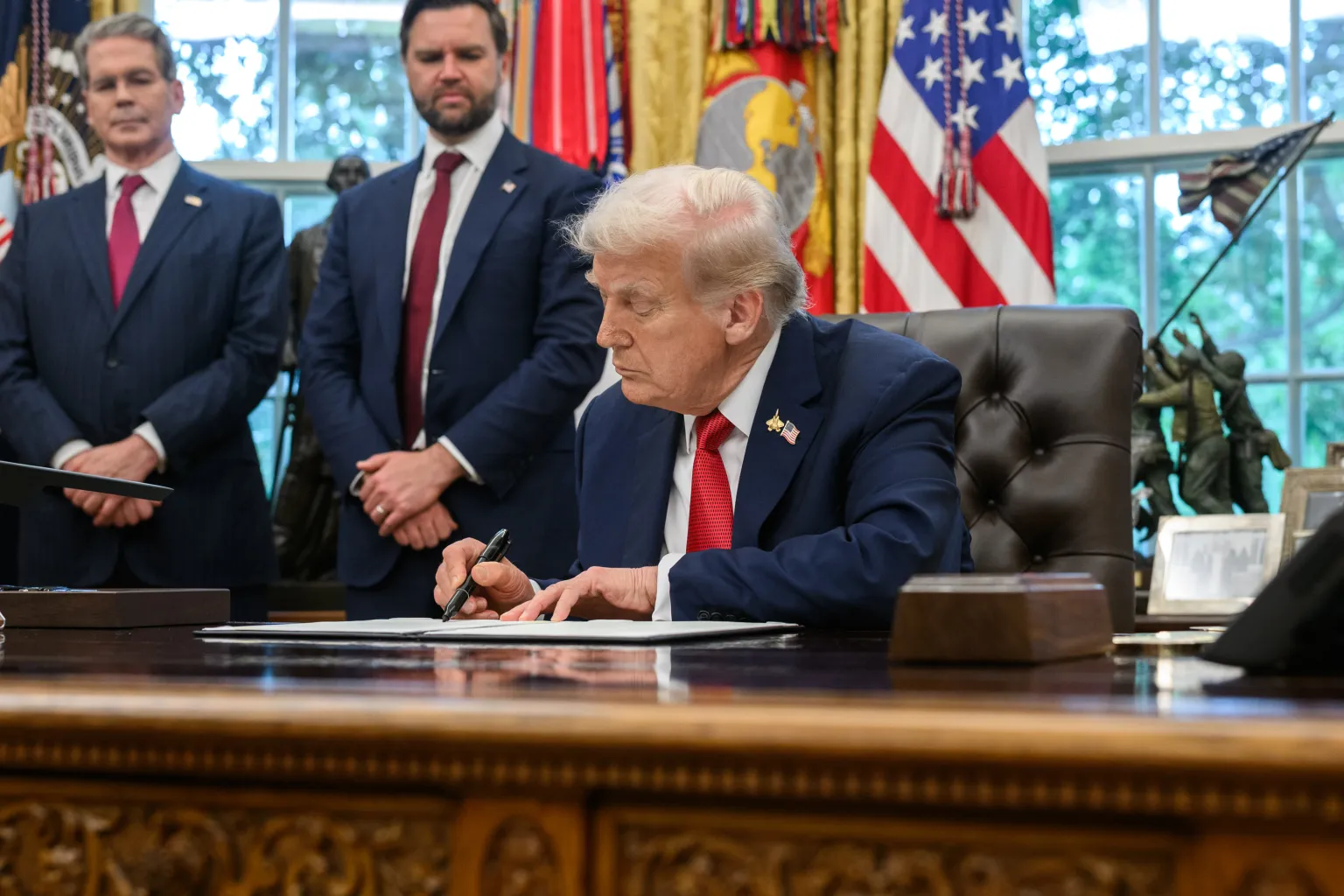
With autocratic caprice, arrogance, crudeness, and rudeness, Trump has assumed the powers of a near absolute monarch to decide when, why, and against whom he will arbitrarily raise and lower and raise again tariffs on the importation of goods into the United States from all the other countries on the planet. Like the French king Louis XIV (1638–1715), who is reputed to have said, “I am the State,” Trump acts as if his mere word, changeable on a nearly daily basis, is the law of the land under the rationale of “national security.” He uses this term with such elastic generality and ambiguity that the importation of the most trivial, everyday consumer item can be declared a threat to the political and economic wellbeing and “greatness” of America, resulting in prohibitive import taxes being imposed on it.
But it is not only Donald Trump who sees America’s future dependent upon government management and direction of the economic affairs of the United States vis-a-vie the rest of the world. Many of those who, no doubt, find the president repugnant for a variety of reasons, also desire and rationalize the essentiality of government oversight and direction of America’s trade relations with other countries.
Dani Rodrik’s call for a new mercantilism
One example of this is found in a recent paper by Harvard University economist Dani Rodrik on “What the Mercantilists Got Right” (NBER Working Paper, No. 34353, October 2025). His purpose is to rehabilitate the ideas of sixteenth- and seventeenth-century advocates of government economic planning, who 250 years ago were among the primary targets in Adam Smith’s The Wealth of Nations (1776) as part of his arguments for free trade and free markets in general.
Rodrik begins by ridiculing Milton Friedman’s use of Leonard E. Read’s famous essay, “I, Pencil,” in which Read and Friedman argued that something as simple as the old fashioned wooden and graphite pencil is too complex an instrument for any one or handful of people to know enough to produce it. Hundreds, even thousands, of people separated by time and space may have participated in its manufacture, with none of them knowing or needing to know all the steps and stages of production necessary to have brought it into existence in its finished form as a writing utensil.
In turn, Read’s argument was a concrete example of Friedrich A. Hayek’s earlier explanation of “The Use of Knowledge in Society” (1945). In a complex system of division of labor, there is an accompanying division of knowledge, the full utilization of which requires a means for information to be shared about all the complicated and ever-changing demand-and-supply conditions of the market, the detailed and concrete knowledge of which no one can ever have the ability to master, understand, and use better than the actual individual participants in the market process.
What connects and integrates all that members of the society are producing, along with how, where, and when, is the competitive price system. By following and responding to the price signals most relevant to those in each corner of the division of labor, the actions of billions of people can be coordinated so that all may benefit from what others know and do. This was a central element in Hayek’s argument that socialist central planning could not work. (See my article, “F. A. Hayek’s ‘The Use of Knowledge in Society’: 80 Years On,” Future of Freedom [September 2025].)
But in Professor Rodrik’s view,
By the 2010s, most of the world’s pencils were made in China. And it was much harder to explain how market forces alone could have been responsible for that outcome. China had no innate advantage in producing pencils…. Indeed, any account of how China came to dominate the production of pencils (or most other manufactures, for that matter) that relied only on decentralized, impersonal market forces would be seriously incomplete. We would have to add to the story the visible hand of the government as well: the state-owned enterprises which absorbed and disseminated know-how, the role of credit and other subsidies that incentive entrepreneurs, the management of the currency that gave Chinese producers a competitive edge on world markets.
Rodrik seems to believe that because government policies can influence the direction and form of investments and production activities, this somehow disproves the logic and essential nature and workings of the free market. It would be difficult to find any free-market economist over the last 250 years who denied the impact of government policy in bringing about economic outcomes different than if the market had been left unrestrained to determine the best use of resources, given consumer demands and the market-based opportunity costs of applying the scarce means of production in one direction rather than another.
Adam Smith’s refutation of mercantilism still stands
This, indeed, was part of Adam Smith’s central argument against government-managed trade, or “mercantilism,” as the eighteenth-century system of central planning was known. As Adam Smith said in The Wealth of Nations:
To give the monopoly of the home-market to the produce of domestic industry, in any particular art or manufacture, is in some measure to direct private people in what manner they ought to employ their capitals, and must, in almost all cases, be either a useless or a hurtful regulation. If the produce of domestic can be bought there as cheap as that of foreign industry, the regulation is evidently useless. If it cannot, it must generally be hurtful….
It is the maxim of every prudent master of a family, never to attempt to make at home what it will cost him more to make than to buy. The tailor does not attempt to make his own shoes, but buys them of the shoemaker. The shoemaker does not attempt to make his own clothes, but employs a tailor. The farmer attempts to make neither the one nor the other, but employs those different artificers….
All of them find it for their interest to employ their whole industry in a way in which they have some advantage over their neighbors, and to purchase with a part of its produce, or what is the same thing, with the price of a part of it, whatever else they have occasion for….
What is prudence in the conduct of every private family can scarce be folly in that of a great kingdom. If a foreign country can supply us with a commodity cheaper than we ourselves can make it, better to buy it of them with some part of the produce of our own industry, employed in a way in which we have some advantage….
It is certainly not employed to the greatest advantage when it is directed towards an object which it can buy cheaper than it can make it…. The industry of a country, therefore, is thus turned away from a more, to a less advantageous employment, and the exchangeable value of its annual produce, instead of being increased, according to the intention of the lawgiver, must necessarily be diminished by every such regulation (Edwin Cannan edition [1937], pp. 423–24).
Fruits of Chinese government planning
The fruits of China’s government-dominated and directed economy are clearly visible. The heavy hand of the planners in Beijing can be seen in the unoccupied or under-occupied “ghost cities” built under government financing and pressures; or in the excess capacities in various industrial and manufacturing sectors that have been placing deflationary pricing pressures in key segments of the Chinese economy; or the overextended financial sector and municipal governments facing debt crises from subsidizing and funding projects for which there were no real justifying profits for the foreseeable future. Glittering, futurist-style skyscrapers do not mean that that was where the scarce resources of the Chinese economy should have been directed in comparison to the production and construction projects that could have and should have been followed based on more consumer-driven, free-market demands.
The fact that the government may have offered subsidies and discounted loans for Chinese businessmen to invest in the pencil business does not prove the superiority of government-business partnerships. And it certainly does not demonstrate the superior wisdom or insight of the Chinese government “experts” claiming to know how to plan the Chinese economy better then leaving it alone to the free choices and voluntary exchanges of Chinese suppliers and demanders themselves.
What is seen, and what is not seen
This is an example of Frederic Bastiat’s “What is Seen and What is Not Seen.” If the government funds, subsidizes, or in some way influences or commands private individuals to direct their production activities in particular directions, that is what is seen. A pencil factory stands completed, workers are employed in manufacturing the writing instrument, and sales are made both in China and in many places abroad. Profits may be earned, and the workers have incomes to spend, which also improves the economic situation of the businesses that cater to their demands.
But what is not seen? All the investments and businesses that might have come into existence if the government had not directly and indirectly “influenced” how the scarce resources that went into the pencil factory could instead have been available to be employed in non-politically manipulated ways. Unseen are the additional hats or shirts, the increased supplies of furniture or other household items, and the investment and manufacturing activities that would have reflected the voluntary choices of Chinese consumers and customers. It is the alternative reality that would have materialized if not for the interfering hand of government.
The hubris and folly of the central planner
Adam Smith understood the greater wisdom in leaving such things to free enterprise instead of the hubris of those who would presume to plan the economic affairs of the citizenry. As Smith explained:
What is the specie of domestic industry which his capital can employ, and of which the produce is likely to be of the greatest value, every individual, it is evident, can, in his own situation, judge much better than any statesman or lawgiver can do for him….
The statesman, who should attempt to direct private people in what manner they ought to employ their capitals, would not only load himself with a most unnecessary attention, but assume an authority which can safely be trusted, not only to no single person, but to no council or senate whatever, and which would nowhere be so dangerous as in the hands of a man who had folly and presumption enough to fancy himself fit to exercise it (p. 423).
Why this all passes out of Professor Rodrik’s attention is the very hubris that Adam Smith warned about in the passage above — that such political authority and power “would nowhere be so dangerous as in the hands of a man who had folly and presumption enough to fancy himself fit to exercise it.” While Rodrik talks about government experts and planners combining their knowledge with that of those in the private sector for a greater synthesis than if each acted alone, it is those in political authority who possess the governmental power to bend private individuals to follow the lead of what the central planners want and insist upon. Have we not read about those Chinese businessmen who get on the wrong side of the political leaders in Beijing and seem to “disappear?” Some never reappear, while others who do reemerge as passive, obedient, submissive good citizens professing how much they now love “Big Brother,” President Xi Jinping, and his guidance and policies.
To assure you that I am not putting words into Rodrik’s mouth, he hails as a great success of government directed leadership for economic development the strong-arming by a South Korean dictator to make businessmen bend to his planning designs:
In South Korea, one of the earliest acts of President Park Chung-hee after taking power in a military coup in 1961 was to imprison scores of the country’s leading businessmen. Park threatened to confiscate their businesses and released them only after he obtained pledges that they would meet export targets and “donate all their property when required for national construction.”
America’s planning follies under Biden and Trump
If we just look closer to home, have we not seen how the power of government in Washington, D.C., was used under Joe Biden to try to end those businesses in fossil-fuel production and use the economic levers of government to direct business into “renewable” energy sources through various sticks and carrots? Or how government money and regulation during the Biden presidency was used to compel people to take the COVID vaccine through the withholding or giving of government funds to businesses and health-care facilities? And have we not seen this during the past year under Trump with his financial strong-arming of colleges and universities to introduce hiring and teaching practices that are the exact opposite of the way federal money was used under Biden to foster political correctness and wokeness?
Or Trump’s blunt political and tariff instruments to arm-twist foreign governments and businesses to invest in those industries and sectors that he considers the basis of making America “great again?” And to make sure, he has pressured companies and industries to transfer shares in their businesses to the U.S. government, so that government is a direct partner to ensure that things go the way Trump wants. It should be remembered that someday Trump will be out of the White House, and it will be Democrats who will possess that same economic control through these government-business “partnerships” to move the American economy in ways that Trump’s Republican sycophants will then call — oh, no! — a road to socialism because the “other side” is holding the reins of power rather than themselves.
The corrupting and power-lusting tendencies that inescapably accompany government intrusion, regulation, and planning in the sort of neomercantilism proposed by Rodrik is also shrugged aside by him. According to him, such unfortunate forms of “crony-capitalism,” would be kept under control and in manageable size. It’s just a matter of the right people in the right positions to keep such unpleasant things under control. That is people like Doni Rodrik, who know the right policies, in the right proportions, for the right purposes. If only we all could be like Doni Rodrik, what a beautiful world we would live in.
Consumer interests versus producer interests
Among the earlier criticisms of free markets, especially in the nineteenth century, was that the interests of consumer demand and the profits that might be acquired by satisfying it was said to be at the expense of radically transforming societies from their far more traditional and rural ways. The impersonal and anonymous forces of “capitalism” destroyed senses of community and belonging to local groups and surroundings in which people had been born and lived out their lives.
Rodrik harkens back to this earlier anticapitalist nostalgia by saying that jobs are more than merely ways of earning a living to buy things. Globalization, especially imports from countries like China, undermined many communities that could not match the foreign competition to sustain their ways of life that gave them meaning, purpose, and “community.”
According to Rodrik, we need more of a producer-oriented policy to guide enlightened neomercantilist economics instead of a blind consumer-oriented policy. How far this should be taken, and in what forms and through which decision-making process, Rodrik does not explain. He merely says, “The social and political salience of jobs would have been naturally on the radar screen of mercantilists, with their focus on what, how, and where we produce.”
The decision-making process, of course, is the political arena in which starry-eyed, ideological, utopian dreamers align themselves with local special-interest groups pushing for their production and employment niches to be protected from foreign competition and innovation. They then use their positions of political power to manipulate government’s regulatory and fiscal policy tools to buy campaign contributions and votes on election day in service to the utopian dreamers at the expense of “the consumer.”
The fact is, we are all consumers and producers. All of us would like to work at things in the division of labor that would be more enjoyable, more psychologically rewarding, more “meaningful” in terms of what we do with our lives. But we each has to made trade-offs in these matters. One type of work might be more enjoyable or personally rewarding and meaningful but may pay less than some alternative employment for which our skills and abilities are also in demand. Remaining in the local community in which we grew up and share happy memories with our childhood friends may have value and importance, but it does not necessarily offer the better-paying jobs and standards of living that other locations may provide.
We are confronted with the necessity to compare, weigh, and choose between the advantages of different jobs and places to work and the relative incomes we might earn from accepting one instead of some other. In other words, we each engage in trade-offs between our dual roles as consumers and producers. The crucial question is, should each of us make these decisions for ourselves and our families, or should such neomercantilists as Dani Rodrik take this out of our hands and decide these things for us, when the values and trade-offs they wish to impose on everyone may be very different from how each individual sees such things?
Both the national and global marketplace bring changes that modify the locations where things might be most cost-efficiently produced. The economic world of today is noticeably different than that of, say, 200 years ago. Our world is different than in the past precisely because over the last two centuries, many countries, including the United States, moved away from the heavily intervening hand of the government that prevailed under the older mercantilism.
If those mercantilist controls, regulations, restrictions, and prohibitions had remained more or less in place for the last 200 years, many if not most of the comforts, conveniences, and “necessities” of modern everyday life might never have come into existence. It would have been stifled and repressed due to central planners and social engineers asserting that they know best how we should live and where we should work and with what methods of production. Economic progress would have been restrained to what the mercantilist planners considered good and desirable.
Planners limit progress to what they know
What is crucial, I would suggest, in fully appreciating the dangers and downsides of the neomercantilism advocated by Dani Rodrik is that it limits human progress to what the central planners and social engineers know, understand, and appreciate. It is what Friedrich A. Hayek referred to in his 1974 Nobel Lecture as the “pretense of knowledge,” the arrogance and folly on the part of those like Rodrik who presume that they do or can ever know enough to “plan” the future of society and mankind better than if the shape-of-things-to-come were the more spontaneous outcomes of multitudes of free individuals creatively using their own knowledge and ideas as they experience life in their respective corners of the market.
Hayek once referred to competition as a “discovery procedure.” It is only in a setting in which people have the latitude and liberty to use their own minds and actions in changing circumstances that they “discover” new ways of imagining and seeing things, finding out their own potential and possibilities that neither they nor anyone else can ever discover other than by overcoming and taking advantage of the obstacles and opportunities they are faced with. As Hayek once expressed it:
Most of the knowledge that guides human beings can exist only dispersed among billions of individuals. Yet at the same time, as the advance of technology increases our interdependence, and the number of human beings on the earth increase, our possibility of knowing explicitly all the relevant facts surrounding those billions of individuals rapidly decreases….
The chief task of an effective social order is thus to assure the utilization of knowledge that can exist only in dispersed form among millions and billions of individuals…. Now, the main point I want to submit to you is that freedom is the most successful method man has found to cope with the constitutional ignorance of all individuals, and to achieve the maximum utilization of knowledge….
Coercion is bad precisely because it prevents the individual from making the fullest use of his knowledge and capacities, which are always unique in some respects…. If the basis of the case for liberty is really what I have called our constitutional ignorance, [then] the aim of liberty [is] to provide room for the unforeseen and the unpredictable.
Rodrik’s mercantilism limits progress to what is already known
Rodrik’s neomercantilist strategies, he says, “encourage much greater interaction between government and business. Policies are shaped in consultation and cooperation with firms. The collaboration continues over time and policies are revised by taking into account both changing circumstances and feedback from firms.”
But he forgets that many of the most innovative and creative of ideas that transform how and what is done, and for whom and where, come from outside the existing firms and enterprises. They come from the upstart with vision, a hunch, a go-getting belief outside of the prevailing ways of doing things. Imagine if Alexander Graham Bell or Thomas Edison had had to get regulatory permission and financial support from the government and the existing suppliers of the prevailing means of communication and illumination to develop, invest in, and offer to the consuming public the telephone or the electric light bulb. We might still be getting our mail via the pony express and our lighting from candles.
But what would happen to all the happy community members raising horses and making candles if their traditional ways of life and earning a living were to be threatened and undermined by these new technologies that may not even work? No, better to place regulatory and taxing barriers in their way rather running the risk of disrupting the existing order of things.
The older mercantilists and the neomercantilists like Dani Rodrik all place special relevance on planning and regulating international trade. They say that certain industries and occupations are essential and crucial to the nation’s well-being. But in whose eyes and for what purposes? There is a pervasive hubris on the part of those like Rodrik, in that they think they know when and how government should intervene and regulate such things through various government policy tools. Their preferences and presumptions, however, are not necessarily those of the citizens of the country in their roles as both consumers and producers in an open, competitive market that includes choices of both domestic and foreign suppliers for desired goods and services.
The cult of domestic production and way of life
All this is nothing new. In 1935, Austrian economist Ludwig von Mises published an article on “The Cult of the Irrational.” During that interwar period of heightened economic nationalism and protectionism, Mises argued against those who claimed to know the “higher” and more important goals and ends of political and social life than simply market supply and demand and economic cost-efficiency. There were ways of domestic living and community life that were more important, it was said, than purchasing a foreign good at a better price or quality than the one offered at home.
If it was true that many in society really valued such things in the manner that the economic nationalists claimed, there was an easy way to find out: let people have the freedom to buy either the less-expensive foreign good or, instead, demonstrate their preference for the outputs of the home market by their willingness to pay a higher price for them. Said Mises:
If it were really true that consumers were willing to voluntarily pay higher prices for domestic products, then tariff barriers, import quotas and prohibitions against imports would be totally unnecessary. All the domestic producer would have to do would be to market his goods as having been manufactured at home, and the market would then provide him with protection from foreign imports. This would be a far more effective device than the intricate methods applied by protectionist policy.
It is the very existence of tariff barriers that destroys the pathetic fantasy concerning the “noble mood” and “higher calling” of the people. The governments that construct these tariff barriers to protect domestic producers from foreign competition clearly understand this…. In debating with the free trader, the proponent of protectionism should admit that the transcendental purposes to which he refers are his own, and not that of the consuming public. He should state that what he wants to do is to impose his own views, ideas, and plans on his neighbors by use, if necessary, of government coercion (Selected Writings of Ludwig von Mises, vol. 2 [Liberty Fund, 2002], pp. 300–301).
This is really what Dani Rodrik’s neomercantilist proposals all come down to. He wants the American economy to be shaped differently than the pattern that it would take on if it reflected the free choices of buyers and sellers both in the domestic and international markets. He implicitly wants economic development and the resulting social relationships to be what he thinks would be good and better than what might result from a competitive free-market order. He wants to replace Adam Smith’s system of natural liberty with a system of compulsory command and control designed by himself and those who think like him.
Inside him, clearly, is a version of that South Korean dictator who had little hesitancy to jail those who wouldn’t invest where he wanted them to give up their private property to the state if he deemed it necessary for “national construction.” Welcome to Dani Rodrik’s neomercantilism, better known under another name: economic despotism.
This article was originally published in the January 2026 issue of Future of Freedom.
Opposing Viewpoint:


