Gold is not only rising, it is also competing with fiat currencies
For decades, the global monetary order has been treated as if it were carved in stone. The dollar sat firmly at the center, with everything else orbiting around it. U.S. Treasuries were the ultimate safe asset. Risk-free. Immutable. A given.
But history has a habit of moving quietly at first—and then all at once.
A new reserve asset is rising. It is not a cryptocurrency. It is not a new fiat experiment. It is something far older, heavier, and far harder to control. I’m speaking, of course, about gold: the metal humans trusted long before they trusted governments. And today, it is quietly reclaiming its role at the center of global trade.
This is not a gold-bug fantasy. It is the early architecture of a new monetary order—one built not on promises, but on something you could actually drop on your foot.
Gold is no longer just rising in price. It is competing directly with fiat currencies for the role of reserve asset. And the buyers are not fringe speculators or newsletter writers. They are central banks, sovereign governments, and major financial institutions.
The Dollar As King
For years, the world operated on a comfortable assumption: the dollar is king, and Treasuries are the ultimate store of value. Yet even today, many economics textbooks still refer to Treasuries as “risk-free assets,” even though their value depends entirely on political decisions, monetary policy, and access to the U.S. banking system.
That assumption cracked in 2022.
When Russia invaded Ukraine, the U.S. Treasury froze hundreds of billions of dollars in Russian reserves—Treasuries and bank deposits accumulated over decades of energy exports. Overnight, Russia learned a harsh lesson: savings held inside another country’s financial system are not truly yours. If you cannot access the banks, you cannot spend the money.
Other nations noticed. India. Saudi Arabia. Turkey. Brazil. They all asked the same question: If it can happen to Russia, why not us?
To understand why this matters, you have to understand what “transacting in dollars” actually means. Dollars do not move around the world as physical objects. They exist as bank deposits inside a U.S.-regulated system. Every dollar transaction ultimately passes through American institutions and is subject to American rules.
That system works—until it doesn’t.
Countries began searching for ways to bypass the dollar: bilateral trade agreements, local-currency settlements, and special central-bank arrangements. But all trade systems share the same structural problem. Trade is never balanced. Someone always ends up with a surplus, and no country wants to hold large piles of another nation’s currency—especially one that inflates, lacks deep markets, or comes with political strings attached.
What surplus countries need is something neutral. Something inflation-resistant. Something that is not the liability of any government.
Throughout most of history, that asset has been gold.
After the invasion of Ukraine, sanctions were supposed to crush Russia’s economy – “turn the ruble into rubble.” Instead, after an initial shock, the ruble stabilized. Russia’s gold holdings, meanwhile, appreciated—eventually exceeding the value of the assets that had been frozen. The lesson was unmistakable: sanctions often fail, but they always accelerate the search for alternatives.
China’s vulnerability to the dollar system
And this is where China enters the story.
China understood its vulnerability to the dollar system decades ago. It began accumulating gold in the early 1980s, built the Shanghai Gold Exchange in 2002, opened it to international trade in 2014, and quietly amassed far more gold than it officially reports. Some estimates suggest Chinese state entities may control over 20,000 tons—far more than the U.S. Treasury’s officially reported 8,133 tons.
China wants the yuan to be a reserve currency, but it faces a credibility problem. Its markets are less open, property rights are weaker, and its political future appears less predictable than America’s. The workaround is gold.
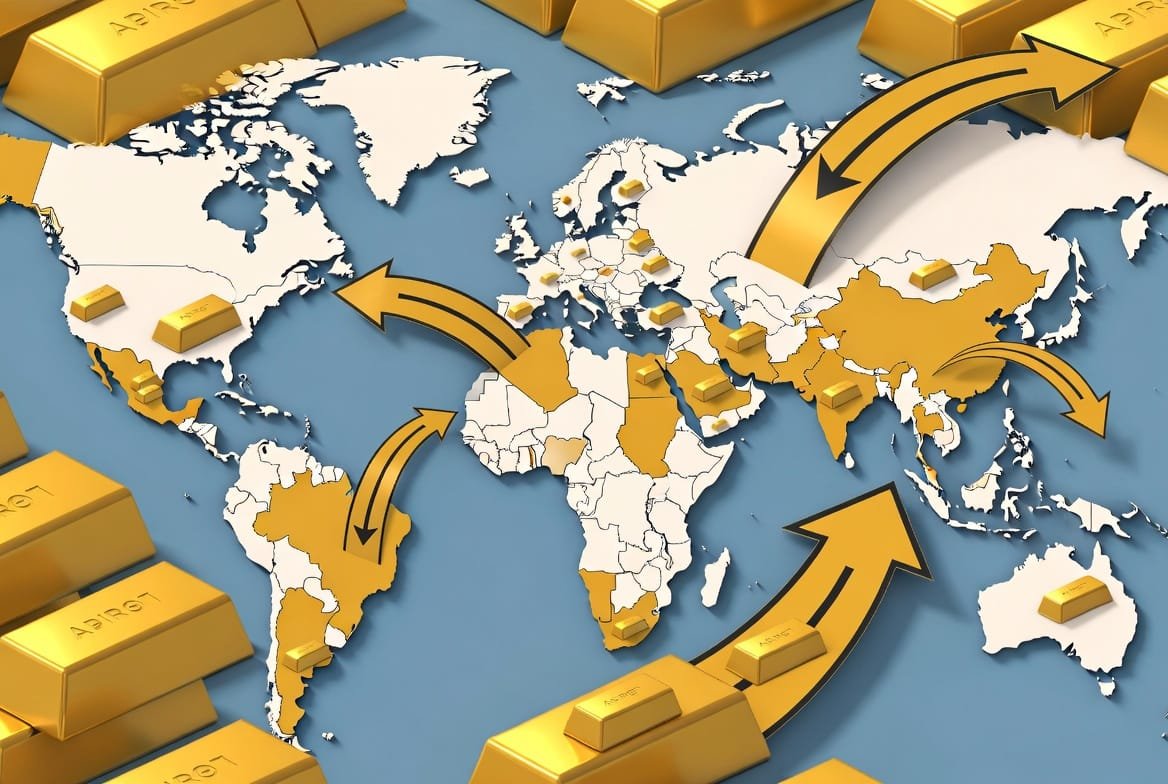
China has built gold depositories in Hong Kong and Saudi Arabia, with plans for others in Singapore, Zurich, and Dubai. These vaults allow trading partners to accept yuan for exports and immediately convert it into locally stored gold—on their own soil. It is a modern twist on the classical international gold standard.
Then China sweetens the deal.
Do you want an airport? A port? High-speed rail? A communications network? China will finance it by lending in yuan, which will be spent on Chinese engineers and suppliers. Your gold—securely stored at home—serves as collateral. You never give up your reserve asset. China gets economic influence and a more widely used currency. You get infrastructure.
As former Treasury Secretary Larry Summers once quipped, referring to a conversation he had with an official from an emerging market country: “What we get from China is an airport. What we get from the United States is a lecture.”
Gold has become pristine collateral again. And this is not theoretical. Brazil recently borrowed in yuan for the first time, while simultaneously increasing its gold reserves by 33%. In late 2025, something unprecedented happened: gold became the United States’ number-one export, as some foreign holders of dollar surpluses chose bullion over Treasuries.
If gold is to function once again as a global balancing asset, its price must rise—by a lot. Official gold reserves are now worth as much as foreign Treasury holdings. JPMorgan projects $6,300 per ounce by the end of 2026, compared to $5,100 today, with upside scenarios far higher. The exact number is less important than the direction.
U.S. government and the gold price
Which raises a final question: does the U.S. government want a higher gold price?
Officially, Washington says nothing. Unofficially, a higher gold price would strengthen the Treasury’s balance sheet, enable revaluation without selling a single ounce, and enhance long-term credibility. The silence, I suspect, is strategic.
Gold is doing what it has always done—quietly balancing the system. And in a world where trust is eroding and geopolitics are hardening, that quiet role may soon become indispensable again.
So watch gold.