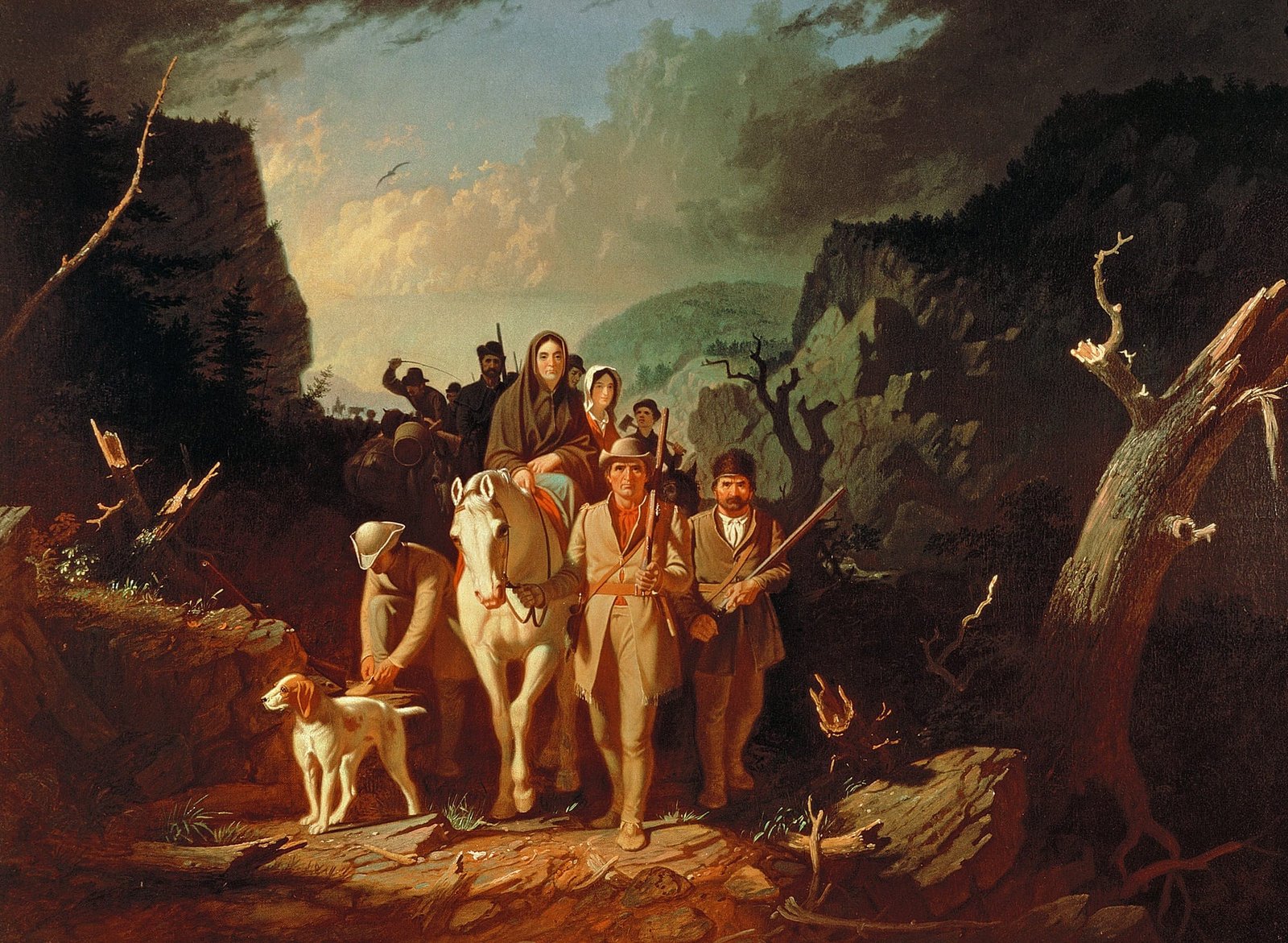
Some Americans claim deeper authenticity through colonial ancestry. They’re wrong. America was built on an idea—that all men are created equal—not on bloodlines. The Heritage American argument imports the very European tribalism our founders rejected.
What Heritage Americans Actually Claim
Let’s be fair. Most Heritage advocates aren’t crude racists. They argue that pre-Revolutionary settlers—mainly Anglo-Protestant stock—created the cultural framework that made America succeed. These pioneers crossed oceans, built settlements, established self-governance, and wrote the founding documents. Their descendants, the argument goes, inherited this legacy.
They point to John Jay’s words in Federalist No. 2 about Americans as “one united people… descended from the same ancestors.” They note the 1790 Naturalization Act limiting citizenship to “free white persons.” They worry that immigration without assimilation creates parallel societies and destroys social cohesion.
Think of it as a family business, they say. Descendants of founders are heirs; newcomers are employees. Both contribute, but only heirs embody the founder’s vision. Every nation has a core ethnic group—France has the French, Japan the Japanese. Why shouldn’t America acknowledge its Anglo-Protestant core?
It’s a reasonable-sounding argument. It’s also completely wrong.
The Historical Reality
The thirteen colonies were never homogeneous. By 1776, only 60% of white colonists were English. Germans made up 10%, Scots-Irish another 10%, with Dutch, French, Swedes, and others filling out the population. Africans—arriving in 1619, before the Mayflower—comprised 20% of the total. Each colony had its own character: Pennsylvania was one-third German, New York remained Dutch in culture, Maryland had significant Catholic populations.
Religious unity? Nonexistent. Massachusetts Puritans hanged Quakers. Virginia Anglicans suppressed Baptists. Catholics and Protestants viewed each other as heretics. These groups shared nothing but British rule—which they were about to reject.
Here’s the knockout blow to Heritage claims: only one-third of colonists supported independence. Another third were Loyalists who backed Britain. The rest stayed neutral. Statistically, any “Heritage American” is as likely descended from traitors as patriots. About 100,000 Loyalists fled after the war. Others stayed but had opposed independence. The idea of pure patriotic bloodlines is fantasy.
The founders knew this. That’s why they built a nation on principles, not ancestry.
Ideas Over Blood: The American Innovation
“We hold these truths to be self-evident, that all men are created equal, that they are endowed by their Creator with certain unalienable Rights.”
The Declaration didn’t address a specific ethnic group but humanity itself. The founders could have written “Englishmen in America deserve English rights.” Instead, they proclaimed universal human rights. They made American identity about accepting principles, not inheriting blood.
Alexander Hamilton—a Caribbean immigrant—wrote that the American government derived from “We the People,” not hereditary authority. This was revolutionary. European states claimed legitimacy through bloodlines and ancient tribal claims. America claimed legitimacy through popular consent.
Thomas Paine arrived from England just two years before writing Common Sense, the Revolution’s most influential pamphlet. He never mentioned ancestry, only universal rights and reason. An immigrant understood America better than many natives because America was about ideas.
The founders built on Enlightenment philosophy that rejected ethnic particularism. Locke argued rights came from human nature, not ethnicity. Montesquieu’s separation of powers could work for any people. The Scottish Enlightenment emphasized reason over tradition. This philosophical foundation made American identity something you could choose, not inherit.
Europe’s Curse, America’s Escape
The founders knew what blood-and-soil nationalism produced. Europe had spent centuries in ethnic warfare. The Thirty Years’ War killed 20% of Central Europe’s population. Every border represented ethnic conflict—Alsace-Lorraine bouncing between France and Germany, the Balkans exploding regularly, Poland carved up between empires.
European society was stratified by birth. Noble blood meant everything; common blood nothing. Your ancestry determined your entire life—job, marriage, legal rights, even which roads you could travel.
A Jew in Poland for ten generations remained “the Jew.” A German in France stayed forever foreign. Assimilation was impossible because belonging was biological.
America’s founders consciously rejected this model. No titles of nobility. No hereditary offices. No blood privileges. They created a nation where immigrants could become full Americans through naturalization. The Constitution requires only that the President be natural-born; naturalized citizens can serve in any other office. This was radical.
Without the Declaration’s principles, North America would have fractured into weak, squabbling states like Europe. The idea that “all men are created equal” is what united thirteen diverse colonies into one nation.
The Heritage-Identity Politics Connection
Here’s what Heritage advocates don’t realize: their ideology is identical to the leftist identity politics they claim to hate.
Both judge individuals by group membership rather than character. Both claim special privileges based on inherited characteristics. Both reject merit in favor of birth status. Both divide Americans into hierarchies of authenticity.
The Heritage American claiming special status through colonial ancestry mirrors the intersectionalist claiming oppression points. One says “My ancestors were here first,” the other says “My ancestors were oppressed.” Both reject the American principle that individuals matter, not groups.
This isn’t a coincidence. Both ideologies stem from the same collectivist root: the belief that group membership trumps individual agency. Both betray the radical individualism the founders established.
The Success of American Principles
America’s approach—unity through ideas rather than ethnicity—created the most successful nation in history.
Every immigrant group deemed “unassimilable” assimilated. Irish Catholics faced “No Irish Need Apply” signs and Know-Nothing riots. Today, 10% of Americans claim Irish ancestry, fully integrated. Germans were feared as forever foreign. Now they’re America’s largest ancestry group. Italians were lynched as non-white. Jews faced quotas and exclusion. Asian Americans were banned then interned. All became American.
The innovation dividend is undeniable. Andrew Carnegie, Alexander Graham Bell, Nikola Tesla, Albert Einstein, Sergey Brin, Elon Musk—immigrants built American industry, technology, and science. Forty percent of Fortune 500 companies were founded by immigrants or their children.
Military service proves the point. In the Civil War, immigrants comprised 25% of Union armies. In World War II, Japanese Americans formed the most decorated unit while their families sat in camps. In Iraq and Afghanistan, immigrants earned citizenship through combat. “Non-heritage” Americans consistently die for principles while many with deep roots avoid service.
The Immigration Reality
America faces real immigration challenges. Illegal immigration undermines rule of law and creates an exploitable underclass. It’s unfair to legal immigrants, dangerous for border communities, and corrosive to social trust. We need secure borders and enforcement.
But the solution isn’t ethnic restrictions—it’s selective, orderly legal immigration that recruits people who want to BE American, not just live in America. We should prioritize immigrants who understand American principles, contribute skills, follow laws, and seek to join our society.
A Nigerian engineer who loves the Constitution is infinitely more valuable than a European who sees America as just an economic opportunity. The question isn’t where you’re from but whether you choose America or just happen to be here.
Why Nativism Always Fails
The Heritage argument resurfaces every generation and fails every time.
The Know-Nothings of the 1850s made identical arguments about Catholics destroying Protestant America. They won elections, then collapsed within two years when Lincoln and others rejected their bigotry.
The 1924 Immigration Act created quotas to preserve ethnic composition. It ranks among America’s greatest mistakes—preventing Jewish refugees from escaping the Holocaust, losing scientists to other nations, and creating illegal immigration by ending circular migration from Mexico.
Today’s Heritage advocates make arguments identical to those used against their own ancestors. Irish Americans forget “No Irish Need Apply.” Italian Americans forget being lynched as non-white. Jewish Americans forget university quotas. The descendant of despised immigrants claiming special status through ancestry achieves peak historical ignorance.
These movements fail because they contradict American principles. Every expansion of who counts as American has strengthened the country.
The Choice
America faces a choice: remain a nation built on ideas, or become another European-style tribe.
The Heritage American ideology tells Black Americans whose ancestors built this country, immigrant Americans who chose this country, and Native Americans who were here first that they can never fully belong. This is a recipe for national suicide.
The true American heritage isn’t ethnic but ideological: the principle that a nation can cohere around shared ideas rather than ancestry. This made America history’s most successful nation. Abandoning it for racial nationalism wouldn’t preserve America—it would destroy what makes America worth preserving.
Those claiming Heritage status betray their ancestors’ revolutionary rejection of blood-and-soil nationalism. They’re not more American—they’re less American for missing the entire point of America.
America is not a race. America is not a bloodline. America is an idea—that free people, equal before the law, governing themselves by consent, can build a society superior to any based on birth. That idea belongs to anyone who accepts it, who comes here legally, and who genuinely wants to be American. Those who don’t understand this don’t understand America, regardless of how many generations their families have been here.